
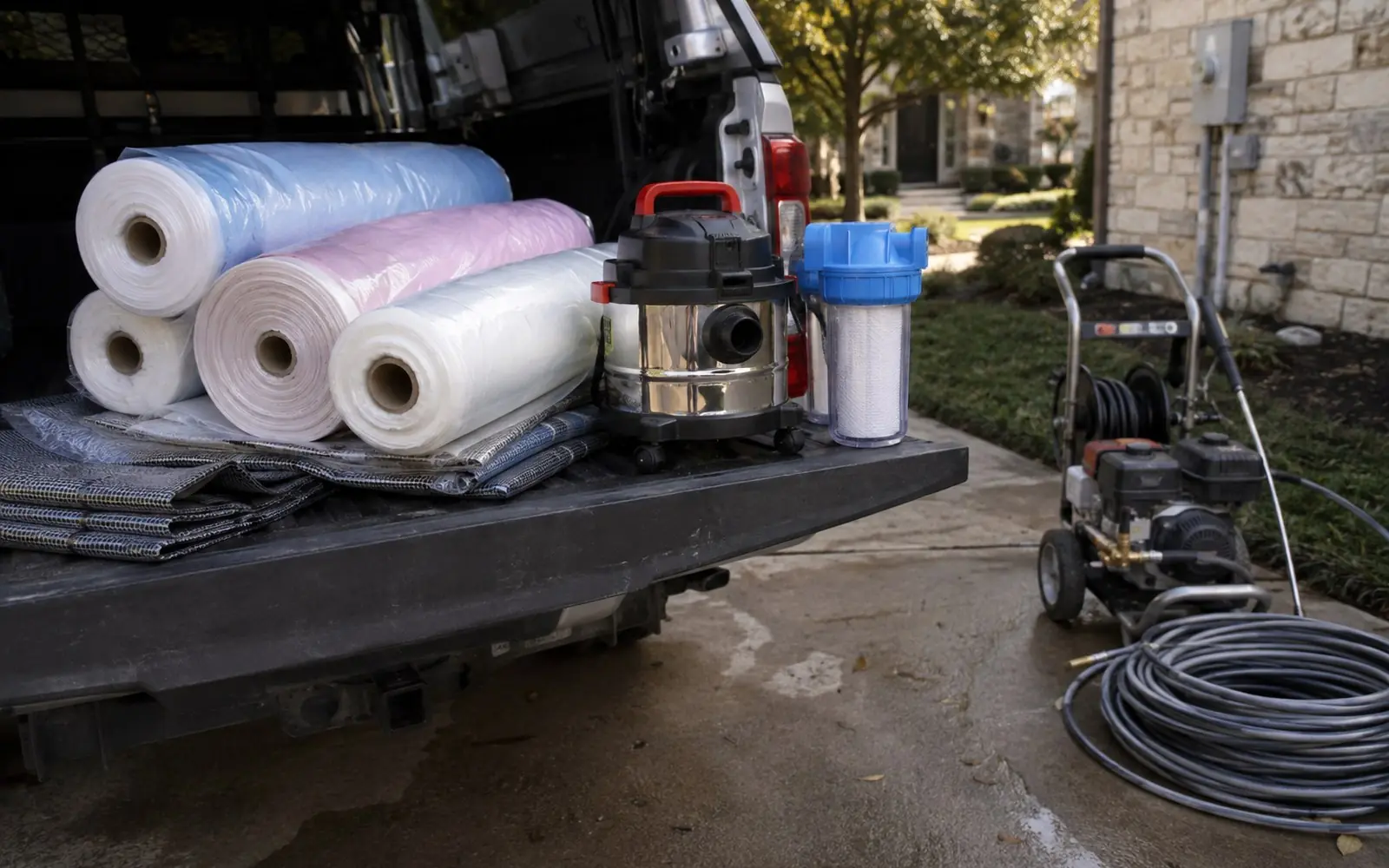
Pressure Washer Parts and Supply
On a covered job the supply list is written into the regulations, right down to the distance the ground sheeting has to reach.
Most of the kit list is a regulation, not a preference
Ask what a pressure washing outfit carries and you will hear about wands, nozzles, hoses and detergent. On a job that falls under federal rules, the more consequential half of the list is written down somewhere public: sheeting with a stated reach, vertical barriers with a stated trigger, vacuum attachments with a stated filter grade, and a plan for the water.
The lead renovation rule is unusually literal about this. It tells the firm to cover the ground with plastic sheeting or other disposable impermeable material extending 10 feet beyond the perimeter of the surfaces being worked on, or further if that is what it takes to collect falling paint debris, unless the property line prevents it1. Few supply lists in the trades come with a measurement attached.
The gap in all of this is price. No published figure exists for a wash water recovery and containment setup, which is the single biggest reason a compliant quote reads higher than a careless one. This guide does not fill that gap with a guess. It does carry the disposal fees that are published, because those you can look up yourself.
Six items on the list that a regulation actually names
These are not upsells invented by a supplier. Each one traces to a federal rule or an EPA guidance document.
Ground sheeting, and the 10 foot reach
Plastic sheeting or other disposable impermeable material, covering the ground 10 feet beyond the perimeter of the surfaces being worked on, or a greater distance if that is what it takes to catch falling paint debris, unless the property line makes 10 feet impossible1. The measurement is in the rule, not in a supplier catalogue.
Vertical containment near a boundary
When the work affects surfaces within 10 feet of the property line, the firm must erect vertical containment or equivalent extra precautions to contain the work area1. That is a second, separate purchase, and its trigger is a distance to your neighbor's line rather than the size of the job.
HEPA vacuum attachments
Machines that strip coatings by high speed operation, including abrasive blasting and sandblasting heads, are prohibited on painted surfaces in covered work unless fitted with a shroud or containment system and a HEPA vacuum attachment collecting dust and debris at the point of generation1. The attachment is what makes the head usable at all.
Water recovery and filtration
EPA's stormwater guidance names the acceptable outcomes as contain, treat or reuse, and notes that treatment systems, generally oil and water separators or some type of filtration, are often required by regulation when wash water is sent to a sanitary sewer and on to a treatment plant2.
Whatever keeps water out of the gutter
Inlet protection is only half of it, because the protected system is defined broadly. San Diego describes the storm drain system as including curb gutters, streets, alleys, ditches and storm drains3. Berms, mats, dams and vacuums all serve one purpose: keeping wash water from reaching any of those.
A route for the leftovers
Paint, solvents and containers still have to go somewhere. Washington County, Utah lists paint disposal at $3.32 per gallon4. Dane County, Wisconsin charges county households $15.00 per trip for hazardous waste and $75.00 for out of county households, plus $15.00 per television or computer monitor5.
What does it cost?
The honest headline is a blank. No agency, association or primary source publishes a price for a wash water recovery and containment setup, meaning the vacuum boom, the wet vacuum, the filtration and the holding tank. That matters more than most missing numbers, because it is the exact cost that separates a contractor who contains the water from one who lets it run to the gutter. Any figure you see quoted for that kit without a named source is somebody's guess, and none appears here.
What is published sits at the disposal end. Washington County, Utah lists paint at $3.32 per gallon on its fee schedule4. Dane County, Wisconsin charges $15.00 per trip for household hazardous waste from county residents and $75.00 per trip from out of county, and lists televisions and computer monitors at $15.00 each and microwave ovens at $10.00 each5. Those are real, checkable, and they are the type of line that belongs on a supply budget alongside the sheeting.
The paint and hazardous waste figures come from the published Washington County UT and Dane County WI fee schedules and cover disposal only. No verified source publishes prices for pressure washers, hoses, nozzles, detergents, sheeting or recovery equipment, so no such figures appear above.
How to hire against a real supply list
Who does the work
The contractor buys the kit and prices it into your quote, which is why two bids for the same wall can differ so much. On a covered job the containment items are not discretionary. Ground sheeting reaching 10 feet, vertical containment near a property line, and HEPA attachments on any stripping head are all written into the federal rule1.
What pros will ask
How close the work sits to your property line, since that distance triggers vertical containment1. How much painted surface will be disturbed, and in what year the house was built. Where the ground slopes and where the nearest inlet, gutter or ditch is3. Whether there is an approved place for the collected water to go6.
What to check before signing
Ask for containment materials itemized rather than folded into a single line. Ask whether any stripping head is planned and whether it is shrouded and HEPA equipped1. Ask how the water is collected and where it is taken, and whether a separator or filter is needed on that route2. Ask who pays the disposal fee for leftover paint4.
Related searches homeowners make
Pulled from the same demand data behind our Pressure Washing & Junk Removal category.
Parts and supply questions, answered straight
What supplies does a compliant exterior job actually need?
On work covered by the federal lead renovation rule, the list starts with plastic sheeting or other disposable impermeable material covering the ground 10 feet beyond the perimeter of the surfaces being worked on, or further if that is what it takes to collect falling paint debris1. Add vertical containment if the work is within 10 feet of a property line1. Add a HEPA vacuum attachment and shroud on any coating removal head1. Then add whatever collects and holds the water, since EPA requires the work area to be isolated so that no dust or debris, including in the wastewater, leaves it7.
How much does containment and recovery equipment cost?
Nobody publishes it. That is the plain answer. The research behind this guide looked for a sourced price on vacuum booms, wet vacuums, filtration and holding tanks and found none from any agency, association or primary source. Rather than repeat an aggregator's estimate, this page leaves it blank. The practical consequence for you as a buyer: when one bid is much lower than another, ask each contractor to describe the water handling in writing. That description, not the total, is usually where the difference actually sits.
Why does sheeting have a distance attached to it?
Because falling debris travels, and the rule sets a floor for how far you plan for it to travel. The provision requires ground cover extending 10 feet beyond the perimeter of the surfaces undergoing renovation, or a sufficient distance to collect falling paint debris, whichever is greater1. It carves out only one exception: where the property line prevents 10 feet of ground covering. That is also why the same rule turns to vertical containment when the work sits within 10 feet of the line, since the space to lay sheeting simply is not there1.
What happens to leftover paint, detergent and containers?
They have their own published disposal prices in some counties, and it is worth checking yours before the job rather than after. Washington County, Utah lists paint at $3.32 per gallon on its fee schedule4. Dane County, Wisconsin runs a household drop off charging $15.00 per trip for hazardous waste from county residents and $75.00 per trip from out of county households, and prices televisions and computer monitors at $15.00 each and microwave ovens at $10.00 each5. Different counties structure this differently, so read your own schedule.
Do I need a filter or separator to send wash water to the sewer?
Often, and you may need permission before you need equipment. EPA notes that treatment systems, generally oil and water separators or some type of filtration, are frequently required by regulation when a facility discharges wash water to a sanitary sewer and on to a municipal treatment plant2. Portland goes further and gates the route itself: City Code 17.34 requires approval to discharge to the sanitary sewer, and pressure washing businesses apply for a Mobile Washer Discharge Authorization6. No published fee for that authorization was found, so ask your local utility.
Where these facts came from
Every figure on this page was read out of the page linked below. We do not cite cost aggregators.
- 40 CFR 745.85, containment requirements and restricted work practices
- EPA-832-F-21-030H, Stormwater BMP: Municipal Vehicle and Equipment Washing
- City of San Diego, pressure washing and storm water requirements
- Washington County, Utah, Solid Waste District fee schedule
- Dane County, Wisconsin, landfill fee structure and Clean Sweep item fees
- City of Portland Bureau of Environmental Services, pressure washing rules
- EPA Lead-Based Paint Program Frequent Questions, January 2026, pressure washing answer
Get quotes for your pressure washer parts and supply project
Free for homeowners. No obligation. Up to four local pros compete.
Keep planning
More guides from the Pressure Washing & Junk Removal hub.
Pressure Washing Runoff Rules
Federal rule lets you wash your car in the driveway and does not extend the same courtesy to a contractor washing your siding. Here is the language.
Read the guideLead Paint and Pressure Washing
EPA has answered this one in writing. Pressure washing old paint is not banned, but on a pre-1978 house the wastewater becomes regulated debris.
Read the guideJunk Removal and Tipping Fees
Five county fee schedules, read line by line. The same ton of household waste costs $37.15 in one of them and $243.38 in another.
Read the guide