
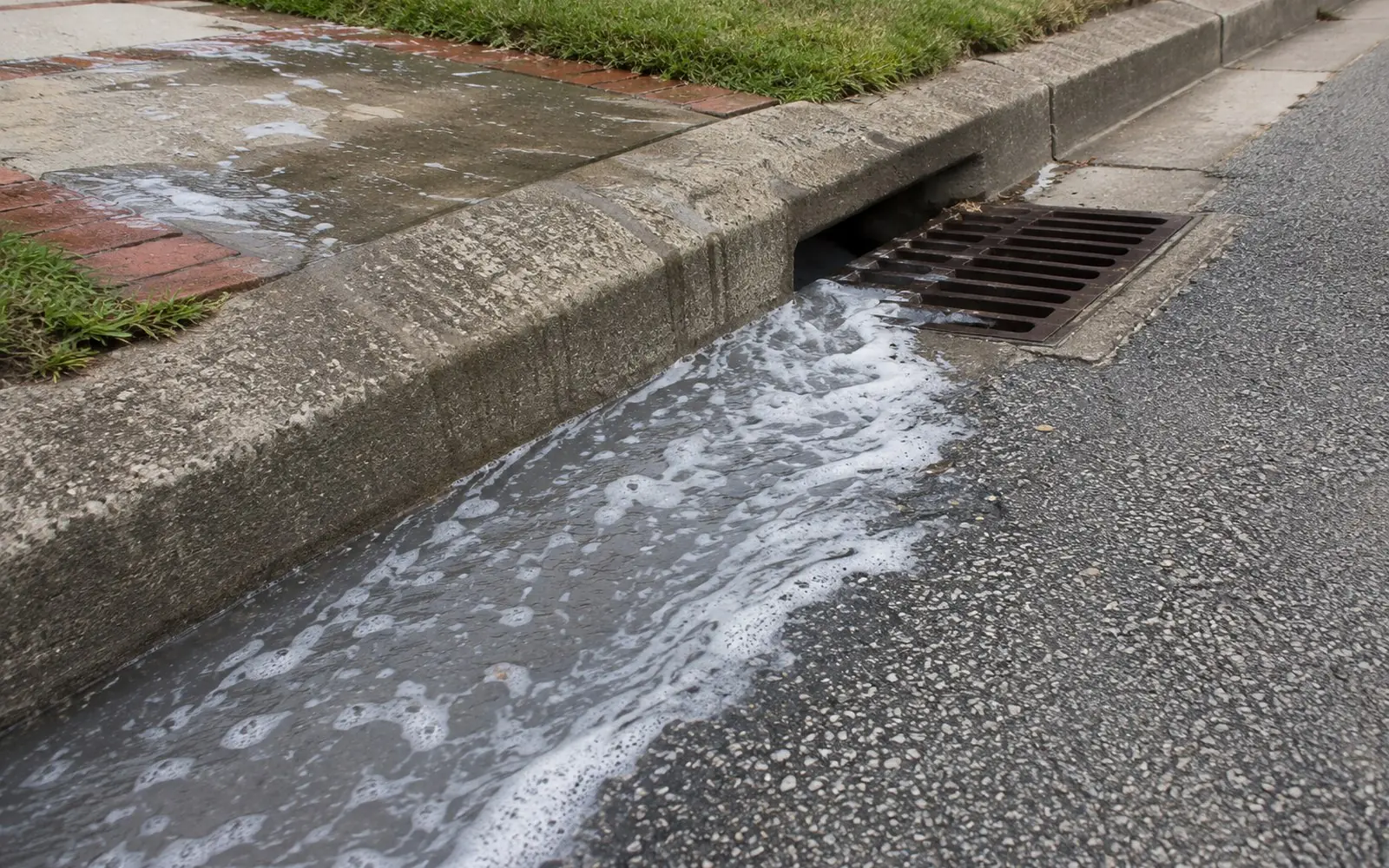
Pressure Washing Runoff Rules
Federal rule lets you wash your car in the driveway and does not extend the same courtesy to a contractor washing your siding. Here is the language.
The test is not whether the water is dirty
Almost nobody selling exterior cleaning mentions this, and it is the most consequential thing about the job. Federal law starts from a flat prohibition. Clean Water Act section 301, codified at 33 U.S.C. 1311(a) and headed illegality of pollutant discharges except in compliance with law, states that except as in compliance with the listed provisions, the discharge of any pollutant by any person shall be unlawful1.
Then the stormwater regulation defines what a storm sewer is allowed to carry. An illicit discharge means any discharge to a municipal separate storm sewer that is not composed entirely of storm water, with narrow exceptions for permitted discharges and firefighting2. Read that test again. It is not whether the water looks dirty. It is whether the water is composed entirely of storm water. Soap and driveway grime fail that test on the face of the rule.
What follows is not a scare piece. Maximum penalties are published and verifiable, but a maximum is not a probability, and no enforcement statistics for residential pressure washing were located for this guide. The point is narrower and more useful: the rule exists, your city was probably required to write it into an ordinance, and the containment method is the thing worth asking a contractor about.
Six pieces of the rule, in the order they stack up
Every line below is quoted or paraphrased from a federal statute, a federal regulation, or a city document you can open yourself.
The federal starting point
Clean Water Act section 301 at 33 U.S.C. 1311(a) makes the discharge of any pollutant by any person unlawful unless it complies with the permitting provisions listed alongside it1. Everything else in this article is downstream of that one sentence, including every local ordinance that names pressure washing.
The illicit discharge test
40 CFR 122.26(b)(2) defines an illicit discharge as any discharge to a municipal separate storm sewer not composed entirely of storm water, other than discharges under a separate permit and discharges from firefighting activities2. That wording, composed entirely of storm water, is what makes wash water a problem by default rather than by inspection.
The car in your driveway is listed. Your siding is not
40 CFR 122.34(b)(3)(ii) names categories a permittee must address only if they are identified as a significant contributor of pollutants. That list includes individual residential car washing and street wash water3. Commercial pressure washing of a house, deck, driveway or roof does not appear anywhere on it.
Your city was required to ban it
Under 40 CFR 122.34(b)(3)(i)(B), a small municipal storm sewer permittee must, to the extent allowable under state, tribal or local law, effectively prohibit non-storm water discharges into the storm sewer system through ordinance or other regulatory mechanism and implement enforcement procedures3. The same measure requires a plan to detect and address them.
How much of the country this covers
EPA reports approximately 855 Phase I regulated systems covered by 250 individual permits, and 6,695 Phase II systems mostly covered by statewide general permits4. Phase I picked up medium and large cities or counties of 100,000 or more; Phase II reaches small systems in Census defined urbanized areas4.
The published ceilings
Federal civil penalties under 33 U.S.C. 1319(d) are capped at $68,445, adjusted annually5. San Diego publishes up to $10,000 per day per incident under Municipal Code 43.03046. Brookhaven, Georgia caps at $1,000 per violation per day and up to six months in jail7. These are ceilings, not typical outcomes.
What does it cost?
The runoff rules do not carry a price, they carry ceilings. The federal table at 40 CFR 19.4 lists the Clean Water Act civil penalty under 33 U.S.C. 1319(d) at $68,445 for violations occurring after November 2, 2015 where penalties are assessed on or after January 8, 2025, against $66,712 for the previous window and $25,000 as originally enacted5. Administrative penalties in the same table run to $68,445 and $342,218 depending on the subsection5. Locally, San Diego publishes up to $10,000 per day per incident6 and Brookhaven, Georgia up to $1,000 per violation per day plus up to six months in jail7.
Treat those as ceilings and nothing more. No enforcement statistics showing how often penalties are actually assessed against residential pressure washing were located for this guide, so nobody should tell you what your odds are. The cost that is certain is the other one: containing, collecting and lawfully disposing of the water. No published price exists for a wash water recovery setup, and no published fee was found for the sanitary sewer authorizations that Portland and San Diego require8, so this guide states neither.
Penalty figures are published statutory and municipal ceilings taken from 40 CFR 19.4 and the San Diego and Brookhaven documents, not typical or expected assessments. No enforcement frequency data was located, and no price for containment equipment or discharge authorizations is published by any source used here.
How to hire without inheriting a runoff problem
Who does the work
A contractor runs the equipment, but the duty is not theirs alone. San Diego states that its regulations apply regardless of whether the activity is conducted by the property owner, lessee, contractor, or other persons6. Brookhaven publishes the full chain behind its rule, from the Clean Water Act through 40 CFR Part 122.26 and Georgia water quality regulation down to its own ordinance7.
What pros will ask
Where the storm drains, curb gutters and ditches sit, because San Diego defines the storm drain system to include all of those and not just the grate6. Which way the ground slopes. Whether detergents or chemicals are in play. Whether there is a sanitary sewer connection available, and whether they already hold the authorization to use it8.
What to check before signing
Get the containment method described in writing: how inlets and gutters are blocked, how water is collected, and where it is taken. EPA frames the acceptable outcomes as contain, treat or reuse9. Ask whether they know your city's ordinance by section number, the way Portland cites Code 17.39 for this exact activity8.
Related searches homeowners make
Pulled from the same demand data behind our Pressure Washing & Junk Removal category.
Runoff questions, answered straight
Is it really illegal to let wash water run into the storm drain?
In many places, yes, and it is written down. The federal rule defines an illicit discharge as any discharge to a municipal separate storm sewer not composed entirely of storm water2, sitting on top of a statute making the discharge of any pollutant by any person unlawful except in compliance with the permitting provisions1. Cities then say it in their own words. Portland City Code 17.39 prohibits discharging wash water from pressure washing into the stormwater system8. San Diego calls discharging polluted wash water from pressure washing into the storm sewer system illegal under Municipal Code 43.03046.
Why can I wash my car in the driveway but not my house?
Because of a list. 40 CFR 122.34(b)(3)(ii) sets out categories a permitted city has to address only if it identifies them as a significant contributor of pollutants. Individual residential car washing is on that list. So are lawn watering, air conditioning condensation, dechlorinated swimming pool discharges and street wash water3. Commercial pressure washing of a house, deck, driveway or roof is not on it. The asymmetry is real and it is deliberate: the federal rule carves out the homeowner rinsing their own car and does not carve out a contractor washing siding for pay.
Am I likely to actually get fined?
Nobody honest can tell you. The maximums are verifiable: $68,445 under the federal civil penalty table5, up to $10,000 per day per incident in San Diego6, up to $1,000 per violation per day and six months in jail in Brookhaven, Georgia7. What could not be found is any statistic on how often penalties are assessed against residential pressure washing, so a maximum should not be read as a likelihood. Brookhaven does report a concrete consequence rather than a hypothetical one: pressure washing there has caused fish kills along entire reaches of streams7.
Does this apply in my town, or only big cities?
The program is wide. EPA reports approximately 855 Phase I regulated municipal systems covered by 250 individual permits, plus 6,695 Phase II systems, mostly under statewide general permits, along with three watershed permits covering a further three Phase I and 40 Phase II systems4. Phase I came from the 1990 regulation and reached medium and large cities or certain counties with populations of 100,000 or more. Phase II came from the 1999 regulation and reaches small systems in Census Bureau defined urbanized areas4. Add the two headline counts and you are near 7,550 permitted systems.
So where is the water supposed to go instead?
EPA's stormwater guidance gives three acceptable outcomes: contain, treat or reuse the wash water9. The sanitary sewer is the usual destination for contained water, but it is not automatic and it is not free of process. Portland City Code 17.34 requires approval to discharge there, and pressure washing businesses apply for a Mobile Washer Discharge Authorization8. EPA also notes that treatment, typically an oil and water separator or filtration, is often required before wash water enters a sanitary sewer9. Ask your local utility which route it will approve.
Where these facts came from
Every figure on this page was read out of the page linked below. We do not cite cost aggregators.
- 33 U.S.C. 1311, illegality of pollutant discharges except in compliance with law
- 40 CFR 122.26(b)(2), definition of illicit discharge
- 40 CFR 122.34(b)(3), illicit discharge detection and elimination measure
- EPA, Stormwater Discharges from Municipal Sources
- 40 CFR 19.4, table of civil monetary penalty amounts
- City of San Diego, pressure washing and storm water requirements
- City of Brookhaven, Georgia, pressure washing guidance
- City of Portland Bureau of Environmental Services, pressure washing rules
- EPA-832-F-21-030H, Stormwater BMP: Municipal Vehicle and Equipment Washing
Get quotes for your pressure washing runoff rules project
Free for homeowners. No obligation. Up to four local pros compete.
Keep planning
More guides from the Pressure Washing & Junk Removal hub.
Lead Paint and Pressure Washing
EPA has answered this one in writing. Pressure washing old paint is not banned, but on a pre-1978 house the wastewater becomes regulated debris.
Read the guideJunk Removal and Tipping Fees
Five county fee schedules, read line by line. The same ton of household waste costs $37.15 in one of them and $243.38 in another.
Read the guideJunk Removal
What a hauler is actually paying to make your pile disappear, and why one refrigerator can cost more to dump than a ton of trash.
Read the guide