
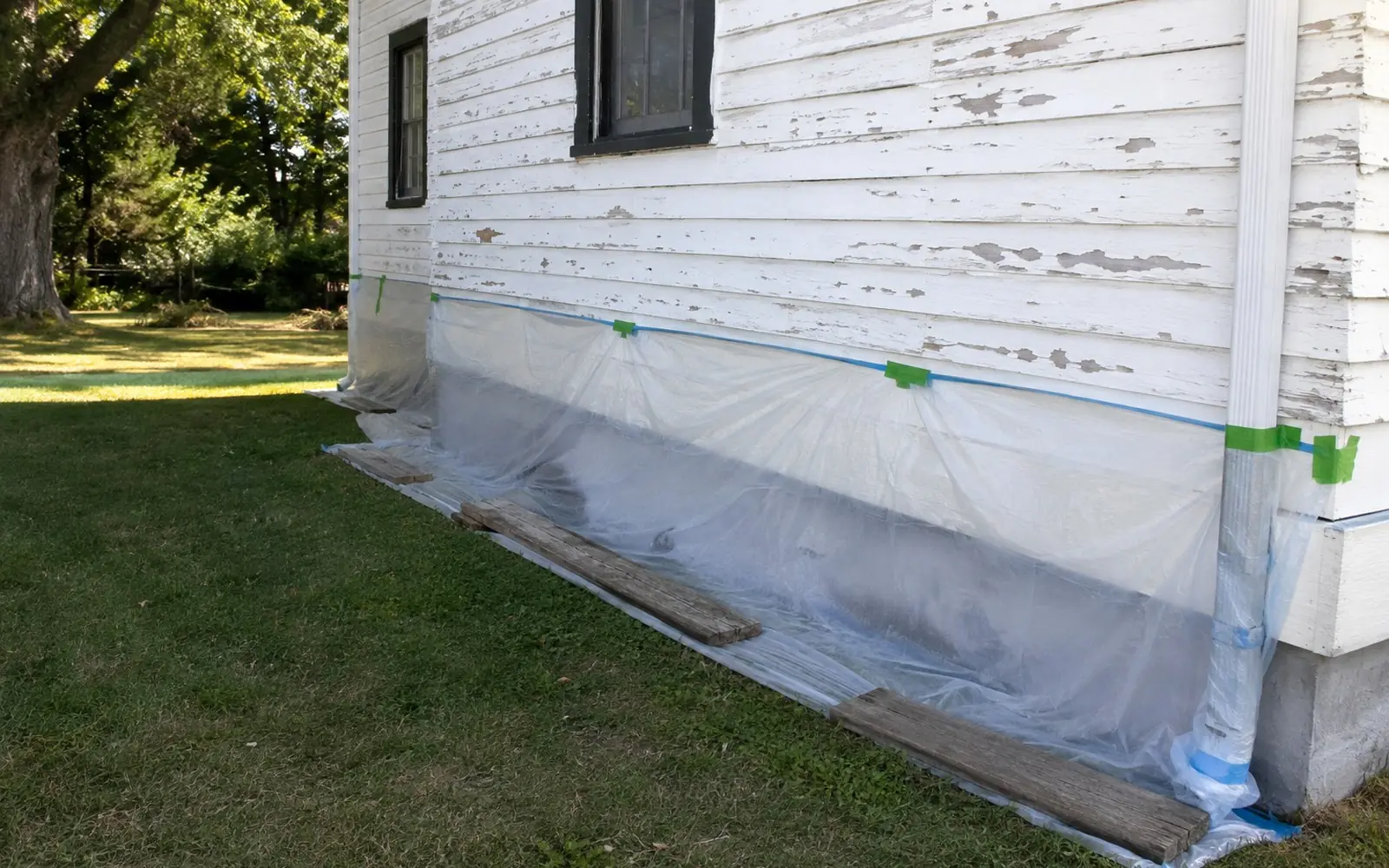
Lead Paint and Pressure Washing
EPA has answered this one in writing. Pressure washing old paint is not banned, but on a pre-1978 house the wastewater becomes regulated debris.
Not prohibited, but not unregulated either
There is a persistent belief that pressure washing a house painted before 1978 is simply banned. It is not, and EPA has said so in a numbered answer in its own Lead-Based Paint Program Frequent Questions document, under the heading Prohibited and Restricted Practices: pressure washing is not a prohibited practice under the renovation rule1.
The rest of that answer is where the work actually changes. Pressure washing is subject to the same containment requirements as other permissible work practices, and before beginning the renovation the firm must isolate the work area so that no dust or debris, including in the wastewater, leaves the work area while the renovation is being performed1. EPA then adds that it is important to properly dispose of that wastewater and to check with your local water treatment authority1.
Read those two sentences together and the practical result is clear. On a covered job the water coming off the wall is not runoff to be swept toward the curb. It is debris that has to stay inside a defined work area and leave by an approved route.
Six things the lead rule says about washing old paint
All six come from EPA's published answer or from the text of the renovation rule itself.
EPA's written answer
The question is numbered and the answer is unambiguous. Pressure washing is not a prohibited practice under the renovation rule, and it is subject to the same containment requirements as other permissible work practices1. The same answer appears with the same question number on EPA's archived site, so it is not a recent reversal2.
What is prohibited, for contrast
Open flame burning or torching of painted surfaces is banned outright. Machines that remove coatings by high speed operation, including sanding, grinding, power planing, needle gun, abrasive blasting and sandblasting, are banned on painted surfaces unless shrouded or contained with a HEPA vacuum attachment. Heat guns are permitted only below 1,100 degrees Fahrenheit3.
The wastewater is the regulated part
EPA's answer requires the work area to be isolated so that no dust or debris, including in the wastewater, leaves it during the renovation, then tells firms to dispose of the wastewater properly and check with the local water treatment authority1. Its stormwater guidance frames the options as contain, treat or reuse4.
Three conditions have to line up
The rule applies to renovations performed for compensation, in target housing and child-occupied facilities5. It steps aside where a certified inspector, a certified renovator using an EPA recognized test kit, or an EPA recognized laboratory has found the components free of coatings at or above 1.0 milligrams per square centimeter or 0.5 percent by weight5.
The 20 square foot line, and the 30 day rule
Exterior work disturbing 20 square feet or less of painted surface is minor repair and maintenance, as is 6 square feet or less per room inside, provided no restricted practices are used and the job is not window replacement or demolition of painted surfaces6. Jobs in the same room within 30 days count as one job6.
Containment has published distances
Cover the ground with plastic sheeting or other disposable impermeable material extending 10 feet beyond the perimeter of the surfaces being worked on, or further if that is what it takes to collect falling paint debris, unless the property line prevents it. Work within 10 feet of a property line requires vertical containment3.
What does it cost?
No source publishes a price for lead-safe exterior washing, so none appears here. What can be described is the mechanism that moves the price. Scope classification comes first: exterior work disturbing 20 square feet or less of painted surface is minor repair and maintenance, and above that line the containment obligations attach6. Then materials: sheeting reaching 10 feet past the work perimeter, and vertical containment when the work is within 10 feet of a property line3. No published price was found for those materials, for a wash water recovery setup, or for the renovation firm certification application fee.
The other side of the ledger is a published ceiling. The federal civil penalty table sets the Toxic Substances Control Act penalty, the one that carries lead paint violations, at $49,772, against $48,512 for the previous assessment window and $37,500 as originally enacted7. Treat that as a maximum rather than an expectation, because no data on how often it is assessed against exterior washing was located. There is also a route out of scope entirely: qualifying testing showing the coatings sit below 1.0 milligrams per square centimeter or 0.5 percent by weight5.
The penalty figure is the published statutory ceiling in 40 CFR 19.4, not a typical assessment, and the square footage and distance figures are the thresholds written into 40 CFR 745.83 and 745.85. No source publishes a price for lead-safe washing, containment materials, testing or firm certification, so no such figures appear above.
How to hire for washing on a pre-1978 house
Who does the work
On a covered job, a certified renovation firm working to the containment requirements, not a general washing crew improvising. The testing route also needs credentials: a certified inspector, a certified renovator using an EPA recognized test kit, or an EPA recognized laboratory is what takes a component out of scope, not a contractor's opinion about the paint5.
What pros will ask
The year the house was built. How many square feet of painted surface the wash will disturb, since 20 square feet exterior is the line6. How close the work sits to a property line, which decides whether vertical containment is needed3. Whether any other work happened on the same area within the last 30 days6. Whether the paint has been tested5.
What to check before signing
Ask for firm certification if the job is covered, and for the actual test result if they claim it is not5. Get the containment plan in writing, including sheeting distances and where the wastewater goes1. Confirm that no torching or unshrouded stripping head will touch painted surfaces, since both are restricted outright3.
Related searches homeowners make
Pulled from the same demand data behind our Pressure Washing & Junk Removal category.
Lead paint questions, answered straight
Can a contractor pressure wash a pre-1978 house at all?
Yes. EPA published the answer under its own Prohibited and Restricted Practices heading: pressure washing is not a prohibited practice under the renovation rule1. The condition attached is containment. Pressure washing carries the same containment requirements as other permissible work practices, and before the work starts the firm must isolate the work area so that no dust or debris, including in the wastewater, leaves it while the renovation is being performed1. The same answer, under the same question number, also appears on EPA's archived site2. So the question to ask a contractor is not whether they will wash, but how they will contain.
What makes a wash fall under the rule in the first place?
Three things together. The work is performed for compensation, it is in target housing or a child-occupied facility, and no qualifying test has taken the components out of scope5. Renovation itself is defined by disturbance rather than by trade: modification of an existing structure that results in the disturbance of painted surfaces, with surface restoration and surface preparation activity such as sanding and scraping listed among the examples6. Below the line, exterior work disturbing 20 square feet or less of painted surface is treated as minor repair and maintenance6.
What is actually banned outright?
Three practices. Open flame burning or torching of painted surfaces is prohibited. Machines designed to remove paint or other surface coatings through high speed operation, listed as sanding, grinding, power planing, needle gun, abrasive blasting and sandblasting, are prohibited on painted surfaces unless they have shrouds or containment systems plus a HEPA vacuum attachment collecting dust at the point of generation, and are run so that no visible dust or release of air escapes. Operating a heat gun on painted surfaces is permitted only below 1,100 degrees Fahrenheit3.
Can a job be split up to stay under the square footage limit?
No, and the rule anticipates the attempt. Jobs other than emergency renovations performed in the same room within the same 30 days must be considered the same job when working out whether something qualifies as minor repair and maintenance6. Two further conditions sit on that exemption: none of the prohibited or restricted work practices may be used, and the work must not involve window replacement or demolition of painted surface areas6. So a small job that reaches for a stripping head loses the exemption regardless of its size.
What is the penalty if the rule is broken?
The lead renovation rule sits under the Toxic Substances Control Act, and the federal civil penalty table lists the TSCA penalty at $49,772, against $48,512 for the previous assessment window and $37,500 as enacted7. That is a statutory ceiling, not a typical outcome, and no figures on how often it is assessed for exterior washing were located for this guide. The more useful takeaway is preventative. Containment, sheeting distances and wastewater handling are all specified in advance3, which means compliance is checkable before the work rather than argued about afterwards.
Where these facts came from
Every figure on this page was read out of the page linked below. We do not cite cost aggregators.
- EPA Lead-Based Paint Program Frequent Questions, January 2026, pressure washing answer
- EPA archived answer, how RRP requirements apply to pressure washing
- 40 CFR 745.85, work practice standards and prohibited practices
- EPA-832-F-21-030H, Stormwater BMP: Municipal Vehicle and Equipment Washing
- 40 CFR 745.82, applicability of the renovation rule
- 40 CFR 745.83, definitions of renovation and minor repair and maintenance
- 40 CFR 19.4, table of civil monetary penalty amounts
Get quotes for your lead paint and pressure washing project
Free for homeowners. No obligation. Up to four local pros compete.
Keep planning
More guides from the Pressure Washing & Junk Removal hub.
Junk Removal and Tipping Fees
Five county fee schedules, read line by line. The same ton of household waste costs $37.15 in one of them and $243.38 in another.
Read the guideJunk Removal
What a hauler is actually paying to make your pile disappear, and why one refrigerator can cost more to dump than a ton of trash.
Read the guidePressure Washing Restoration Services
Restoration washing is a containment job as much as a cleaning job, and where the water goes separates a safe contractor from a costly one.
Read the guide