
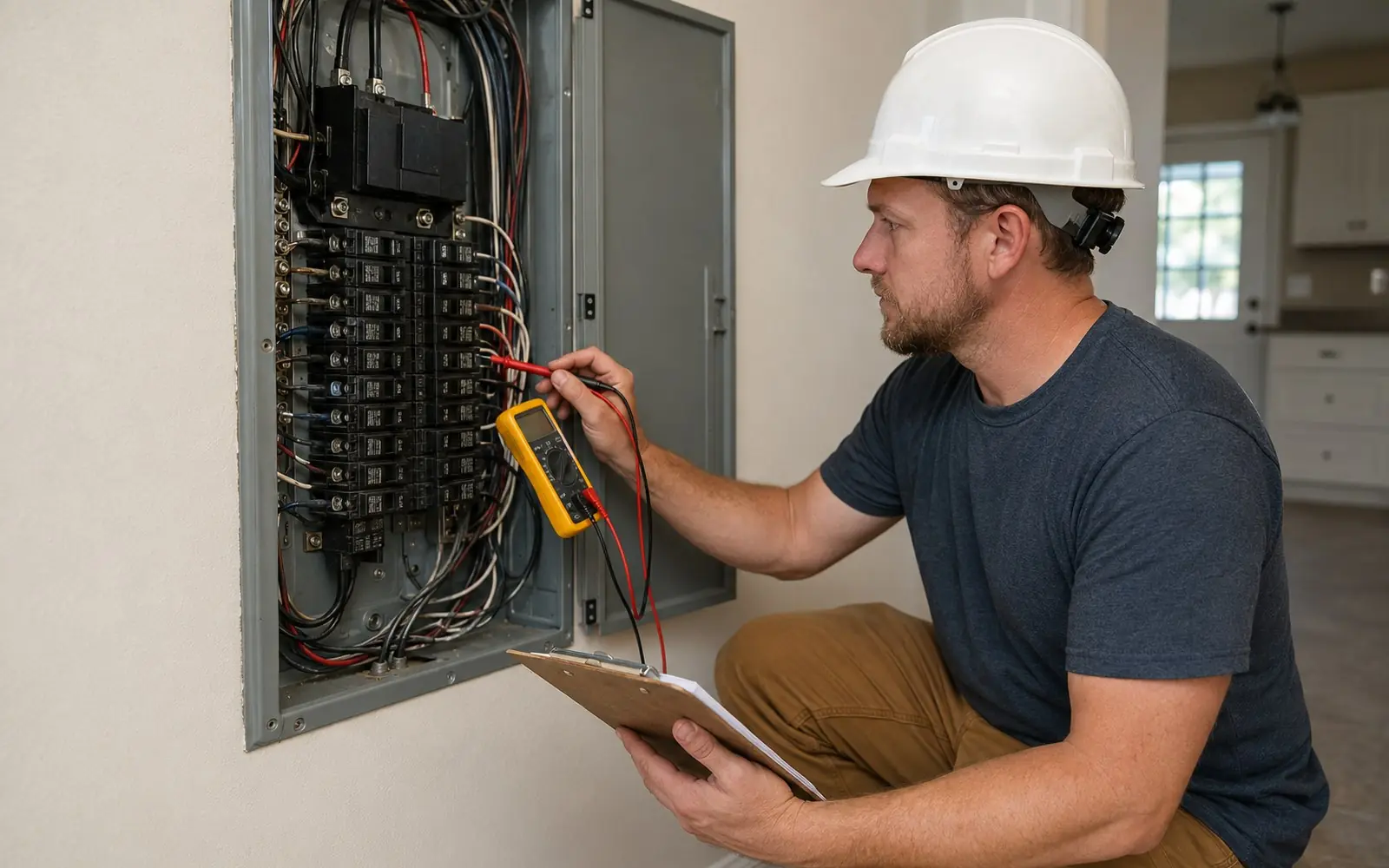
Electricians & Electrical Contractors
What the licence actually covers, the hour counts behind it, and why a published electrician wage is not the rate you will be billed.
A licence is checkable, an hourly rate quoted at you is not
Electrical is the trade where the credential is easiest to verify and the hardest to skip. California licenses the firm under a C-10 electrical contractor classification, and writes the scope broadly: placing, installing, erecting or connecting any electrical wires, fixtures, appliances, apparatus, raceways, conduits or solar photovoltaic cells that generate, transmit, transform or utilize electrical energy1. Texas licenses the individual as well as the company. Anyone who performs non-exempt electrical work in Texas must be licensed and must work through a licensed electrical contractor3.
The hour counts behind those licences are exact, and almost nobody reports them correctly. A Texas journeyman works under the general supervision of a master electrician and needs 8,000 hours of on-the-job training under a Texas-licensed master. Submitting 7,000 hours only buys the right to sit the examination early4. A master has held a journeyman licence at least two years and can show 12,000 hours5. Application fees are $30 and $45, and both licences renew annually45.
There are 757,220 electricians employed in the United States, and the federal government publishes what they earn in detail6. It does not publish what their employers charge you. Nearly every cost page online blurs the two. This guide keeps them apart, because it changes what you should expect from a quote.
Credentials, exemptions, and what the wage data means
Six things worth knowing before you compare electrical quotes.
Licensed electrical contractor
In California this is the C-10 classification, cited to Title 16, Division 8, Article 3 of the state regulations. The scope covers wires, fixtures, appliances, apparatus, raceways, conduits and solar photovoltaic cells, for any purpose that generates, transmits, transforms or uses electrical energy1.
Journeyman electrician
A Texas journeyman is licensed to perform electrical work under the general supervision of a master electrician4. The requirement is 8,000 hours of on-the-job training under a Texas-licensed master. The 7,000 hour figure you often see quoted is only the point at which a candidate may sit the exam early4.
Master electrician
A Texas master electrician has held a journeyman licence for at least two years and completed 12,000 hours of on-the-job training under a licensed master5. The application fee is $45 against $30 for a journeyman45. On a residential job the master often pulls the permit rather than climbing your ladder.
The small-job exemption, corrected
California exempts a job from contractor licensing only when the aggregate contract price for labor, materials and all other items is under $1,000 and the work does not require a building permit2. Both conditions, not either one. Most electrical work needing a permit fails the second test regardless of price.
Splitting the contract does not work
The same California statute closes the loophole in writing. The exemption does not apply where a division of the operation is made into contracts under $1,000 for the purpose of evading the chapter2. If a bidder proposes invoicing your job in slices, that is the behaviour the law names.
Wages are published, rates are not
Employed electricians earn a mean $34.37 an hour and a median $30.38, which is $71,490 and $63,190 a year6. Those are wages. A contractor's billing rate also carries insurance, vehicles, licensing, permit handling, warranty exposure and profit, and no authoritative source publishes the ratio between the two.
What does it cost?
Two federal numbers are worth having, and neither is a price for your job. The first comes from the 2023 American Housing Survey: homeowners reported a median of $1,000 spent on electrical wiring and fuse boxes7. That is a median across all such jobs, so half came in under $1,000. For scale, the same infographic puts the median across all improvement types at $6,500, HVAC at $5,500 and roofing at $10,0007.
The second number is the wage table6. Treat it as a floor under labour cost, never as a rate to quote back at a bidder. The spread runs from $20.50 an hour at the 10th percentile to $52.17 at the 90th, and state mean annual wages run from $94,470 in Washington to $57,510 in Alabama, roughly 1.64 times on the same job title6. That range is why a national average price for electrical work carries almost no information. Professionals did 64% of improvement projects but took 84.1% of the dollars78.
Wage figures are BLS Occupational Employment and Wage Statistics 2025 estimates from the agency's public API, and the $1,000 is a Census Bureau and HUD median from the 2023 American Housing Survey; no authoritative source publishes an installed price for a named electrical task.
How to hire an electrical contractor
Who does the work
A licensed electrical contractor, and in some states a licensed individual working through one. California issues the C-10 classification to the business1. Texas requires the person holding the tools to be licensed and the work to run through a licensed electrical contractor3. Ask which entity holds the licence and which person will be on site, because they are often not the same.
What pros will ask
The age of the house, because older wiring changes every answer. The rating on your service and panel, since the federal tax code itself treated 200 amps as a capacity threshold9. What else runs on the circuit you want extended. Whether the wall or ceiling cavity is open. And whether anyone did unpermitted work an inspector will now find.
What to check before signing
Pull the licence number and check it against the issuing board yourself rather than trusting a badge on a truck13. Get the permit in writing: who applies, who pays the fee, who calls for inspection, and who carries the cost if the work fails and has to be re-inspected. Confirm nobody is proposing to slice the contract into pieces to stay under a licensing threshold2.
Related searches homeowners make
Pulled from the same demand data behind our Lighting & Electrical category.
Electrician licensing questions, answered straight
Do I need a licensed electrician for a small job?
In California the exemption is narrow and has two conditions, not one. The job is exempt only if the aggregate contract price for labor, materials and all other items is under $1,000 and the work does not require a building permit2. Most electrical work that touches a circuit, a panel or a permanent fixture needs a permit somewhere in the process, which kills the exemption no matter how small the invoice. Other states set their own thresholds, so check your own board.
What does an electrician charge per hour?
No authoritative source publishes that. What is published is what electricians are paid: a mean of $34.37 an hour and a median of $30.38, with the 10th percentile at $20.50 and the 90th at $52.176. A contractor's billing rate sits above the wage by an amount covering insurance, vehicles, licensing and profit, and the multiplier is not published by any federal or trade source we could verify. Anyone giving you a national hourly rate for electricians is estimating.
Journeyman or master, which one do I need?
For most residential work the distinction matters less than the licensing chain behind it. In Texas a journeyman performs electrical work under the general supervision of a master electrician4, and a master has held a journeyman licence at least two years plus 12,000 hours of on-the-job training5. The practical question is which licensed person is responsible for your job on paper, since that is who the state holds accountable and who signs the permit application.
How do I verify a licence is real?
Go to the issuing state board directly. California publishes its classification definitions and licence records through the Contractors State License Board1, and Texas publishes electrician licensing through the Department of Licensing and Regulation3. There is no reliable national table of electrician licensing rules. Every all-fifty-states chart we examined came from a marketing site with no primary citation, so look up your own state's board.
Is there still a federal tax credit for a panel upgrade?
Not for work placed in service after 31 December 2025. The Energy Efficient Home Improvement Credit covered electrical components supporting residential energy property, including panelboards, sub-panelboards, branch circuits and feeders, at a limit of $600 per item, provided they met the National Electric Code and carried a capacity of 200 amps or more9. The IRS states the credit applied to improvements made through 31 December 20259. Plenty of currently ranking content still says this credit is live. As of the IRS page checked in August 2026, it is not.
Where these facts came from
Every figure on this page was read out of the page linked below. We do not cite cost aggregators.
- California CSLB, C-10 electrical contractor classification
- California Business and Professions Code section 7048
- Texas Department of Licensing and Regulation, electricians
- TDLR, journeyman electrician licence requirements
- TDLR, master electrician licence requirements
- BLS public API, OEWS estimates for electricians, SOC 47-2111
- Census Bureau and HUD, 2023 American Housing Survey home improvements
- Harvard Joint Center for Housing Studies, Improving America's Housing 2025 key facts
- IRS, Energy Efficient Home Improvement Credit
Get quotes for your electricians & electrical contractors project
Free for homeowners. No obligation. Up to four local pros compete.
Keep planning
More guides from the Lighting & Electrical hub.
Ceiling Fans
The box, the switching and the permit question, plus what three real fee schedules charge to hang one.
Read the guideElectrical Wiring and Supply
Circuits, outlets and service capacity, priced the way permit offices actually price them: by the device and by the amp.
Read the guideRecessed Home Lighting Design
Fixture count is the design decision and the permit decision at the same time, and one fee schedule prices it in blocks of twenty.
Read the guide