
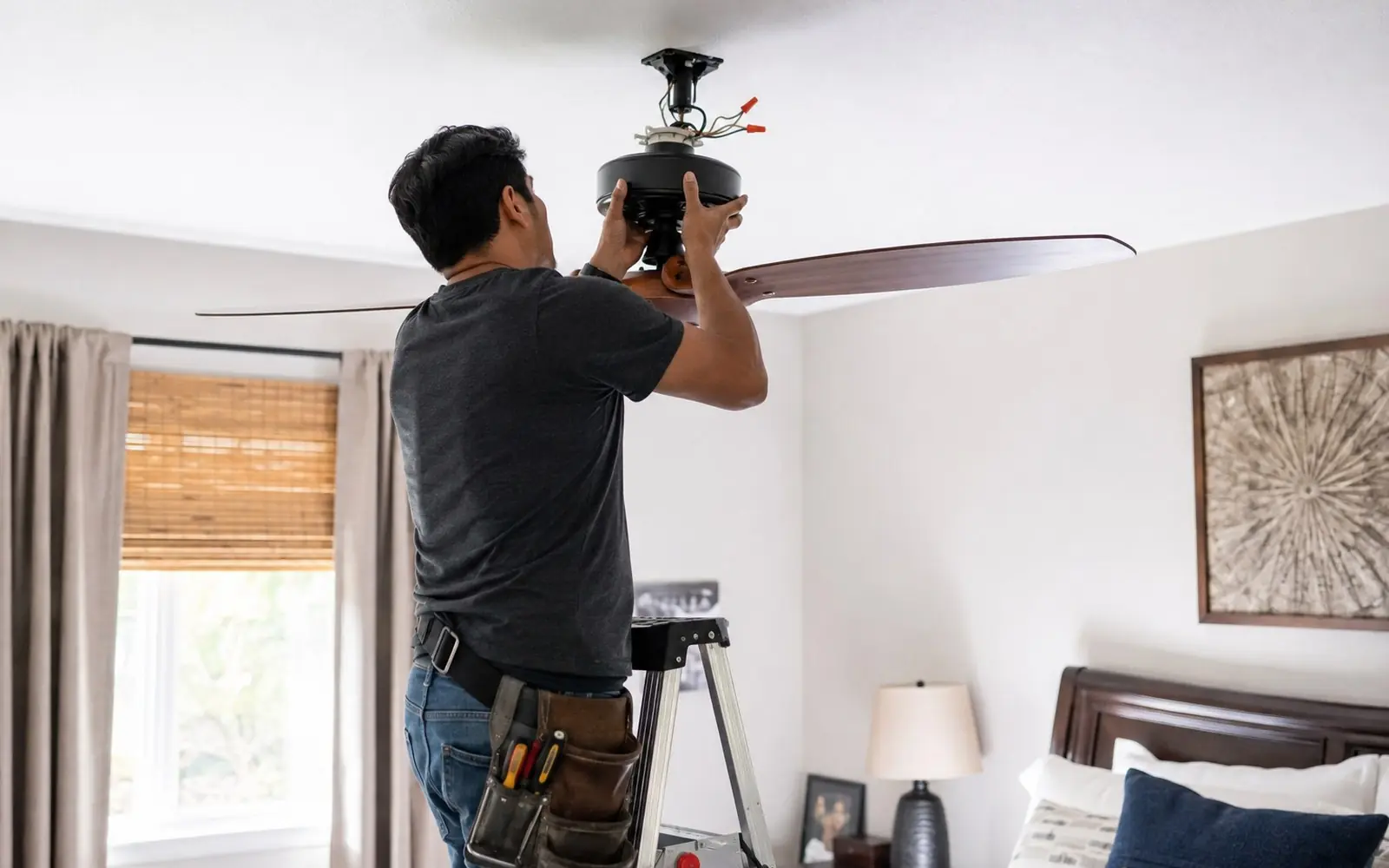
Ceiling Fans
The box, the switching and the permit question, plus what three real fee schedules charge to hang one.
A fan is not a light fixture with blades bolted on
A ceiling fan hangs heavier than a light, and it moves while it hangs. That single difference drives everything else: what the fan mounts to, whether the existing ceiling box stays, how many conductors come down from the switch, and whether anyone pulls a permit. A fixture swap can be a quick job. A fan going up where a light used to be often is not.
The permit question is genuinely murky and worth being honest about. Austin, Texas publishes a list of residential electrical work exempt from a building permit: temporary decorative lighting, reinstalling attachment plug receptacles, replacing branch circuit overcurrent devices in the same location, wiring under 25 volts that cannot supply more than 50 watts, and minor repair work1. Replacing a ceiling fan is not on that list. Austin's commercial list does exempt replacing a ceiling paddle fan at up to 480 volts and 30 amps1. No Austin page we found resolves the difference, so treat it as an open question in your own city.
Austin also states the point that gets forgotten: work exempt from a permit must still comply with applicable building codes and ordinances1. No permit is not the same as no rules.
Six fan installations, in rising order of difficulty
Which one you are buying decides most of the quote.
Fan replacing a fan
The simplest case, because the mounting and the switching already exist and already worked. The questions are whether the old bracket suits the new fan, and whether the box up there is the one the original fan came with or a later substitute. Ask the electrician to look inside the box.
Fan where a light fixture hangs
This is the common upgrade and the one people underestimate. A light box was chosen to hold a light. Boxes sold for fan support are a different product. The question to your electrician is which box is up there now, and which box will be there when the job is finished.
Fan where nothing hangs now
Now you are adding an outlet rather than swapping a fixture. Someone has to get a cable to that spot in the ceiling, mount a new box, and give it a switch. This is where an electrical permit becomes far more likely, and where fee schedules that count outlets start to matter2.
Fan with a separately switched light
Running the fan and its light kit off one switch is cheap and annoying to live with. Two switches means an extra conductor from the switch box to the ceiling, which either exists in the wall or does not. Ask before you buy, because that answer sets the job length.
Remote and wall control fans
A receiver in the canopy can avoid pulling a new conductor for separate light control, which is why it gets recommended in older houses. The tradeoffs are a battery remote to lose and a receiver to fail. Confirm which control that specific fan is listed to work with.
Sloped ceilings, high ceilings and outdoors
Each of these turns on the manufacturer's listing rather than the electrician's opinion. Sloped ceilings need a mount rated for that angle. Tall rooms need a downrod length. Porches and other damp spots need a fan listed for the location. Get the model number into the quote.
What does it cost?
Nobody official publishes what it costs to hang a ceiling fan. What is published is the permit side, and three real fee schedules price the same work three incompatible ways. Rockville, Maryland charges $65.25 for 1 to 20 fixtures and $17.75 for each additional block of 202. Wake County, North Carolina charges one flat $75 residential trade permit covering electrical, mechanical and plumbing together3. Broward County, Florida charges the greater of a $125 base fee or 1.85% of job value, valued from the RS Means manual or the applicant's estimate, whichever is higher4.
Rockville is also a lesson in reading the whole schedule. On top of the $65.25 sits a residential filing fee of $142.00 for work other than new construction, plus an automation fee of 10.25% charged on all permit and application fees2. The headline number is not the number. On the labour side the honest inputs are ceiling access, whether a box and cable already reach the spot, switch wiring, and ceiling height. For scale only: builders reported an average $5,392 on lighting per new home, 1.3% of a $428,215 construction cost5.
Permit figures come from the adopted fee schedules of Rockville, Wake County and Broward County, and the lighting and construction figures from an NAHB builder survey with only 41 usable responses; no authoritative source publishes an installed price for a ceiling fan.
How to hire for a ceiling fan install
Who does the work
A licensed electrician for anything that adds an outlet, adds a switch leg or touches a circuit. A handyman may legitimately handle a like-for-like swap in some places, but exemption lists are narrower than people assume: Austin's residential list does not mention fan replacement at all1. If a permit is required, licensing usually is too.
What pros will ask
The fan's weight and model number. What is above the ceiling: attic, another floor, or a cathedral. Whether a fixture already hangs there and how it is switched. Ceiling height and slope. The age of the house. Whether you want the light and the fan on separate switches, since that single answer decides whether anyone opens a wall.
What to check before signing
That the quote names the mounting box and bracket going in, not just the fan. That the permit responsibility is written down: who applies, who pays, who meets the inspector. That the quote covers patching if a ceiling or wall gets opened. And ask about re-inspection charges, which Wake County publishes at $100, then $200, then $300, then $4003.
Related searches homeowners make
Pulled from the same demand data behind our Lighting & Electrical category.
Ceiling fan questions, answered straight
Do I need a permit to replace a ceiling fan?
It depends on your jurisdiction, and at least one city leaves it genuinely ambiguous. Austin publishes a residential electrical exemption list that does not mention ceiling fans or light fixtures, while its commercial list explicitly exempts replacing a ceiling paddle fan at up to 480 volts and 30 amps1. We could not find an Austin page explaining the difference. Call your building department and ask directly, and remember that exempt work still has to comply with the applicable codes1.
Can a fan hang from the box my light hangs from?
Put that question to the electrician rather than to a search engine. Boxes rated to support a ceiling fan are sold as a distinct product from ordinary lighting boxes, and what is in your ceiling can only be established by opening it. zipBuilder has not verified which edition of the National Electrical Code your jurisdiction adopted, and adoption varies, so we do not quote article numbers. Ask the electrician to name the box going in and the inspector to confirm it.
What should a ceiling fan installation cost?
No authoritative source publishes that figure. Federal statistics cover what electricians earn and what homeowners spent in aggregate, not per-task installed prices, and retailer installation pages could not be verified. The nearest honest anchors are a $1,000 median for homeowner spending on electrical wiring and fuse boxes6 and an average $5,392 lighting line in new construction5. Any site quoting you a national average per fan is estimating, not reporting.
We are hanging four fans. Does that cost four permits?
Usually no, and the fee structure is worth reading before you split a job across visits. Rockville prices fixtures in blocks: $65.25 covers 1 to 20 fixtures, and each additional block of 20 adds $17.752. Wake County issues one $75 permit covering electrical, mechanical and plumbing for the project3. Broward works off job value instead, at 1.85% with a $125 floor4. Doing all four at once is almost always cheaper on the permit line.
Is this a reasonable job to do myself?
Americans do plenty of their own work: 36% of home improvement projects are done by do-it-yourselfers against 64% by professionals6. But professionally installed work took 84.1% of improvement dollars in 20237, which tells you DIY concentrates in the small, cheap, low-consequence jobs. A like-for-like fan swap can sit there. Adding an outlet, adding a switch leg or working in a ceiling you cannot inspect does not, and unpermitted work surfaces later when the house is sold.
Where these facts came from
Every figure on this page was read out of the page linked below. We do not cite cost aggregators.
- City of Austin, work exempt from building permits
- City of Rockville MD, FY2026 Inspection Services Division fee schedule
- Wake County NC, permits and inspections fee schedule
- Broward County FL, Building Code Services Division fee schedule
- NAHB, Cost of Constructing a Home in 2024
- Census Bureau and HUD, 2023 American Housing Survey home improvements
- Harvard Joint Center for Housing Studies, Improving America's Housing 2025 key facts
Get quotes for your ceiling fans project
Free for homeowners. No obligation. Up to four local pros compete.
Keep planning
More guides from the Lighting & Electrical hub.
Electrical Wiring and Supply
Circuits, outlets and service capacity, priced the way permit offices actually price them: by the device and by the amp.
Read the guideRecessed Home Lighting Design
Fixture count is the design decision and the permit decision at the same time, and one fee schedule prices it in blocks of twenty.
Read the guideCeiling Tile
The one ceiling where the lighting layout and the ceiling itself are a single decision, and the only part anyone publishes a price for.
Read the guide