
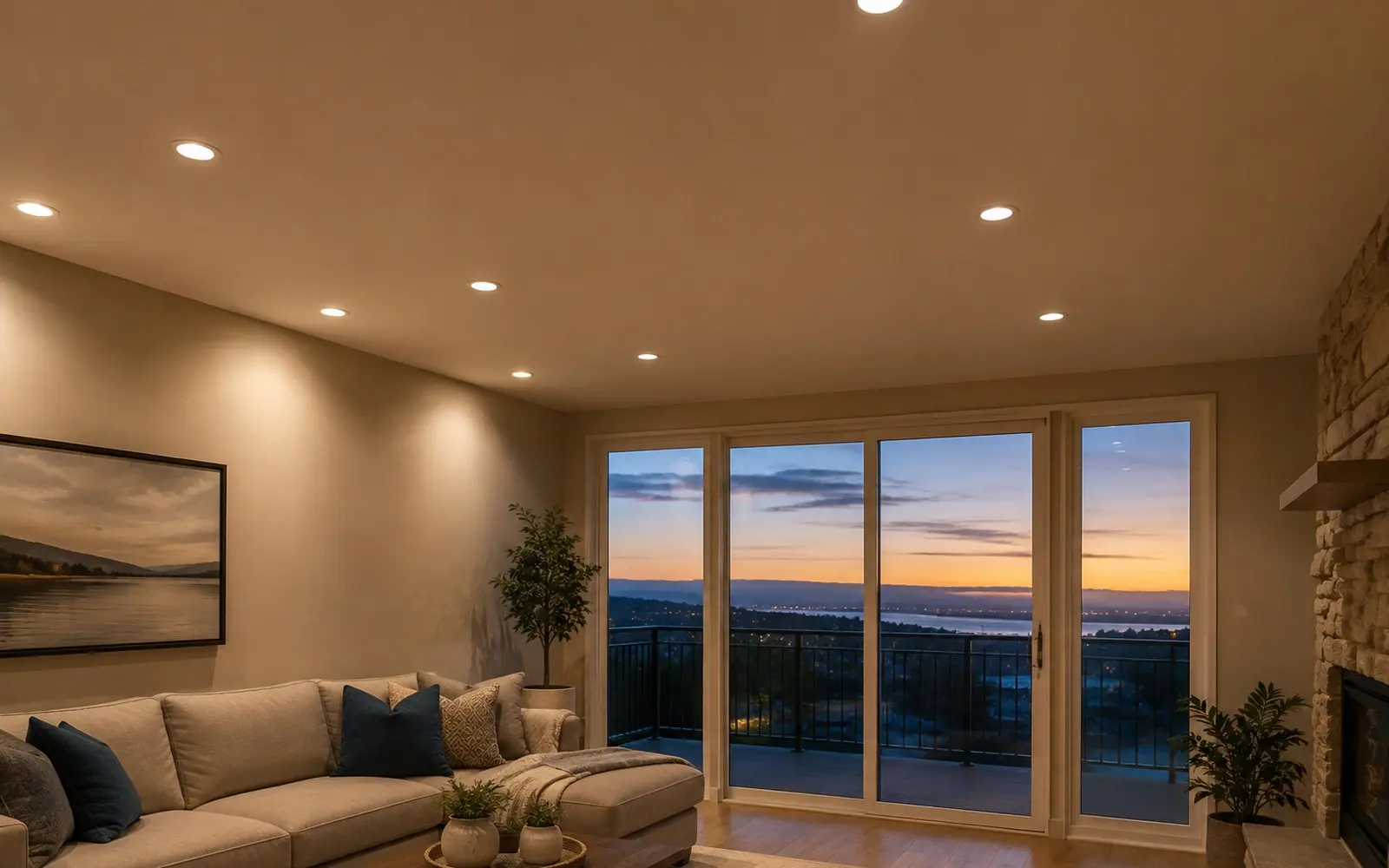
Recessed Home Lighting Design
Fixture count is the design decision and the permit decision at the same time, and one fee schedule prices it in blocks of twenty.
Every extra can adds a hole, a fixture, and a line on the permit
Recessed lighting is the one lighting job where the design decision and the cost decision are the same decision. Each can is a hole in the ceiling, a fixture, a length of cable and a device an inspector will count. A layout conversation that starts with how many cans go in the living room is really a conversation about scope.
The permit side makes this concrete. Rockville, Maryland charges $65.25 for 1 to 20 fixtures on an electrical permit, then $17.75 for each additional block of 201. The twenty-first downlight starts a new block. That is small money, but it tells you the authority counts fixtures, so your quote should count fixtures too. Broward County, Florida works differently, taking the greater of a $125 base fee or 1.85% of job value2, so more fixtures raise the fee through the valuation. Wake County, North Carolina charges a flat $75 and does not count at all3.
Builders spent an average of $5,392 on lighting per new single-family home, 1.3% of a $428,215 total construction cost, in a house averaging 2,647 finished square feet4. That works out to about $2.04 per finished square foot for all the lighting in a new house.
Six recessed lighting situations, in order of difficulty
The ceiling above you decides most of this before you pick a trim.
New construction or a gut
Ceiling open, joists visible, cable pulled before drywall. Housings go up in minutes and layout changes are nearly free. This is when to over-provision switching and zones, because the same change later means cutting the finished ceiling and paying somebody to patch and paint it.
Retrofit into a finished ceiling
Every fixture is a hole saw cut, a fish through a joist bay, and a housing that clips in from below. The variable that swings the price is what is above: an accessible attic is a different job from a bedroom with a bathroom directly overhead. Ask what access the electrician found.
Ceilings with insulation above
This is the question to settle before anything is ordered. Fixtures carry a listing marking that states whether insulation may contact the housing. Ask the electrician which listing the specified fixture carries, and confirm the requirement with your local inspector, since jurisdictions adopt different editions of the electrical code.
Swapping existing cans for LED
Cheapest real upgrade in the category, because the housing, cable and switch already exist. The catch is that the new module has to suit the housing you have. Get the existing can's make and aperture size into the conversation, not just the size of the hole in your ceiling.
Dimming and multiple zones
Splitting a room into zones is a wiring decision, not a shopping decision. Each zone is a switch leg back to a control point, which is cheap in an open ceiling and expensive in a finished wall. Decide the zones before the cans go in, and confirm the dimmer is compatible with the specific fixture.
Fixture count and the layout itself
There is no verified national rule for spacing, and anyone quoting one is passing along a convention rather than a standard. Output, beam angle, ceiling height and the room's purpose all move the answer. Ask for a marked ceiling plan with a fixture count, and price against that plan1.
What does it cost?
No authoritative source publishes an installed price for a single recessed light, and we will not estimate one. The nearest defensible figure is builder-side and derived: NAHB reports an average $5,392 spent on lighting in a new single-family home averaging 2,647 finished square feet4, which is $5,392 divided by 2,647, or about $2.04 per finished square foot. That is what a builder spent on all lighting in a new house, not a retrofit quote. It excludes the separate $27,383 electrical rough-in line and comes from a survey with 41 usable responses4.
The permit is the part you can price exactly, and it depends on which logic your jurisdiction uses. Rockville counts fixtures in blocks of twenty, then adds a $142.00 residential filing fee for work other than new construction plus a 10.25% automation fee on all permit and application fees1. Broward charges 1.85% of job value with a $125 floor, so a larger fixture package raises the fee through the valuation2. Wake County charges $75 flat for all trades combined3. Homeowners reported a $1,000 median across electrical wiring and fuse box work5.
The per-square-foot figure is our own arithmetic on two NAHB averages from a 41-response builder survey, covering all lighting in new construction and excluding electrical rough-in; permit fees come from three adopted municipal schedules.
How to hire for recessed lighting
Who does the work
A licensed electrician, and for a whole-house layout, one who will draw the plan rather than eyeball it. Austin's residential permit exemption list covers replacing lamps as minor repair work but does not list replacing a luminaire, while its commercial list does exempt luminaire replacement up to 480 volts and 30 amps6. Do not assume a fixture swap is exempt where you live.
What pros will ask
Ceiling height and construction. What sits directly above: attic, insulation, a bathroom, a second floor. Whether an existing lighting circuit reaches the room. How many switch zones you want and where the switches go. Whether the ceiling is drywall, plaster or something that will not take a clean cut. And what the room is used for.
What to check before signing
A marked ceiling plan with a fixture count, since that count is what the permit and the inspection turn on1. The exact fixture model, not just a wattage. Who patches and paints the ceiling. Whether the quote includes the dimmers and confirms they suit the fixtures. And who pays if the inspection fails, because Wake County charges $100, then $200, then $300, then $400 for re-inspections3.
Related searches homeowners make
Pulled from the same demand data behind our Lighting & Electrical category.
Recessed lighting questions, answered straight
How many recessed lights does a room need?
There is no authoritative published rule we could verify, and the spacing formulas circulating online are trade conventions rather than standards. Ceiling height, fixture output, beam angle, wall colour and the task the room supports all change the number. Ask the electrician or designer for a marked ceiling plan with a fixture count, then price the job against that plan. A count on paper also protects you, because the permit and the inspection are measured in fixtures1.
Can recessed lights sit against attic insulation?
Only fixtures listed for that use, and the marking on the fixture is where the answer lives. We are not quoting an electrical code article here, because zipBuilder has not verified which edition of the National Electrical Code your jurisdiction has adopted and adoption is not uniform. Ask two questions instead: which listing does the specified fixture carry, and does the local inspector accept it in your ceiling assembly. Get both answers before the fixtures are ordered.
Do I need a permit to add recessed lights?
In most places adding fixtures and circuits is permitted work. Rockville has a dedicated fee line for fixtures, which only exists because fixtures get permitted and inspected1. Austin's residential exemption list covers replacing lamps but not replacing a luminaire6, and Austin notes that exempt work still has to comply with the applicable codes6. Call your building department with a fixture count rather than a general description of the job.
Does adding more fixtures raise the permit fee?
It depends which of three logics your jurisdiction uses. In Rockville the fee steps: $65.25 covers 1 to 20 fixtures and each further block of 20 adds $17.751. In Broward the fee is 1.85% of job value with a $125 minimum, so a bigger package raises it through the valuation, which is taken from the RS Means manual or your estimate, whichever is greater2. In Wake County a flat $75 covers electrical, mechanical and plumbing together3.
What should recessed lighting cost per light?
No source we can stand behind publishes that. Retailer installation pages were unreachable, and aggregator estimates state no methodology or sample size. What is verifiable: builders averaged $5,392 on all lighting per new home4, homeowners reported a $1,000 median across electrical wiring and fuse box work5, and state mean wages for electricians range from $94,470 in Washington to $57,510 in Alabama7. That labour spread is why a national per-light figure would tell you very little.
Where these facts came from
Every figure on this page was read out of the page linked below. We do not cite cost aggregators.
- City of Rockville MD, FY2026 Inspection Services Division fee schedule
- Broward County FL, Building Code Services Division fee schedule
- Wake County NC, permits and inspections fee schedule
- NAHB, Cost of Constructing a Home in 2024
- Census Bureau and HUD, 2023 American Housing Survey home improvements
- City of Austin, work exempt from building permits
- BLS public API, OEWS estimates for electricians, SOC 47-2111
Get quotes for your recessed home lighting design project
Free for homeowners. No obligation. Up to four local pros compete.
Keep planning
More guides from the Lighting & Electrical hub.
Ceiling Tile
The one ceiling where the lighting layout and the ceiling itself are a single decision, and the only part anyone publishes a price for.
Read the guideTrack Lighting
One box, one circuit, many light points, and one permit question your fee schedule probably does not answer.
Read the guideElectrical Safety Code and Wiring Diagrams
Which rules bind you, who enforces them, what a failed inspection costs, and why we will not hand you a circuit diagram.
Read the guide