
Electrical Safety Code and Wiring Diagrams
Which rules bind you, who enforces them, what a failed inspection costs, and why we will not hand you a circuit diagram.
The rules that bind you are the ones your own city adopted
There is no single national electrical rulebook that applies to your house directly. The National Electrical Code is a model document, and it reaches you only when a state or local authority adopts an edition of it, usually with local amendments. Different jurisdictions adopt different editions in different years. That is why this guide quotes no code article numbers: zipBuilder has not verified which edition applies where you live, and a stale article number is worse than none. Ask your building department which edition it enforces.
The federal government does reference the code, and one place you can read it in plain language is tax law. The IRS wrote that electrical components supporting residential energy property, including panelboards, sub-panelboards, branch circuits and feeders, qualified for the Energy Efficient Home Improvement Credit if they met the National Electric Code and had a capacity of 200 amps or more, at a limit of $600 per item1. That credit applied through 31 December 2025 and is gone for property placed in service after that date1.
The mechanism that actually puts code into your walls is the permit and the inspection. That part is documented, priced and checkable, and it is where this guide gets specific.
Six things that decide whether your work is compliant
Each of these is answerable locally, none of them nationally.
Which edition your jurisdiction adopted
Adoption is not uniform across the country and it is not automatic. Your building department can tell you which edition it enforces and which local amendments it added. Get that answer before researching anything else, because an article number carries a different meaning between editions.
The permit, which starts the process
The permit is how the authority learns your work exists. Fee schedules show what is being tracked: Rockville, Maryland lists rough wiring outlets, dedicated circuits, fixtures, service by amperage, and even smoke and carbon monoxide alarms at $1.15 per alarm2. The line items tell you what an inspector expects to see.
The inspection, which is the real test
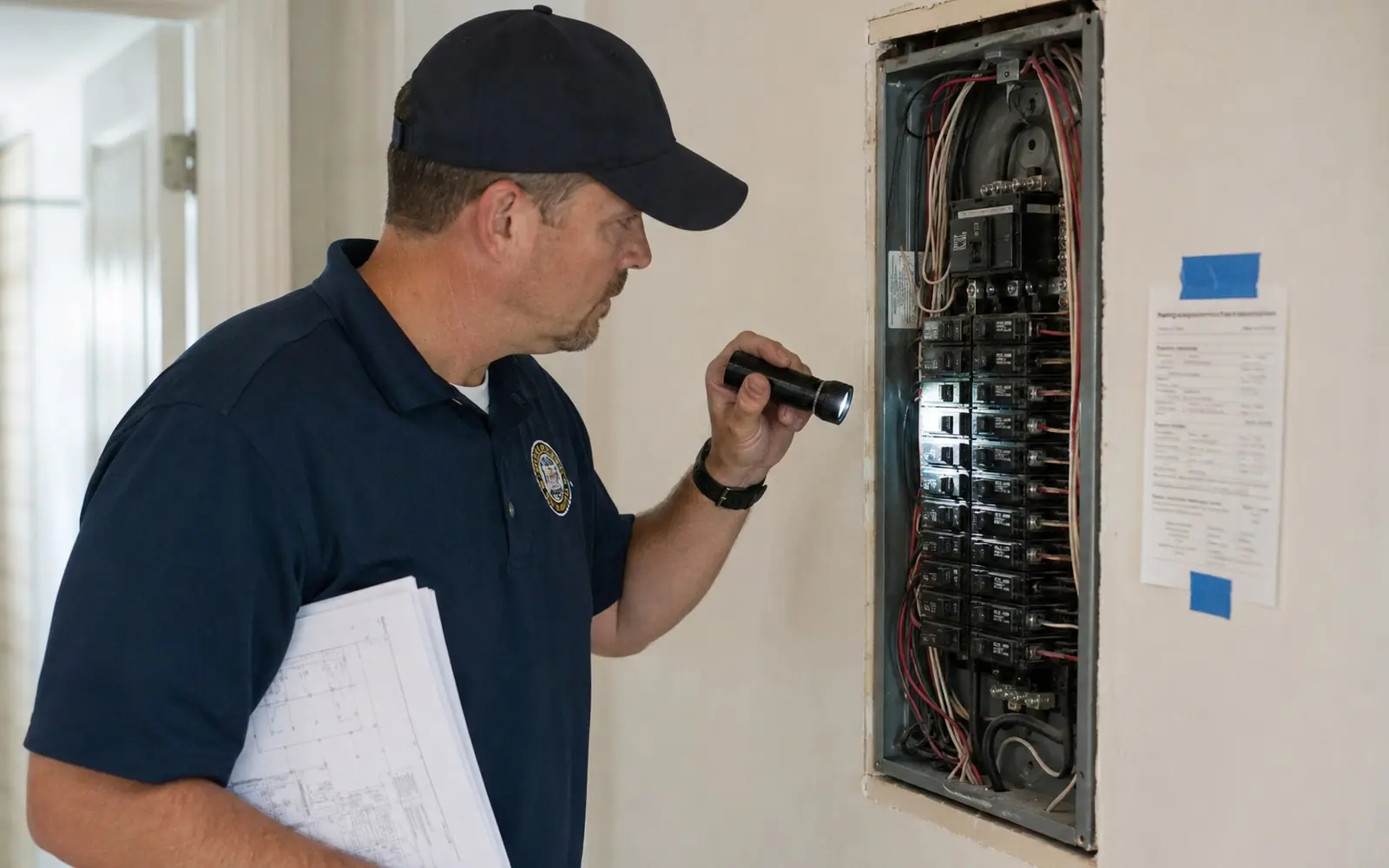
Approval attaches to the installation in front of the inspector, not to a plan, a diagram or a product listing. The useful questions in any quote are who calls for inspection, when, and at what stage. Rough inspection before the walls close is the one that is expensive to miss.
Exempt does not mean unregulated
Austin, Texas puts it directly on the page: work exempt from a permit must still comply with applicable building codes, city codes and all other applicable ordinances3. Its residential exemptions are narrow, covering temporary decorative lighting, reinstalling attachment plug receptacles, replacing overcurrent devices in the same location, work under 25 volts, and lamp replacement3.
Licensing, the other control
California defines an electrical contractor's scope in regulation and issues it as the C-10 classification4. Texas requires the individual to be licensed and to work through a licensed electrical contractor, with 8,000 hours of on-the-job training behind a journeyman licence5. Licensing and permitting are separate controls and both apply.
Wiring diagrams, and their limits
A diagram is a communication tool between you, the electrician and the inspector. It is not an approval, and a generic one from a search result knows nothing about your adopted code edition, your panel, or what is in your walls. Useful as a record of what was installed. Not useful as a permission slip.
What does it cost?
Compliance itself has no published price, but the enforcement machinery does, and the most useful number in it is the cost of failing. Wake County, North Carolina charges $100 for a first re-inspection, $200 for a second, $300 for a third and $400 for a fourth or more6. That ladder is the clearest published signal that inspections are not a formality. Wake County otherwise charges a flat $75 residential trade permit covering electrical, mechanical and plumbing, and $75 plus $0.25 per square foot for alterations6.
The permit itself is priced three incompatible ways in the three schedules we read, which is why no national average exists. Rockville counts devices and amperage, with a $65.25 minimum fee, service permits stepping from $65.25 up to 225 amps to $130.25 above 1,000 amps, a $142.00 residential filing fee for work other than new construction, and a 10.25% automation fee on all permit and application fees2. Broward County, Florida charges the greater of $125 or 1.85% of job value, taken from the RS Means manual or the applicant's estimate, whichever is greater7.
All fees here are quoted from the adopted schedules of Rockville, Wake County and Broward County, and the tax language from the IRS; no source we could reach publishes the cost of bringing existing wiring into compliance.
How to hire for code compliance work
Who does the work
A licensed electrical contractor, and for anything involving a service or a panel, one who deals with your inspector regularly. California's exemption from contractor licensing requires both a contract price under $1,000 and work that does not require a building permit8, so most compliance work fails it on the second test alone. Ask who holds the licence and who supervises.
What pros will ask
The age of the house and whether it has ever been rewired. Whether previous work was permitted, and whether you have the paperwork. Your service rating in amps. What the inspector flagged, if anything has been flagged. Whether you are correcting a specific defect or bringing a whole system up to current requirements, because those are different scopes.
What to check before signing
That the permit is named, with who applies and who meets the inspector. That rough inspection is scheduled before anything is closed up. That the quote says who pays for re-inspections, which escalate from $100 to $4006. And that you get the permit sign-off document at the end, because that is the record a buyer's inspector will ask for.
Related searches homeowners make
Pulled from the same demand data behind our Lighting & Electrical category.
Code and inspection questions, answered straight
Which electrical code applies to my house?
Whichever edition your jurisdiction has adopted, plus its local amendments. There is no national default that reaches you directly. We deliberately print no article numbers in this guide, because zipBuilder has not verified adoption in your area and code editions renumber between cycles. Call your building department and ask two questions: which edition do you enforce, and are there local amendments. Write the answers down, then have any advice you read online checked against them.
Can I follow a wiring diagram I found online?
A diagram does not know which code edition binds you, what is already in your walls, how your panel is fed, or what your inspector will ask to see. Approval attaches to the installation, not to the drawing. Diagrams earn their keep in two places: agreeing scope with an electrician before work starts, and recording what was actually installed afterwards. Neither of those is a substitute for a permit, and neither makes unpermitted work compliant.
What happens if the work fails inspection?
It gets corrected and re-inspected, and re-inspection is billable. Wake County publishes the ladder plainly: $100 for the first re-inspection, $200 for the second, $300 for the third and $400 for the fourth or more6. That escalation is the reason to settle in the contract who carries re-inspection costs before anyone starts. It is also the reason to insist on a rough inspection before drywall goes up, since failing after the walls close costs far more than the fee.
Is small work really exempt from a permit?
Some is, and the lists are narrower than people assume. Austin's residential electrical exemptions cover cord-and-plug connected temporary decorative lighting, reinstalling attachment plug receptacles but not the outlets, replacing branch circuit overcurrent devices of the required capacity in the same location, work under 25 volts that cannot supply more than 50 watts, and minor repair work including lamp replacement3. Austin states directly that exempt work must still comply with the applicable codes and ordinances3.
Where does the federal government reference the electrical code?
One readable place is the IRS page for the Energy Efficient Home Improvement Credit, which required electrical components supporting residential energy property to meet the National Electric Code and carry a capacity of 200 amps or more, at a limit of $600 per item within a $1,200 annual cap1. That credit applied to improvements made through 31 December 20251. We searched for a replacement federal incentive covering panel work and did not find one, so check current IRS guidance before planning around it.
Where these facts came from
Every figure on this page was read out of the page linked below. We do not cite cost aggregators.
- IRS, Energy Efficient Home Improvement Credit
- City of Rockville MD, FY2026 Inspection Services Division fee schedule
- City of Austin, work exempt from building permits
- California CSLB, C-10 electrical contractor classification
- TDLR, journeyman electrician licence requirements
- Wake County NC, permits and inspections fee schedule
- Broward County FL, Building Code Services Division fee schedule
- California Business and Professions Code section 7048
Get quotes for your electrical safety code and wiring diagrams project
Free for homeowners. No obligation. Up to four local pros compete.
Keep planning
More guides from the Lighting & Electrical hub.
Electricians & Electrical Contractors
What the licence actually covers, the hour counts behind it, and why a published electrician wage is not the rate you will be billed.
Read the guideCeiling Fans
The box, the switching and the permit question, plus what three real fee schedules charge to hang one.
Read the guideElectrical Wiring and Supply
Circuits, outlets and service capacity, priced the way permit offices actually price them: by the device and by the amp.
Read the guide