
Electrical Wiring and Supply
Circuits, outlets and service capacity, priced the way permit offices actually price them: by the device and by the amp.
The wiring you never see is the biggest electrical line in the house
Builders reported an average of $27,383 spent on electrical work excluding fixtures in a new single-family home, which is 6.4% of a $428,215 total construction cost1. Lighting is counted separately at $5,392, or 1.3%1. So roughly five dollars go into wire, boxes, circuits and the panel for every one that goes into the fittings you can see. That ratio is the single most useful thing to carry into a conversation about wiring.
Read the caveat before quoting the figure. That NAHB survey went to a sample of 4,000 builders and produced usable responses from 41 of them, and NAHB itself warns it is not a perfect tool for estimating costs for a particular house in a particular location1. It is still the only builder-side breakdown that publishes its own methodology, and it describes a specific house: 2,647 finished square feet at about $162 per square foot1.
Retrofit work is a different animal and the federal number for it is much smaller. Homeowners reported a median of $1,000 spent on electrical wiring and fuse boxes in the 2023 American Housing Survey2. Half of those jobs came in under that. Against a $6,500 median across all improvement types, wiring work is usually a small job, not a large one2.
Six kinds of wiring work, and what separates them
The permit office draws these lines too, and prices them differently.
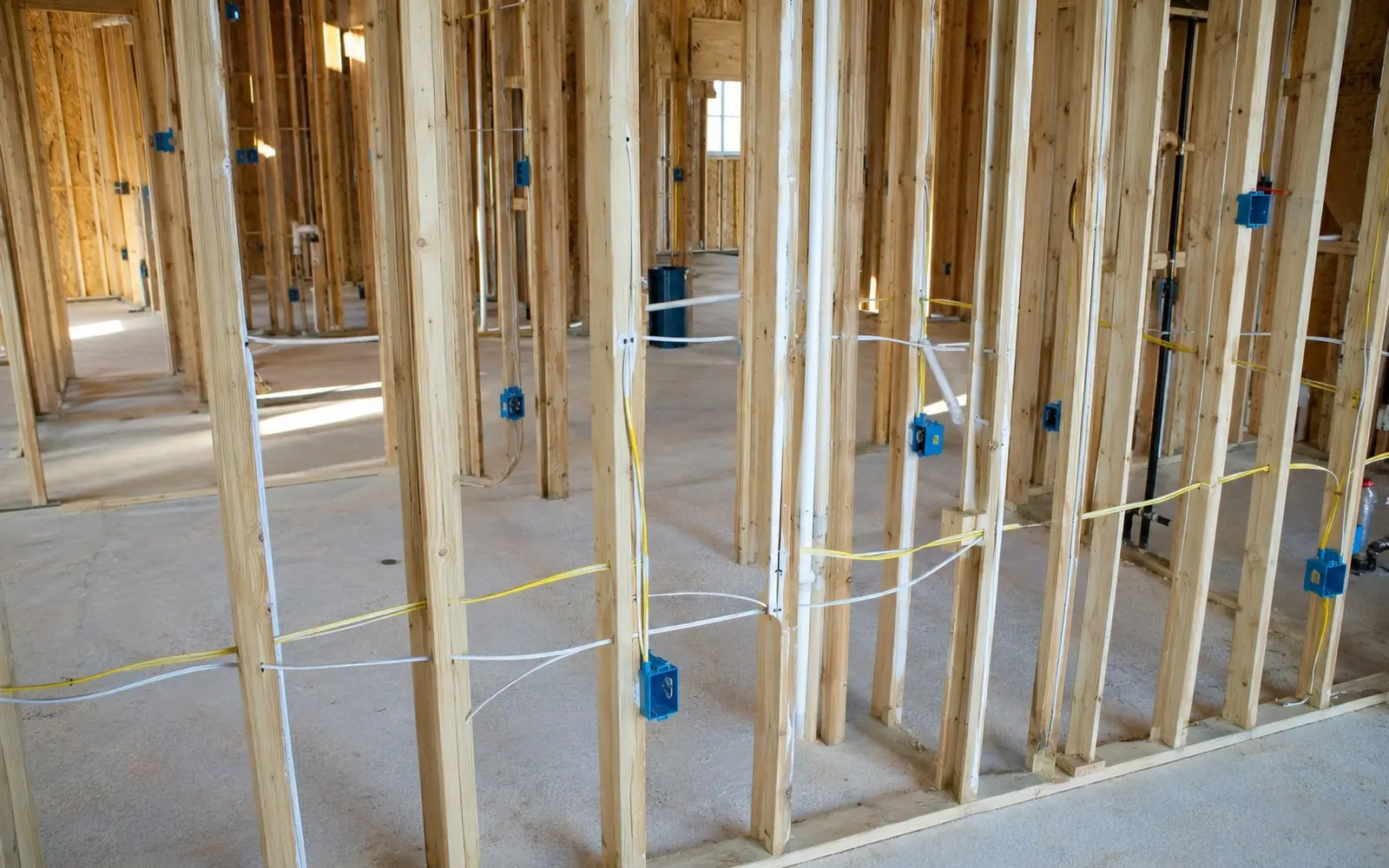
Rough-in on new construction
Cable pulled and boxes set before the walls close. This is the $27,383 line in the NAHB breakdown, and it sits inside a major systems rough-in total of $82,319, or 19.2% of construction cost1. Cheapest possible time to do any of it, because nothing has to be opened.
Adding a general purpose circuit
New receptacles and switches in a finished room. Rockville, Maryland calls this rough wiring outlets, meaning all switches and receptacles, and charges $65.25 for the first 1 to 20 outlets with $17.75 for each additional block of 203. Permit offices count devices because that is what the inspector counts.
Dedicated appliance circuits
A range, a dryer, an HVAC unit or a shop tool that wants a circuit to itself. Rockville prices these per outlet rather than in blocks of 20: $65.25 for the first, $17.75 for each additional3. On the permit line a single dedicated circuit costs what twenty ordinary outlets cost.
Service and panel capacity
The feed from the meter through the main panel. Rockville tiers this by amperage: $65.25 up to 225 amps, $83.00 for 225 to 400, $100.50 for 400 to 1,000 and $130.25 above that3. The tiering tells you what the inspection effort scales with.
Old wiring in old houses
An older house changes this conversation more than any other fact about it. Whether a circuit can be extended, whether the existing wiring method is still serviceable, and whether the job becomes a rewire are questions answered by opening a box, not by phone.
New loads: EV charging and solar
These are priced as their own categories. Rockville charges $31.00 per outlet for residential EV charging and $120.00 for a residential solar installation, and excludes both from its standard minimum fee3. If your project includes one, do not assume it rides along on the general electrical permit.
What does it cost?
There is no published installed price for rewiring a house, adding a circuit or upgrading a service. Not from the Bureau of Labor Statistics, not from the Census Bureau, not from NAHB, not from any state or city source we could reach. What exists is the two anchors above: an average $27,383 electrical rough-in inside new construction from a 41-response builder survey1, and a $1,000 median for homeowner spending on wiring and fuse boxes from a federal housing survey2. Those measure different things and neither is a quote.
The permit side is knowable and worth budgeting. Rockville counts devices and amps3, then adds a $142.00 residential filing fee and a 10.25% automation fee charged on all permit and application fees3. Wake County, North Carolina charges one flat $75 for electrical, mechanical and plumbing combined, and $75 plus $0.25 per square foot for alterations4. Broward County, Florida takes the greater of $125 or 1.85% of job value, valued from the RS Means manual or your own estimate, whichever is higher5. For scale, building permit fees averaged $7,640 per new home1.
Construction figures come from NAHB's 2024 cost survey, which had 41 usable builder responses; the $1,000 median is Census Bureau and HUD 2023 American Housing Survey data; permit fees are from three adopted municipal schedules. None is an installed price.
How to hire for wiring and service work
Who does the work
A licensed electrical contractor. This is the end of the category where the licensing exemptions stop applying: California's exemption requires both a contract price under $1,000 and work that does not require a building permit6, and adding circuits or touching a service will normally require a permit. Ask who holds the licence and who supervises the crew.
What pros will ask
The year the house was built. Your current service rating in amps. What is already on the circuit you want to extend. Whether the panel has physical space and whether the feeder can carry more. What new loads are coming: an EV charger, a heat pump, a range, a shop. Whether walls or ceilings can be opened, and who patches them.
What to check before signing
That the quote counts devices, since that is how the inspection is measured3. That permit and inspection responsibility is written down. That any service or panel work names the amperage. That patching is included or explicitly excluded. And ask what happens on a failed inspection, because re-inspection fees escalate: Wake County publishes $100, $200, $300 and $4004.
Related searches homeowners make
Pulled from the same demand data behind our Lighting & Electrical category.
Wiring and service questions, answered straight
How do I know if I need a bigger service?
An electrician answers that with a load calculation on your actual house, not from a rule of thumb online. The one federal marker worth knowing is that the IRS used 200 amps as its threshold: electrical components supporting residential energy property qualified for the Energy Efficient Home Improvement Credit only if they met the National Electric Code and had a capacity of 200 amps or more7. That is a tax rule, not a code requirement, but it shows where the federal government drew the line on a modern panel.
What does it cost to rewire a house?
No authoritative source publishes that number, and we will not invent one. The closest verified figures point in opposite directions: new construction electrical rough-in averaged $27,383 in a 2,647 square foot house1, while the federal median for homeowner spending on electrical wiring and fuse boxes was $1,0002. A whole-house rewire sits somewhere above the second and is not the first, since retrofit work carries demolition and patching that a new build does not.
Do I need a permit just to add an outlet?
Usually yes, and exemption lists are narrow. Austin exempts reinstallation of attachment plug receptacles but explicitly not the outlets themselves, along with replacing branch circuit overcurrent devices of the required capacity in the same location8. Rockville's schedule has a line item for rough wiring outlets, which only makes sense because those outlets are permitted and inspected3. Austin also notes that exempt work still has to comply with the applicable codes8.
Is there still a tax credit for a panel upgrade?
Not for property placed in service after 31 December 2025. The Energy Efficient Home Improvement Credit covered panelboards, sub-panelboards, branch circuits and feeders at a limit of $600 per item, within an annual cap of $1,200, at 30% of qualified expenses7. The IRS states the credit applied to improvements made through 31 December 20257. We searched for a replacement federal incentive and did not find one. Check current IRS guidance before you plan around it.
Why are quotes so different in different cities?
Two verified reasons. Labour: state mean annual wages for electricians run from $94,470 in Washington to $57,510 in Alabama, about 1.64 times on the same job title9. Permits: Rockville counts devices, Wake County charges a flat $75 and Broward takes 1.85% of job value345. Those are three incompatible pricing logics, which is why a national average electrical permit fee would be a manufactured number rather than a reported one.
Where these facts came from
Every figure on this page was read out of the page linked below. We do not cite cost aggregators.
- NAHB, Cost of Constructing a Home in 2024
- Census Bureau and HUD, 2023 American Housing Survey home improvements
- City of Rockville MD, FY2026 Inspection Services Division fee schedule
- Wake County NC, permits and inspections fee schedule
- Broward County FL, Building Code Services Division fee schedule
- California Business and Professions Code section 7048
- IRS, Energy Efficient Home Improvement Credit
- City of Austin, work exempt from building permits
- BLS public API, OEWS estimates for electricians, SOC 47-2111
Get quotes for your electrical wiring and supply project
Free for homeowners. No obligation. Up to four local pros compete.
Keep planning
More guides from the Lighting & Electrical hub.
Recessed Home Lighting Design
Fixture count is the design decision and the permit decision at the same time, and one fee schedule prices it in blocks of twenty.
Read the guideCeiling Tile
The one ceiling where the lighting layout and the ceiling itself are a single decision, and the only part anyone publishes a price for.
Read the guideTrack Lighting
One box, one circuit, many light points, and one permit question your fee schedule probably does not answer.
Read the guide