
Kids Beds and Bedroom Sets
What the federal bunk bed, crib and crib mattress standards actually require, and the numbers you can measure before you buy.
Three federal standards decide what a child's bed must do
A child's bed is one of the few things in a house that carries a federal safety standard. Three of them, in fact. Bunk beds fall under 16 CFR 1213, full-size cribs under 16 CFR 1219, and crib mattresses under 16 CFR 1241.124 Each turns on a measurement you can take yourself.
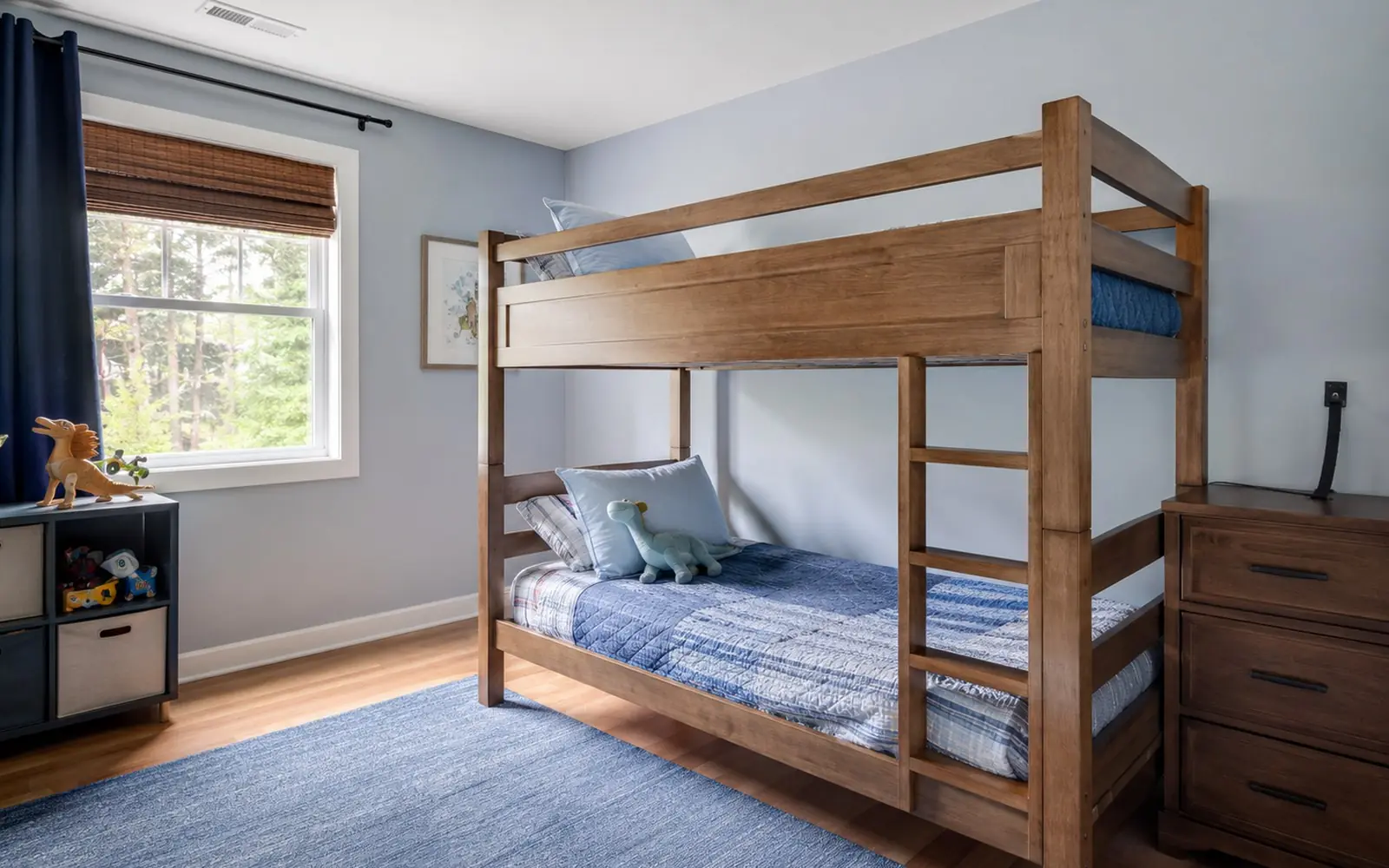
The bunk bed standard exists to reduce the risk that children die or are injured from being trapped between the upper bunk and the wall, in openings below guardrails, or in other structures in the bed.1 A bed counts as a bunk bed when the underside of any foundation is over 30 inches from the floor.1 The instructions must warn: do not allow children under 6 years of age to use the upper bunk.1
A bedroom set usually ships with a dresser, and that is a separate rule and a separate hazard. CPSC reports 44 percent of reported tip-over fatalities happened in bedrooms.6 On price, no manufacturer publishing prices for cribs, bunk beds or children's mattresses was reachable in this research, so this page gives dimensions and dates instead.
Six parts of a kids bedroom set, and what to measure
Most of these carry a federal standard, and several of those standards come down to a measurement you can take in the store.
Full-size cribs
Every full-size baby crib must comply with ASTM F1169-25, approved December 15, 2025.2 Full-size is a defined interior dimension, not a marketing word: 28 inches wide plus or minus 5 eighths, and 52 and 3 eighths inches long plus or minus 5 eighths, measured between the innermost surfaces of the crib.2
Portable cribs and play yards
Non-full-size cribs sit under a different part, 16 CFR 1220, which incorporates ASTM F406-24, approved on August 1, 2024.3 The covered subtypes are named in the rule: portable crib, crib pen, specialty crib, undersize crib and oversize crib.3 If a crib is not full-size, this is the standard to ask about.
Crib mattresses
A full-size crib mattress must measure at least 27 and a quarter inches wide and 51 and 5 eighths inches long, and with the test mattress sheet on it the corner gap must not exceed 3.15 inches.4 The incorporated standard is ASTM F2933-25, approved October 1, 2025.4 An aftermarket mattress that leaves a wider corner gap fails a federal standard.
Toddler and twin beds
A bed only becomes a bunk bed federally when the underside of any foundation is over 30 inches from the floor.1 Below that line the bunk bed rule does not apply. The lead paint ban does: it names beds as furniture articles and covers products manufactured after February 27, 1978.7 Older painted frames fall outside it.
Bunk beds and loft beds
Two guardrails, at least one on each side.1 One must be continuous, meaning any gap between the guardrail and end structure must not exceed 0.22 inches, to avoid finger entrapment.1 The other may stop short, with no more than 15 inches between either end and the nearest bed end structure.1 Where a ladder attaches, the continuous guardrail goes on the other side.1
The dresser that comes with the set
Clothing storage units manufactured after September 1, 2023 must comply with ASTM F2057-23.5 A matching set bought secondhand almost certainly predates that. Of the 16 furniture-related child tip-over deaths CPSC reported since January 1, 2020, 13 involved a chest, bureau or dresser.6 Anchor it to the wall on the day it arrives.
What does it cost?
There is no honest price on this page, because no manufacturer publishing prices for cribs, bunk beds, dressers or children's mattresses was reachable in the research behind it. That is the biggest single expense in a child's room and the one with no authoritative figure. The averages in circulation come from lead-generation aggregators with no published methodology.
What is worth knowing is where a cheap decision costs you something other than money. The 5 inch minimum guardrail height on a bunk is measured above the top surface of the mattress when a mattress of the maximum thickness specified by the bed manufacturer's instructions is on the bed.1 Swap in a thicker mattress and a compliant guardrail stops being compliant. The same logic applies in a crib, where a bargain mattress that leaves a corner gap over 3.15 inches fails the standard outright.4
Every figure above is a dimension or a date read from the Code of Federal Regulations, not a price; no crib, bunk bed or mattress price was obtainable from a manufacturer for this page.
How to hire for kids bed delivery and assembly
Who does the work
Usually the retailer's delivery crew, a handyman, or you. There is no federal license for bed assembly, and no one inspects the result. Bunk beds are where assembly errors turn into the exact hazards the standard names: gaps below guardrails and the space between the upper bunk and the wall.1 If the set includes a dresser, anchoring it is a separate task and crews differ on whether they do it.
What pros will ask
For a bunk or loft, expect questions about ceiling height, which side the ladder goes on, and the mattress you plan to use, because the manufacturer's maximum mattress thickness governs guardrail height.1 Expect a question about the ages of the children, since the instructions must carry a warning against children under 6 using the upper bunk.1 For a crib, expect a question about full-size or portable.
What to check before signing
Ask for the maximum mattress thickness in writing before you buy a mattress. On delivery, confirm both guardrails are fitted, that the continuous one is opposite the ladder, and that the warning label and instructions arrived with the bed.1 For any crib, ask which ASTM standard it was built to.2 For the dresser, ask for the manufacture date and get anchoring included in the job.
Related searches homeowners make
Pulled from the same demand data behind our Kids Rooms category.
Kids bed questions, answered straight
Can my five-year-old sleep on the top bunk?
The federal standard requires the bed's instructions to warn against it. The mandated wording is direct: do not allow children under 6 years of age to use the upper bunk.1 That is a requirement written into 16 CFR 1213, not a manufacturer's preference or a cautious opinion. The same part explains why the rule exists, which is to reduce or eliminate the risk that children die or are injured from being trapped between the upper bunk and the wall, in openings below guardrails, or in other structures in the bed.1
Is it legal to use or pass along a hand-me-down crib?
The crib rule is unusual in that it reaches used cribs directly. 16 CFR 1219 establishes a consumer product safety standard for new and used full-size baby cribs, and compliance applies to the manufacture, sale, contract for sale or resale, lease, sublet, offer, provision for use, or other placement in the stream of commerce, from June 28, 2011 onward.2 The currently incorporated standard is ASTM F1169-25, approved December 15, 2025.2 A crib passed between families is inside the rule, not outside it.
How tightly does a crib mattress have to fit?
There is a published number. A full-size crib mattress must measure at least 27 and a quarter inches wide and 51 and 5 eighths inches long, and when the mattress with the test mattress sheet is placed against the perimeter and in the corner of the crib, the corner gap must not exceed 3.15 inches.4 You can check that with a tape measure. The incorporated standard is ASTM F2933-25, approved October 1, 2025.4
Does a thicker mattress on a bunk bed cause a problem?
It can undo the guardrail. The rule sets the upper edge of the guardrails no less than 5 inches above the top surface of the mattress, measured when a mattress of the maximum thickness specified by the bed manufacturer's instructions is on the bed.1 A deeper mattress raises the sleeping surface without raising the rail, so the protected height shrinks. Find the maximum thickness in the bed instructions and buy to it, rather than buying the mattress first.
What does a kids bedroom set cost?
No source used for this page publishes one. No manufacturer with retrievable prices for cribs, bunk beds, dressers or children's mattresses was reachable, and the averages that dominate search results come from lead-generation sites with no stated methodology, so none of them appear here. What you can compare is what is specified: the crib standard on the label, the maximum mattress thickness for a bunk, and whether anchoring hardware and installation are included in the delivery price.
Where these facts came from
Every figure on this page was read out of the page linked below. We do not cite cost aggregators.
- 16 CFR 1213, safety standard for entrapment hazards in bunk beds
- 16 CFR 1219, safety standard for full-size baby cribs
- 16 CFR 1220, safety standard for non-full-size baby cribs and play yards
- 16 CFR 1241, safety standard for crib mattresses
- 16 CFR 1261, safety standard for clothing storage units (ASTM F2057-23)
- CPSC, Product Instability or Tip-Over Injuries and Fatalities Associated with Televisions, Furniture, and Appliances: 2023 Report
- 16 CFR 1303, ban on lead-containing paint and certain consumer products bearing it
Get quotes for your kids beds and bedroom sets project
Free for homeowners. No obligation. Up to four local pros compete.
Keep planning
More guides from the Kids Rooms hub.
Kids Bedding Sets
The federal rules land on the mattress and the bed, not the bedding, and that changes what is worth checking before you buy.
Read the guideKids Room Decorating and Decor
Published wallpaper and decal prices, the federal rule that governs repainting an older room, and what anchoring has to do with decor.
Read the guideKids Room Themes and Ideas
How to build a theme out of reversible materials with published prices, and which theme choices carry a real safety cost.
Read the guide