
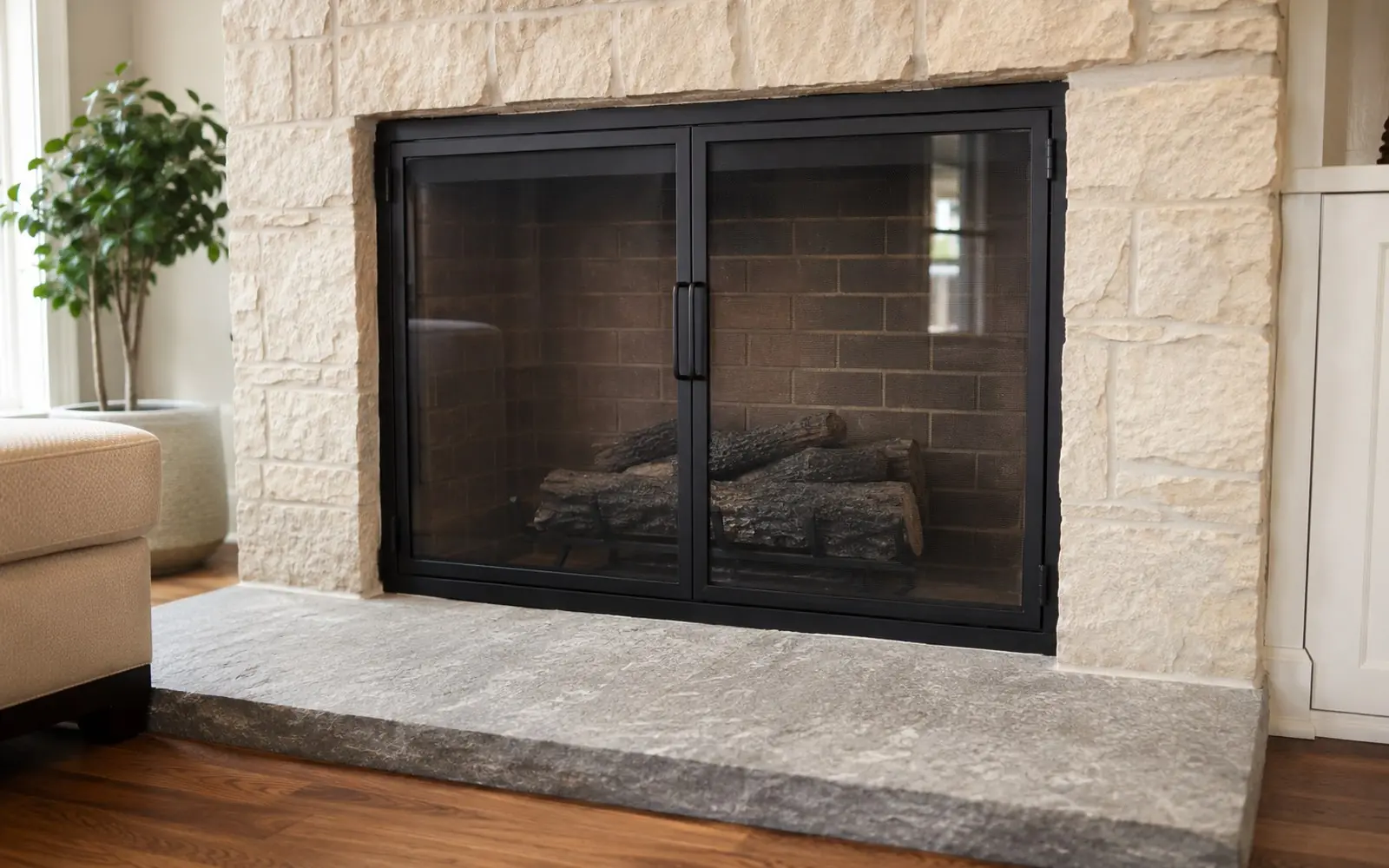
Fireplace Screens and Doors
Hearth extension dimensions, what a screen actually protects against, and how a door set affects the sweep.
The floor in front of the opening has published dimensions
Start on the floor, because that part is measurable. CSIA's Level 1 fireplace procedure states that if the fireplace opening is less than six square feet, the hearth extension should extend 16 inches to the front and 8 inches to each side, and that if the opening is 6 square feet or larger the extension should reach 20 inches to the front and 12 inches to each side1. Everything else about screens and doors is preference. That is not.
The trigger is the area of the opening, so measure before you shop. Height times width in inches, divided by 144, gives you square feet, and six is the line that changes the numbers1. A wide, low opening and a tall, narrow one can land on opposite sides of it. If your existing hearth already falls short, a new screen does not fix that, and fitting one does not make the shortfall go away.
Then be honest about what a screen is for. USFA reports that fires confined to chimneys, flues or fuel burners accounted for 77% of residential building heating fires3. Most of the problem is inside the chimney, where nothing you hang across the opening reaches it. Screens and doors address what leaves the firebox. Sweeping and inspection address what accumulates above it, and the two jobs do not substitute for each other.
What the sources say about the front of a fireplace
Six checks, from the hearth dimensions out to what a screen does not cover.
The small opening dimensions
For a fireplace opening less than six square feet, CSIA's procedure has the hearth extension reaching 16 inches to the front and 8 inches to each side1. Measure from the opening, and measure what is actually there now rather than what the fireplace looks like it should have.
The large opening dimensions
At 6 square feet or larger, the same procedure calls for 20 inches to the front and 12 inches to each side1. The jump is not proportional, it is a step. An opening a fraction over the line carries the bigger requirement, which is why the measurement is worth doing carefully.
Doors are accessible, not readily accessible
CSIA defines readily accessible as reached without tools or ladders, and accessible as possibly requiring the removal of a panel or door and the use of common hand tools such as a screwdriver or wrench2. A bolted door set sits in the second category. Expect it to be part of the conversation, not assumed.
Most heating fires never leave the chimney
Confined fires, meaning those confined to chimneys, flues or fuel burners, accounted for 77% of residential building heating fires3. A screen has no effect on that category. The measures that do are the annual inspection and sweeping at the 1/8 inch threshold CSIA sets for masonry fireplaces4.
Combustibles too close drives the rest
For the fires that did escape the appliance or chimney, USFA reports the heat source was too close to combustibles in 27% of nonconfined residential building heating fires3. That is a clearance problem, and a rug or a chair pulled up to the hearth is part of the same picture as the extension dimensions.
Do not let a screen stand in for an alarm
USFA reports that smoke alarms were present in 56% of nonconfined heating fires in occupied residential buildings3. Read that as a gap rather than a reassurance. A screen is a spark barrier. It is not detection, and it is not a substitute for anything that makes a noise.
What do fireplace doors and screens cost?
No source used for this guide publishes a price for a screen, a door set or hearth masonry. The standards material gives dimensions. The fire agencies give incident data. Neither gives money, and the federal wage tables are no help either, since the May 2025 national occupational employment and wage table lists no occupation containing the word chimney or sweep6. So the dimensions below are cited and the prices are simply absent.
Two things realistically move your number. The first is whether the hearth extension already meets the figure for your opening size, because falling short turns a shopping decision into masonry work1. The second is access: a complete chimney sweeping includes the chimney flue and smoke chamber4, so if your doors have to come off for that, find out now whether removal and refitting are inside the sweeping price or billed separately.
The dimensions above come from CSIA's Level 1 fireplace procedure. No source used here publishes a price for a screen, a door set or hearth work, so none is stated.
How to hire for fireplace doors or a screen
Who does the work
A freestanding screen is a purchase, not a trade. A fitted door set is usually a hearth retailer or a sweep. Extending a hearth is masonry. Those can be three different people, and the one who should confirm the result is the person doing your annual inspection, since correct clearances are named in the inspection language CSIA quotes4.
What pros will ask
The height and width of the opening, and therefore whether it is under or at least 6 square feet1. What the existing hearth extension measures to the front and to each side. What the floor is in front of it. Whether the fireplace is masonry or factory-built. And whether anything already fitted has to come off before a sweep can work4.
What to check before signing
Written measurements, not eyeballed ones, with the opening area stated. Confirmation that the door set can be removed for sweeping and who pays for that. And read the limits on any inspection you are relying on: CSIA states it does not warrant in any way whatsoever that adhering to its procedure will reveal every possible defect2.
Related searches homeowners make
Pulled from the same demand data behind our Fireplaces & Chimneys category.
Screen and door questions, answered straight
How far does the hearth need to extend in front of the fireplace?
It depends on the size of the opening. CSIA's Level 1 fireplace procedure states that if the fireplace opening is less than six square feet, the hearth extension should extend 16 inches to the front and 8 inches to each side, and that if the opening is 6 square feet or larger it should extend 20 inches to the front and 12 inches to each side1. Measure the opening rather than estimating it, since the two cases are a step apart and a small error moves you across the line.
Do glass doors protect against a chimney fire?
No source used for this guide says they do, and the fire data points the other way. USFA reports that fires confined to chimneys, flues or fuel burners accounted for 77% of residential building heating fires3. Those start and stay above the firebox, where a door at the opening is not the control. What addresses that category is the annual inspection and sweeping once buildup reaches the 1/8 inch threshold CSIA sets for masonry fireplaces4.
Will fitted doors get in the way of sweeping?
They can, and it is a fair question to ask before you buy. CSIA says a complete chimney sweeping includes the chimney flue and smoke chamber4, so the sweep needs real access through the opening. CSIA's own definitions put anything requiring a screwdriver or wrench in the accessible category rather than the readily accessible one2. Ask whether removing and refitting your doors is inside the sweeping price or an extra line on the invoice.
Is a screen enough on its own?
Treat it as one layer. USFA reports the heat source was too close to combustibles in 27% of nonconfined residential building heating fires3, which is a clearance problem a screen only partly addresses. The same report says smoke alarms were present in 56% of nonconfined heating fires in occupied residential buildings3. A screen stops sparks leaving the firebox. Alarms, clearance and an annual inspection do the rest of the work.
Does adding doors change what inspection I need?
The situations CSIA names for a Level 2 are about change and damage: a new appliance, a dissimilar replacement, a Level 1 that cannot settle serviceability, a property sale, planned lining or relining, and a fire, weather or seismic event5. A door set is not among them. If your installer says otherwise, ask which trigger they mean. And remember CSIA states that following its procedure does not warrant that every possible defect will be revealed2.
Where these facts came from
Every figure on this page was read out of the page linked below. We do not cite cost aggregators.
- CSIA, Level 1 Standard Operating Procedure, masonry fireplace
- CSIA, Level 1 Standard Operating Procedure, masonry chimney
- USFA, Heating Fires in Residential Buildings, Topical Fire Report Series
- CSIA, Homeowner Resources
- CSIA, Level 2 Standard Operating Procedure, masonry fireplace
- BLS, Occupational Employment and Wage Statistics, May 2025 national table
Get quotes for your fireplace screens and doors project
Free for homeowners. No obligation. Up to four local pros compete.
Keep planning
More guides from the Fireplaces & Chimneys hub.
Fireplace Logs, Tool Sets and Accessories
Why a certified rating comes from lumber not logs, where gas logs sit in EPA rules, and what actually triggers a sweep.
Read the guideChimney Caps
A cap sits at the top, and only the Level 2 procedure explicitly sends someone up there. Here is what to ask for.
Read the guideGas and Electric Fireplaces
What EPA rules do not cover, why a gas vent still gets an annual inspection, and where CPSC says CO alarms go.
Read the guide