
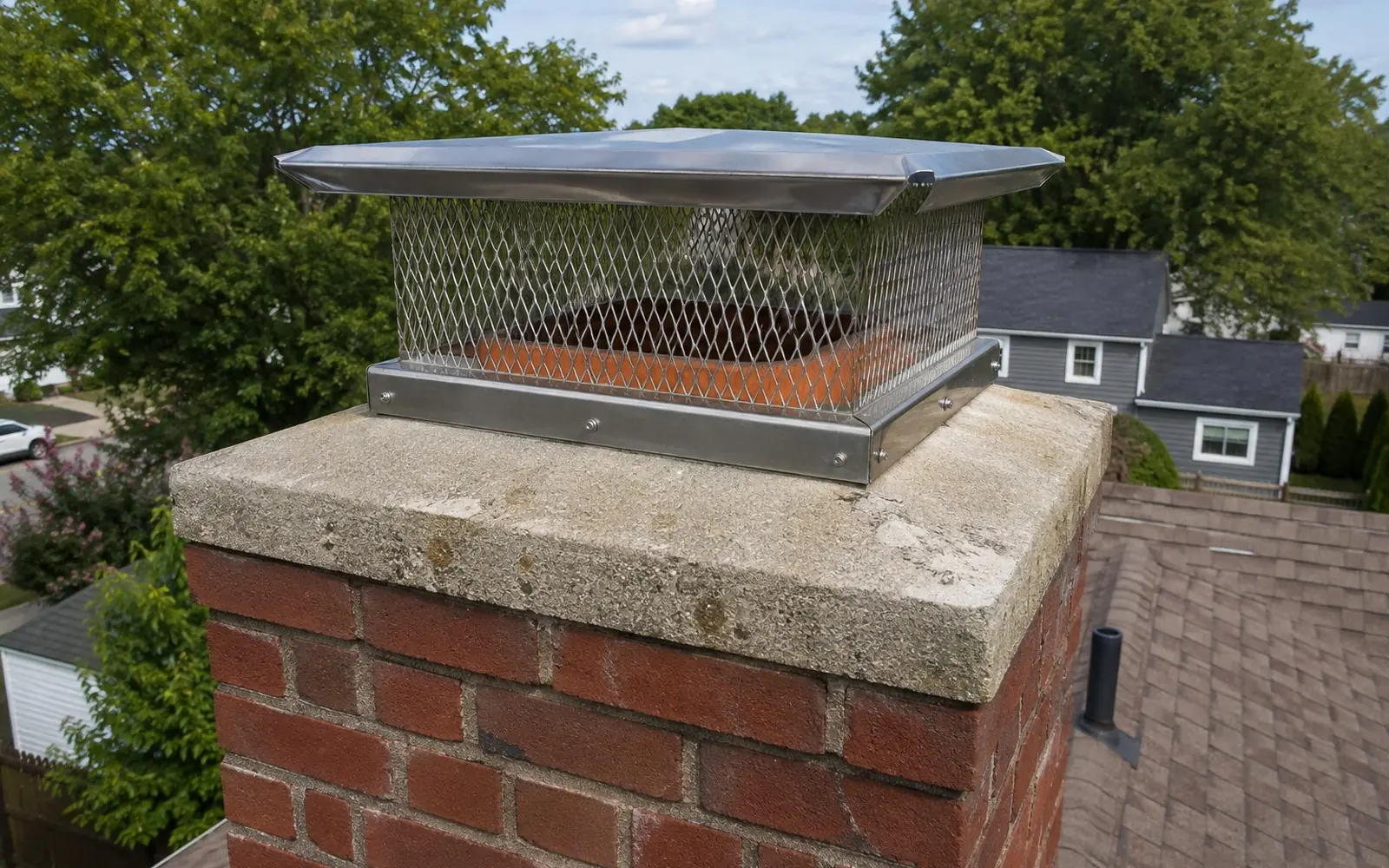
Chimney Caps
A cap sits at the top, and only the Level 2 procedure explicitly sends someone up there. Here is what to ask for.
Only one inspection level explicitly puts someone on the roof
A chimney cap is the hardest component to judge, because it is the one you cannot see. CSIA's Level 2 procedure is explicit: a Level 2 inspection will require that you go on the roof to investigate the chimney, and inspect the system within accessible attics, basements and crawl spaces2. The Level 1 procedure carries no such requirement. If nobody has been up, nobody has looked at your cap closely.
CSIA's access definitions explain why that matters. Readily accessible means quickly or easily reached, requiring no tools and no ladders. Accessible could require moving a panel or door, a ladder, or common hand tools such as a screwdriver or wrench. Neither one permits removing permanently attached components or destructive actions to the building1. So the top of a chimney is reachable in principle and easy to skip in practice. Ask what was actually reached, and read the report.
The events that damage a cap are also the events that call for the higher level. CSIA recommends a Level 2 after a building or chimney fire, a weather or seismic event, or any operating malfunction likely to have caused damage to the chimney2. A storm that takes a cap off is squarely in that list. Booking a routine visit after one asks the wrong question.
Six things that decide whether your cap gets checked
The cap is the component whose inspection depends most on access.
Level 2 says roof, in writing
CSIA's Level 2 procedure states the inspection will require going on the roof to investigate the chimney, and inspecting the system within accessible attics, basements and crawl spaces2. That is the only level in CSIA's published procedures that says so outright. If the cap is your question, that is the level to book.
Ladders sit on the accessible side of the line
CSIA's definitions put ladders and common hand tools under accessible, and exclude them from readily accessible1. Neither category permits removing permanently attached components or destructive actions to the building1. An inspection that never left the living room did not assess the top of your chimney.
Storm damage is a named trigger
A building or chimney fire, a weather or seismic event, or any operating malfunction likely to have caused damage to the chimney all appear in CSIA's list of situations calling for a Level 22. Those are exactly the events that dislodge or crush a cap. Match the level to the event.
Soundness is in the annual language
The sentence CSIA quotes from NFPA 211 asks that chimneys, fireplaces and vents be inspected at least once a year for soundness, freedom from deposits, and correct clearances3. Soundness is the structural word, and it covers the top of the stack as much as the firebox. Ask how it was judged up there.
A cap does not change the sweep threshold
CSIA still recommends sweeping masonry fireplaces at 1/8 inch of sooty buildup, and sooner if any glaze is present3. A complete chimney sweeping includes the chimney flue and smoke chamber3. A cap is not a maintenance shortcut, and USFA reports 77% of residential building heating fires were confined to chimneys, flues or fuel burners4.
More flues, more to check
CSIA says a Level 2 should include all flues within a chimney and their connected appliances2. A single stack can carry more than one flue, and a report naming only the fireplace flue has not covered the chimney. Ask for each flue listed separately in writing.
What does a chimney cap cost?
This one has no honest number. No government body and no trade association publishes a price for a chimney cap, supplied or fitted. Manufacturer and retailer list prices for the hardware exist, but none were captured for this guide, so quoting one would be guesswork dressed as research. There is no wage benchmark to reason from either: the May 2025 national occupational employment and wage table lists no occupation containing the word chimney or sweep5.
What genuinely moves the number is access and count. How many flues the stack carries, since a Level 2 should cover all of them and their connected appliances2. Whether someone is going on the roof anyway, which they are during a Level 22, so a cap discussed during a sale or reline inspection is not a separate trip. And whether the visit was triggered by a storm or a chimney fire, which puts you at Level 2 regardless2.
No source here publishes a price for a chimney cap, supplied or installed. Everything above is an inspection requirement from CSIA, or a statement that no wage data exists.
How to hire for a chimney cap
Who does the work
Roofers and chimney sweeps both get on roofs, and only one of them writes a chimney inspection report. A CSIA Certified Chimney Sweep earns the credential by completing a CSIA review and passing the exam6. CSIA also tells homeowners to ask for the inspection by name, and to find someone else if the sweep does not know the term3.
What pros will ask
How many flues the chimney carries, since a Level 2 should cover all of them2. Whether anything has come down the flue. Whether there has been a storm, a chimney fire or a seismic event, each of which is its own Level 2 trigger2. When the chimney was last inspected, and at what level. Whether the house is being sold, another trigger2.
What to check before signing
That the quote names a level and states plainly that the roof will be accessed2. That you get photographs of the top, not a verbal summary. That the report says what could not be reached. And note the limit CSIA puts on its own procedure: it does not warrant in any way whatsoever that following it will reveal every possible defect1.
Related searches homeowners make
Pulled from the same demand data behind our Fireplaces & Chimneys category.
Chimney cap questions, answered straight
Will a routine chimney inspection actually look at my cap?
Not necessarily, and the procedures show why. CSIA's Level 2 document states the inspection will require going on the roof to investigate the chimney2. Its Level 1 document carries no equivalent line, and CSIA's access definitions treat ladders as belonging to the accessible category rather than the readily accessible one1. So ask directly whether the roof will be accessed, and get the answer in the written report rather than in conversation.
My cap came off in a storm. What should I book?
A Level 2. CSIA lists a building or chimney fire, a weather or seismic event, and any operating malfunction likely to have caused damage to the chimney among the situations calling for a Level 2 inspection2. A storm that removed hardware from the top of your chimney fits that description. A Level 2 also requires video scanning of the chimney interior, and where size or multiple offsets make that impossible, the sweep is told to note it in the report2.
Does having a cap mean I can skip sweeping?
No, and the thresholds are unchanged by it. CSIA recommends sweeping masonry fireplaces at 1/8 inch of sooty buildup and sooner if there is any glaze present, and sweeping factory-built fireplaces when any appreciable buildup occurs3. A complete chimney sweeping includes the chimney flue and smoke chamber3. USFA reports that 77% of residential building heating fires were confined to chimneys, flues or fuel burners4, which is the part of the system a cap does not clean.
I have two flues in one chimney. Do I need two caps?
No source used for this guide states a rule about the number of caps, so this page will not invent one. What is stated is the inspection scope: a Level 2 should include all flues within a chimney and their connected appliances2. Get every flue inspected and listed separately, then let the findings decide the hardware. If a contractor quotes a cap without identifying how many flues you have, press that question.
Is the cap covered by the annual inspection?
The annual language CSIA quotes from NFPA 211 asks for chimneys, fireplaces and vents to be inspected once a year for soundness, freedom from deposits, and correct clearances3. Soundness plainly reaches the top of the stack. What it does not do is specify how close the inspector gets, and only the Level 2 procedure explicitly requires a roof visit2. Note too that CSIA's quotation is undated, so read it as CSIA's stated practice.
Where these facts came from
Every figure on this page was read out of the page linked below. We do not cite cost aggregators.
- CSIA, Level 1 Standard Operating Procedure, masonry chimney
- CSIA, Level 2 Standard Operating Procedure, masonry fireplace
- CSIA, Homeowner Resources
- USFA, Heating Fires in Residential Buildings, Topical Fire Report Series
- BLS, Occupational Employment and Wage Statistics, May 2025 national table
- CSIA, Certified Chimney Sweep credential
Get quotes for your chimney caps project
Free for homeowners. No obligation. Up to four local pros compete.
Keep planning
More guides from the Fireplaces & Chimneys hub.
Gas and Electric Fireplaces
What EPA rules do not cover, why a gas vent still gets an annual inspection, and where CPSC says CO alarms go.
Read the guideChimney Sweeps and Repair
The inspection and the sweep are two different jobs. Here is the buildup threshold, the inspection levels, and what a quote should name.
Read the guideFireplace Mantels
The two clearance numbers a mantel has to meet, where they come from, and what an inspector checks.
Read the guide