
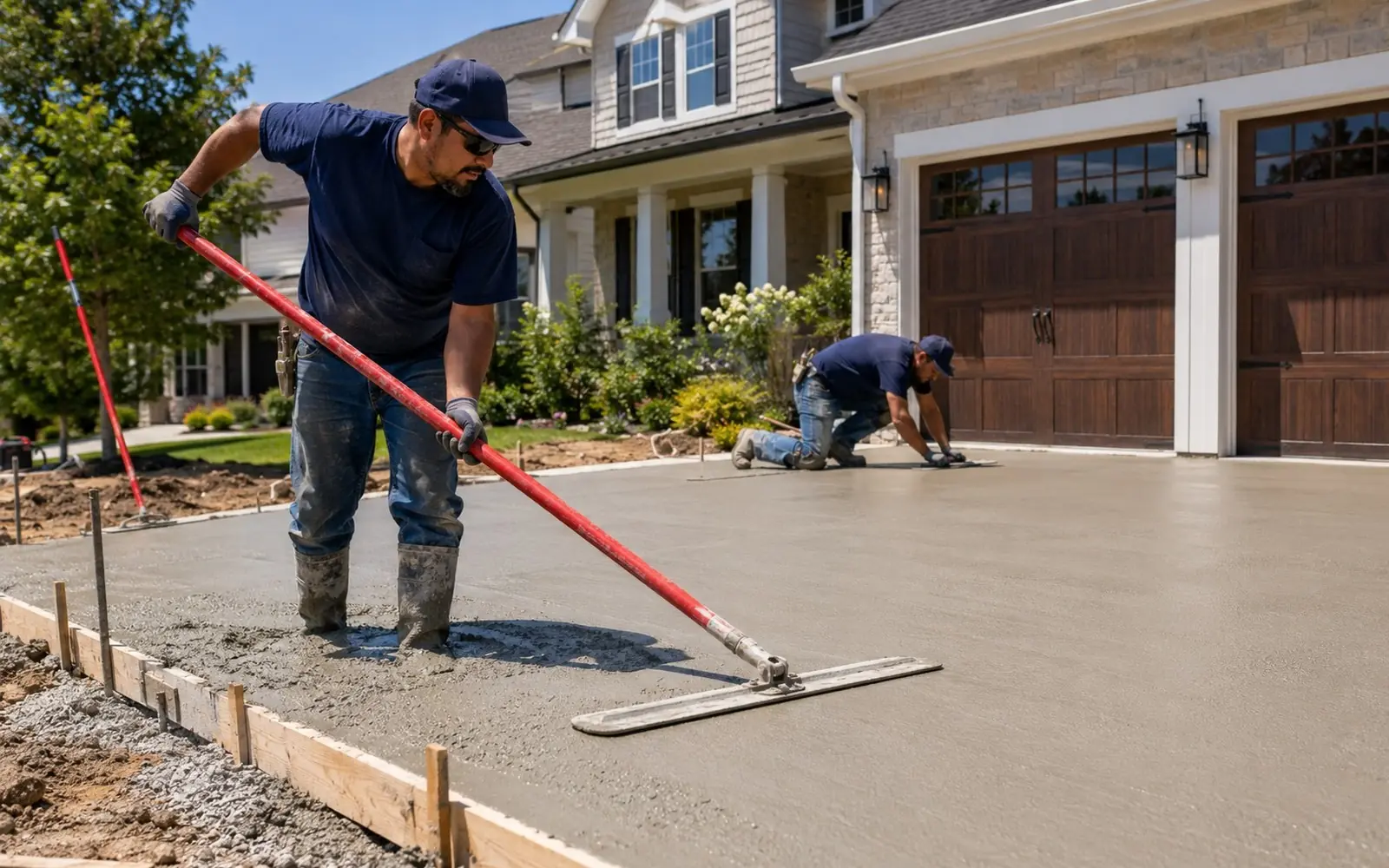
Concrete Driveways
The most visible slab you own. Thickness, base and joints decide whether it lasts ten years or forty.
Where most concrete contractor calls begin
Concrete contractor terms draw over twenty seven thousand tracked searches in our demand data, and the driveway is the job that starts more of those conversations than any other. It is a big, visible, permanent surface, and unlike interior work, every crack and settled corner shows from the street for decades.
A driveway that lasts is built from the ground up: organic soil out, gravel base compacted in lifts, four inches of concrete minimum for cars and more where trucks will park, reinforced with rebar or wire mesh, and control joints sawn or tooled on a sensible grid so the inevitable cracking happens on schedule and in straight lines. Concrete cracks; the whole craft is deciding where.
Replacement versus overlay is the other common fork. A slab with widespread cracking, settling or scaling past its surface is a tear-out. A structurally sound but ugly slab can often be resurfaced or overlaid for far less. An honest contractor will tell you which side of that line yours sits on, and a dishonest one will resurface a slab that is moving.
Driveway decisions that set the price
Get these into every quote so bids compare cleanly.
Thickness and reinforcement
Four inches with mesh or rebar is the residential standard; five to six inches where RVs or trucks park. Thickness is the last place to save money.
Base preparation
Excavation and compacted gravel carry the slab. Most driveway failures are base failures wearing a concrete costume.
Control joints
Sawn or tooled lines on roughly a 10 foot grid direct cracking. A slab poured without a joint plan writes its own random one.
Finishes and color
Broom finish is the traction default. Exposed aggregate, integral color and stamped patterns upgrade looks at added cost per foot.
Drainage and slope
Water must leave the slab and miss the garage. Slope, channel drains and downspout routing belong in the design conversation.
Tear-out and haul-away
Removing an old driveway is real money: breaking, loading and disposal. Confirm it is itemized rather than assumed.
What does it cost?
Commonly published ballparks put plain broom-finish concrete around $4 to $8 per square foot installed, which lands a typical two-car driveway in the $3,000 to $7,000 band before tear-out. Decorative finishes, thicker sections and poor access push higher; stamped work commonly runs $12 to $18 per square foot.
Concrete needs about a week before cars and a month to reach full strength. A contractor who invites you to park on day two is telling you something.
Ballparks based on commonly published national averages, stated as assumptions, not measured local pricing. Your competing quotes set the real number for your home and ZIP.
How to hire for concrete driveway work
Who does the work
Concrete contractors, sometimes called flatwork contractors, do driveways daily. Big pours need a crew and a pump or chute plan, not a lone handyman. Where the driveway meets the public sidewalk or apron, many towns require a permit and their own spec.
What pros will ask
Square footage and shape, what vehicles will park on it, the state of the existing surface, and drainage behavior in storms. Photos and a rough measurement get you realistic numbers before the site visit refines them.
What to check before signing
That the quote states thickness, reinforcement, base depth and joint layout in writing, not just square footage and price. That curing method and time before use are spelled out. And that tear-out, haul-away and apron permits are itemized. Skimping happens in the invisible layers.
Related searches homeowners make
Pulled from the same demand data behind our Concrete and Masonry category.
Concrete Driveways questions, answered straight
How thick should a concrete driveway be?
Four inches of concrete over a compacted gravel base is the common residential standard, with five to six inches recommended where trucks, trailers or RVs will sit. Reinforcement with mesh or rebar is cheap insurance against crack separation either way.
How long before I can drive on new concrete?
Common guidance: keep foot traffic off for a day or two, cars off for about a week, and heavy vehicles off for a month while the slab builds strength. Concrete reaches most of its design strength around 28 days after the pour.
Why do concrete driveways crack, and is it a defect?
Concrete shrinks as it cures and moves with the soil, so hairline cracking is expected behavior, which is why contractors cut control joints to steer it. Wide, offset or spreading cracks are different: those point to base or reinforcement problems worth a professional look.
Concrete or asphalt for a driveway?
Concrete costs more upfront and typically lasts decades longer with minimal upkeep. Asphalt is cheaper to install, needs periodic sealing, and suits freeze climates where its flexibility helps. In hot-sun regions concrete's reflectivity and stability usually win the math.
Should I seal my concrete driveway?
In freeze-thaw and deicing-salt climates, a penetrating sealer every few years meaningfully slows surface scaling. In mild climates it is optional maintenance. Either way, avoid deicing salts the first winter while the surface is young.
Get quotes for your concrete driveway project
Free for homeowners. No obligation. Up to four local concrete and masonry pros compete.
Keep planning your concrete or masonry project
More guides from the Concrete and Masonry hub.
Stamped and Decorative Concrete
Stamped patterns, stains, overlays and coating budgets.
Read the guideConcrete Patios, Walkways and Pavers
Slabs, pavers and stone paths, plus the base rules under all three.
Read the guideConcrete Foundation Repair
Crack triage, piers, lifting and when to call an engineer.
Read the guide