
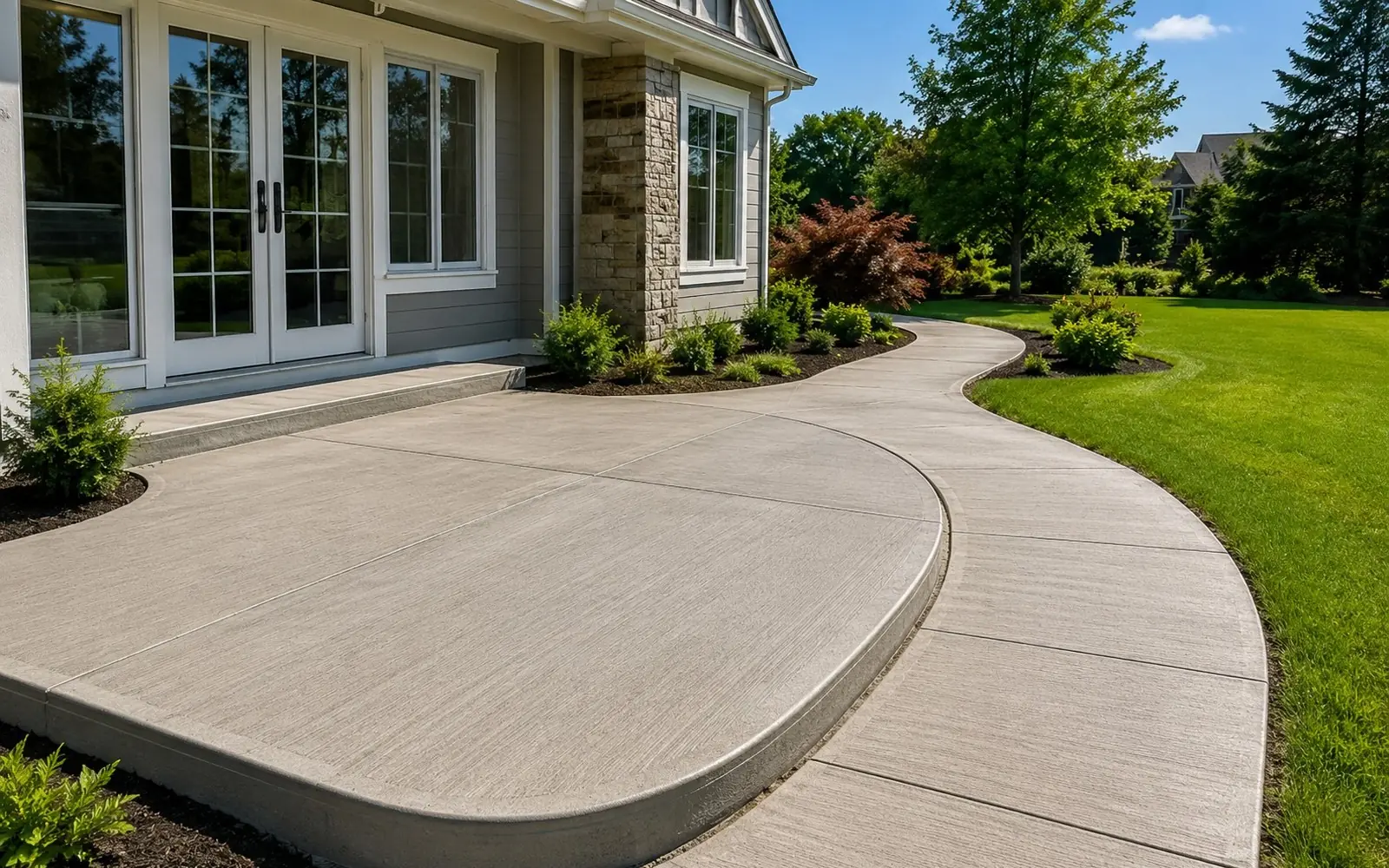
Concrete Patios, Walkways and Pavers
Flatwork you live on: patios, paths and paver hardscapes, and the base preparation that decides how they age.
Everyday flatwork, from path to patio
Between concrete patios, sidewalks, pavers and paving stones, our demand data shows well over ten thousand tracked searches for ground-level hardscape. It is approachable work with visible payoff: a patio extends the living space, a walkway fixes the muddy path everyone actually walks, and pavers dress both up.
The material fork is the same one driveways face, with lighter loads. Poured concrete is the value answer for patios and walks, plain or stamped. Concrete pavers cost more upfront and repay it in repairability: individual units lift and re-bed when soil moves, where a slab would crack. Brick pavers and natural stone push looks and price higher again. Every one of them stands or falls on excavation, compacted base and drainage pitched away from the house.
Walkways have their own quiet rules: at least three feet wide for a main path, four where two people should pass, gentle grades instead of surprise single steps, and lighting where evening use is real. Cities often regulate public sidewalk sections and may share replacement cost; check before paying for the whole strip.
Surface options for patios and paths
Loads are light; soil movement and water are the real enemies.
Poured concrete patios
The value baseline, broom finished or stamped. Control joints and base compaction are the difference between decades and disappointment.
Concrete pavers
Interlocking units over compacted gravel and sand. Premium look, immune to slab cracking, and repairable one paver at a time.
Brick pavers
Clay brick's warmth and permanence, laid in classic patterns. Costs above concrete pavers; colorfast for the life of the surface.
Natural stone
Flagstone and bluestone at the top of the market. Dry-laid or mortared by crews with real stone experience.
Walkways and steps
Width, grade and lighting decide whether a path gets used. Steps want consistent riser heights, and codes apply above a few risers.
Edging and drainage
Paver fields need restrained edges, and every surface needs water routed away from foundations. The invisible third of a good quote.
What does it cost?
Commonly published ballparks: poured concrete patios and walks around $6 to $12 per square foot, stamped $12 to $18, concrete pavers $10 to $25 and natural stone $15 to $30 or more. A typical 12 by 14 patio therefore spans roughly $1,000 in plain concrete to $5,000 or more in premium pavers.
Tear-out of old surfaces, added base depth on soft soils and curves versus straight lines all move the number. Itemized quotes keep those visible.
Ballparks based on commonly published national averages, stated as assumptions, not measured local pricing. Your competing quotes set the real number for your home and ZIP.
How to hire for patio and walkway work
Who does the work
Concrete contractors handle poured work; hardscape and landscape construction crews specialize in pavers and stone. Many do both, but portfolios reveal which one is home turf. Public sidewalk sections often require the city's spec and permit.
What pros will ask
Square footage, the surface you are replacing if any, soil and drainage behavior, and pattern or finish preferences. For pavers, ask about base depth and edge restraint; for concrete, joints and reinforcement. The answers tell you who plans and who just pours.
What to check before signing
That base depth and compaction are written into paver quotes, and reinforcement and joint layout into concrete ones. That slope pitches water away from the house at a stated grade. And that polymeric sand, sealing and haul-away are itemized rather than assumed.
Related searches homeowners make
Pulled from the same demand data behind our Concrete and Masonry category.
Concrete Patios, Walkways and Pavers questions, answered straight
Pavers or a poured patio: which is the better buy?
Poured concrete wins on day-one price; pavers win the long game on soils that move, because individual units re-level instead of cracking. If your area freezes hard or your soil is expansive clay, the paver premium is usually the cheaper decade.
How much does a small walkway cost?
A straightforward 3 by 30 foot concrete path commonly lands around $600 to $1,200 at typical per-foot rates, with pavers roughly double. Curves, steps, demolition and lighting add from there. Small jobs also carry minimum-visit pricing, so bundling flatwork saves money.
What keeps pavers from shifting and growing weeds?
Compacted base in lifts, a proper sand setting bed, solid edge restraints and polymeric sand swept into the joints. Weeds root in joints from above, not below, and polymeric sand plus an occasional refresh keeps them out. Skipped edges are why cheap paver jobs splay apart.
Who is responsible for the public sidewalk in front of my house?
It varies: many cities put repair responsibility on the homeowner but control the spec and permit, and some share costs for tree-root damage. Call the city before hiring, because pouring a public section out of spec can mean doing it twice.
Can a new patio go over my old cracked one?
Sometimes. Sound-but-ugly concrete can take an overlay or even pavers laid over it with proper edge and height management. A slab that is settling, heaving or widely cracked is a tear-out, because whatever moves below moves the new surface above.
Get quotes for your patio or walkway project
Free for homeowners. No obligation. Up to four local concrete and masonry pros compete.
Keep planning your concrete or masonry project
More guides from the Concrete and Masonry hub.
Concrete Foundation Repair
Crack triage, piers, lifting and when to call an engineer.
Read the guideConcrete Cutting, Breaking and Resurfacing
Demo, sawing, coring and the overlay alternative to tear-out.
Read the guideBrick and Stone Masonry
Veneer, garden walls, tuckpointing and mortar matching.
Read the guide