
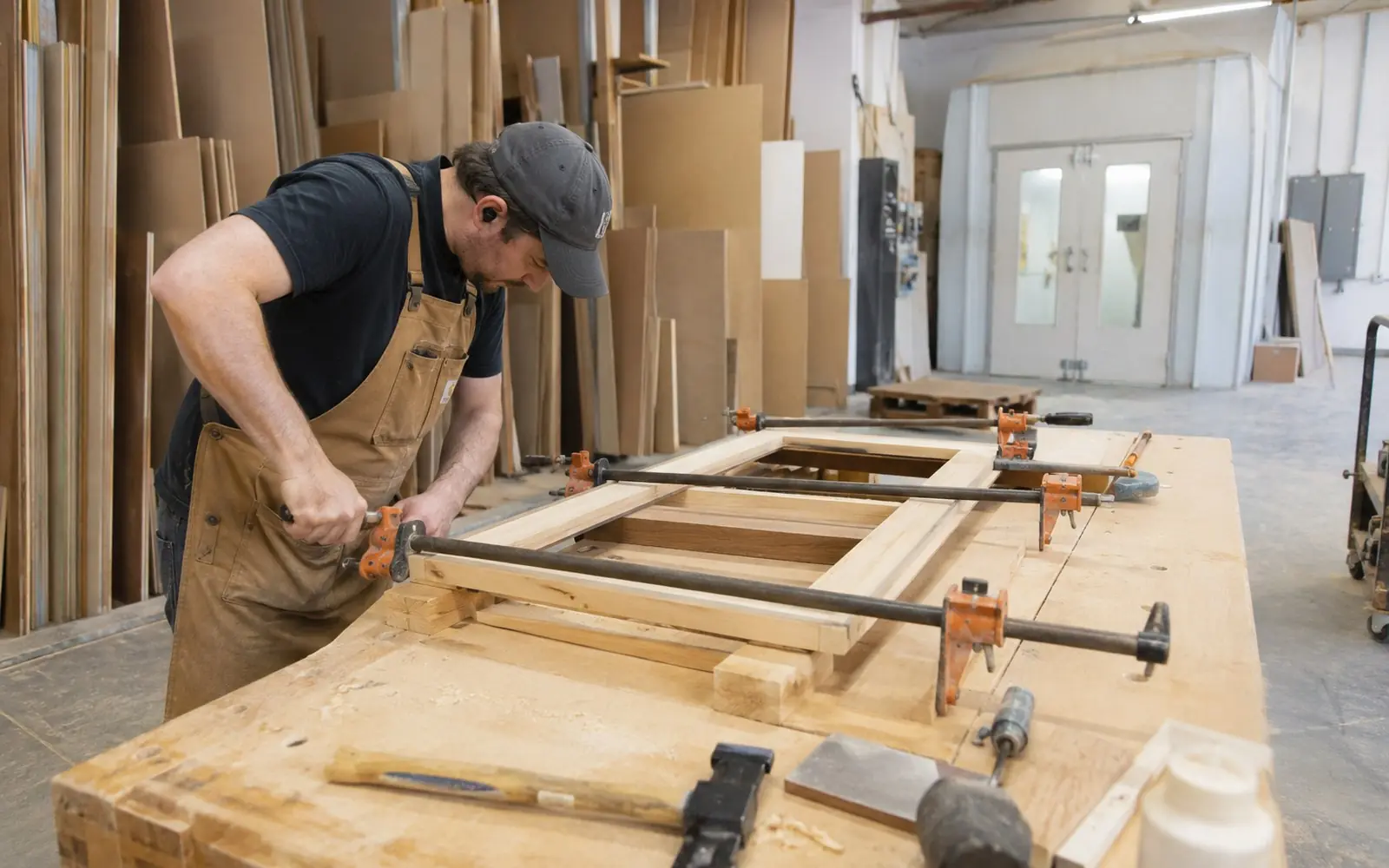
Custom Cabinet Makers
How to tell a real shop from a rebadged box, what to settle before you pay a deposit, and what the trade actually earns.
Custom means built for your room, not just built to order
The word custom does a lot of work in cabinet marketing. It can mean a shop that draws, mills, assembles and finishes your cabinets from sheet stock. It can also mean a dealer who orders modified sizes from a factory. Both are legitimate. They are not the same purchase, and only one of them can solve an odd corner.
The trade is small. The federal wage survey counts 77,170 cabinetmakers and bench carpenters nationally, against 670,090 site carpenters12. That scarcity is the reason a good shop has a queue and the reason the queue is worth joining.
This guide is about evaluating a shop: whether it builds, how it finishes, what drawings you should see before money moves, and who ends up installing. It also says plainly where no source exists, which includes lead times and deposit norms.
Six things to establish about any cabinet shop
Work through these in order. The first one changes the meaning of every answer after it.
Does the shop actually build
Ask to see the shop, not a showroom. Some businesses selling custom cabinetry are dealers who order from a factory and sub out the install. KCMA, founded in 1955, counts almost 300 member companies across North America who manufacture kitchen, bath and other residential cabinets, which is one way to separate makers from resellers3.
What the shop can machine
Capability sets the price and the possible. A shop with a panel saw, an edgebander and a CNC handles frameless work efficiently. A bench shop with a shaper and a wide belt sander does frame and panel doors in house. Ask which parts are made there and which are bought in, because most shops buy doors.
How it finishes
Finish quality separates shops more than joinery does. A sprayed catalyzed finish applied in a booth, under controlled temperature and dust, is a different product from a coating brushed on in your kitchen. Ask where the finish is applied, what the product is, and whether the interiors are finished too.
Drawings you sign before cutting
You should see elevations and a plan showing every cabinet, its dimensions, door swings, filler locations, appliance openings and toe kick heights. Sign them. Once a shop cuts, changes cost money because the material is already committed. Vague drawings are the single most common source of a bad custom job.
Site measure and template
A shop should measure the room itself rather than working from your numbers, and should measure again after demolition, when the real walls are exposed. Whoever takes the final measurement owns the fit. Get it in writing which party that is, because it decides who pays if a run comes out long.
Who installs, and under whose license
Installing is finish carpentry and often a separate crew. In California the same C-6 classification covers making and installing: it describes a contractor who fabricates cabinets and millwork and then places, erects and finishes them in structures6. Confirm which entity holds the contract and the license.
What does it cost?
No price for custom cabinetry was found in any government, association or manufacturer source, in any unit. Not per linear foot, not per box, not per kitchen. Home center pages block automated access and no shop publishes a fetchable list, so the tier ladders in circulation come from sites that state no methodology. The one real anchor is new construction: NAHB's builder survey puts cabinets and countertops at $19,056 per single family home, 4.5 percent of construction cost, on usable responses from 41 builders8.
The labor side is public and it is revealing. Cabinetmakers and bench carpenters run from $17.14 an hour at the 10th percentile to $30.64 at the 90th, a spread of $13.50, with a median of $22.441. Site carpenters run $19.43 to $48.03, a spread of $28.602. The whole cabinetmaking scale is compressed, and its 90th percentile sits below the 75th percentile for site carpenters at $36.9412. Those are employee wages, not shop billing rates, and no published multiplier between the two exists, so do not treat them as a quote.
Figures come from the BLS OEWS 2025 public API and NAHB's 2024 construction cost survey. They are wages and new construction line items, not prices for custom cabinetry, which no source found publishes.
How to hire a custom cabinet maker
Who does the work
Cabinetmakers and bench carpenters are a distinct federal occupation with 77,170 people in it, separate from the 670,090 site carpenters who install12. A shop may employ both, or may build only and hand off. California licenses the combined trade as C-6, covering cabinets, cases, sashes, doors, trims and nonbearing partitions6.
What pros will ask
Your layout and appliance list with model numbers, since panel ready appliances change the cabinet entirely. Face frame or frameless, and your overlay. Species, door style and finish. Whether the floor goes in before or after. Whether there is an island, and how power reaches it. And your realistic date, which is usually the constraint.
What to check before signing
Signed elevations and a plan, a written finish specification, and named hinge and slide brands. A payment schedule tied to milestones rather than dates. Who measures after demolition. In California, verify the license number and note that the unlicensed exemption is $1,000 for the aggregate price of labor and materials, and only when no building permit is required7.
Related searches homeowners make
Pulled from the same demand data behind our Carpentry & Cabinets category.
Custom cabinet questions, answered straight
What actually makes a shop custom?
The test is whether they can build a cabinet that does not exist in a catalog. A true custom shop starts from your dimensions, so an odd corner, a sloped ceiling or a 41 inch gap is just a drawing. A dealer selling modified factory boxes works from a size grid, filling anything left over with a filler strip. Ask directly: can you build any width, and where is it built. The answer tells you which purchase you are making.
How long do custom cabinets take?
This guide cannot tell you, and it will not guess. No government, association or manufacturer source publishes lead times for custom cabinetry, so any range quoted elsewhere is somebody's impression. Ask each shop for its current lead time in writing, ask what it was six months ago, and ask what happens to your slot if you change the drawings after signing. Lead time is often the real constraint on a kitchen project, more than price.
What deposit is normal?
No authoritative source publishes a customary deposit, so treat any figure you are quoted as a negotiation rather than a standard. What you can control is the structure. Tie payments to milestones you can verify: drawings signed, material purchased, boxes assembled, finish complete, delivery, and a final payment after the punch list is closed. Keep a meaningful amount for that last stage, because the last five percent of a cabinet job is where the fit and finish problems surface.
Do cabinet makers need a license?
It depends on the state, and there is no verified national picture. California licenses the trade specifically as C-6, covering making and installing cabinets, cases, sashes, doors, trims and nonbearing partitions6. California also sets the unlicensed threshold at $1,000 for the aggregate contract price of labor and materials, and only where the work requires no building permit7. Splitting a larger job into smaller contracts to stay under that does not work7. Check your own state board rather than trusting a summary.
Is now a good time to order custom cabinets?
Manufacturer demand is soft, which usually helps a buyer. KCMA runs a monthly Trend of Business survey of participating cabinet companies, managed by an independent third party research firm, and has done so for over 20 years4. Members reported overall cabinet sales down 3.5 percent in April 2026, 8.4 percent in May and 2.8 percent in June, each against the same month a year before5. That measures manufacturers, not local custom shops, so use it as context rather than a forecast for your quote.
Where these facts came from
Every figure on this page was read out of the page linked below. We do not cite cost aggregators.
- BLS OEWS 2025, Cabinetmakers and Bench Carpenters (SOC 51-7011), public API series
- BLS OEWS 2025, Carpenters (SOC 47-2031), public API series
- Kitchen Cabinet Manufacturers Association, about the association
- KCMA, Trend of Business program description
- KCMA, June 2026 Trend of Business report
- CSLB, C-6 Cabinet, Millwork and Finish Carpentry classification
- California Business and Professions Code section 7048
- NAHB, Cost of Constructing a Home in 2024
Get quotes for your custom cabinet makers project
Free for homeowners. No obligation. Up to four local pros compete.
Keep planning
More guides from the Carpentry & Cabinets hub.
Storage and Filing Cabinets
Built-in storage is carpentry, filing cabinets are furniture, and knowing which one you want changes who you call.
Read the guideCabinet Knobs, Hinges and Hardware
The cheapest part of a cabinet to change and the one you touch every day, plus how to specify it so quotes compare.
Read the guideCarpenters and Carpentry Projects
What carpenters build, what federal wage data says about the trade, and which jobs need a license or a permit.
Read the guide