
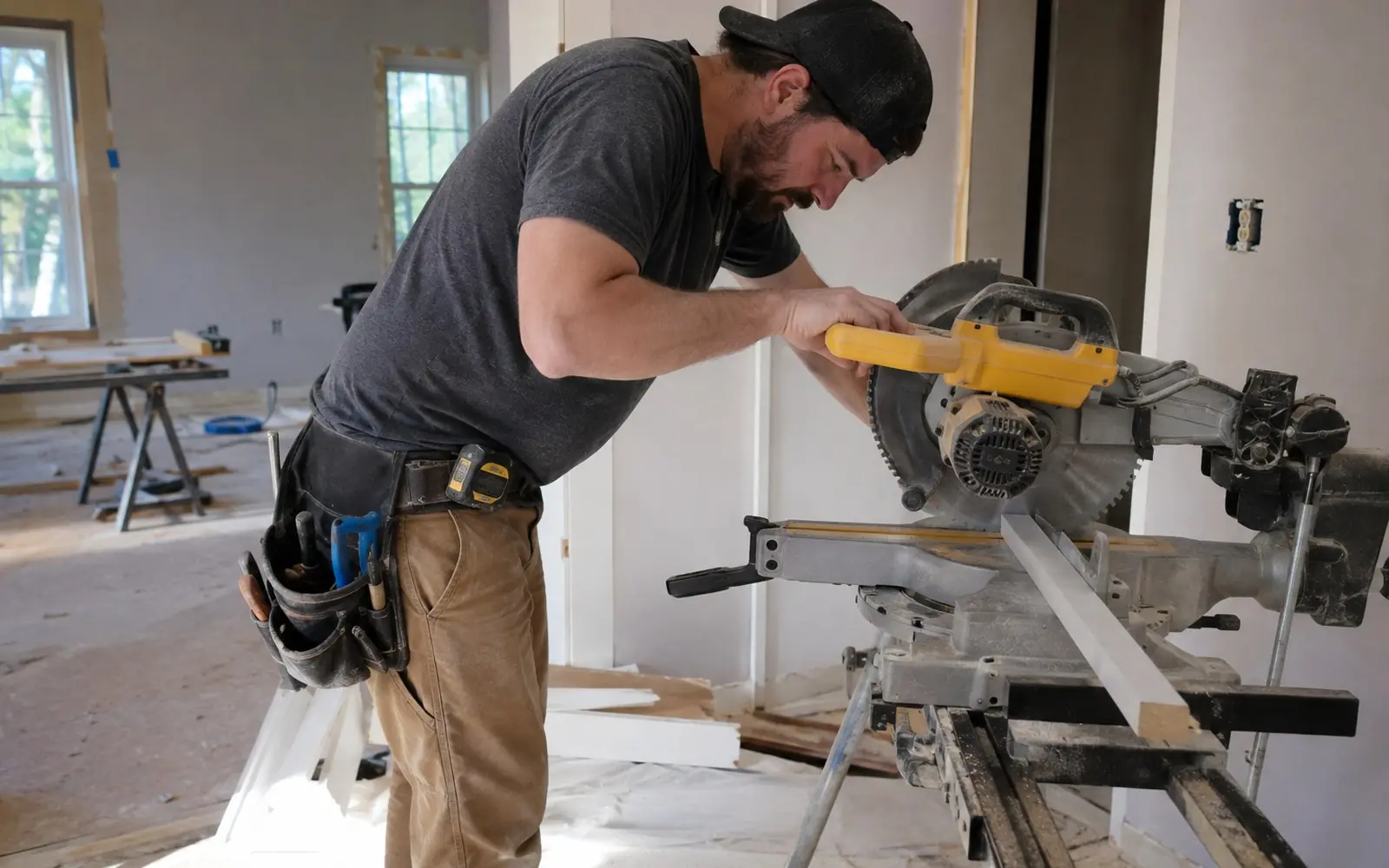
Carpenters and Carpentry Projects
What carpenters build, what federal wage data says about the trade, and which jobs need a license or a permit.
Carpentry is really two trades, and they are not paid alike
The word carpenter covers two jobs that share a name and little else. One person frames walls, sets trusses and sheathes a roof. Another hangs doors, runs crown molding, builds a bookcase into an alcove and scribes a cabinet run to a wall that is not straight. Both are carpentry. They use different tolerances, different tools and, on most jobs, different people.
The federal government splits them too. The Bureau of Labor Statistics counts Carpenters as one occupation, 670,090 employed, and Cabinetmakers and Bench Carpenters as a separate one, 77,170 employed12. Site carpenters earn a mean of $31.55 an hour. Shop cabinetmakers earn a mean of $23.2212. That gap is worth knowing before you assume one quote covers both kinds of work.
This guide covers what carpenters actually do, what the wage data can and cannot tell you about a quote, when the work needs a permit, and the one state that licenses this trade by name. Where no authoritative source publishes a number, that is said plainly rather than filled in.
Six kinds of work that all get called carpentry
Different projects, different skills, and often different contractors, so name the one you actually want.
Framing and structural work
Walls, floors, roofs and trusses. This is the biggest carpentry line in a new house by a wide margin, at $70,982 or 16.6 percent of construction cost, of which framing proper is $49,763 and trusses $12,9033. On a remodel it is the part most likely to trigger a permit and an inspection.
Interior trim and molding
Baseboard, casing, crown, chair rail, wainscot and window stool. Tolerances here are measured in fractions of a sixteenth because every joint is visible. In new construction, interior trims, doors and mirrors run $12,920, or 3.0 percent of the cost of the house3.
Doors and nonbearing partitions
Hanging prehung and slab doors, building out a closet, framing a nonbearing wall to split a room. California treats this as the same trade as cabinetry: the C-6 scope explicitly covers doors, trims and nonbearing partitions alongside cabinets and millwork6. Hire one person for both.
Cabinet and millwork installation
Setting boxes level and plumb in a room that is neither, shimming, scribing fillers, aligning door reveals and fastening to studs. This is a finish carpentry skill and it is separate from building the cabinets. The installer and the maker are often two different businesses.
Built-ins and custom storage
Bookcases, window seats, mudroom lockers, closet systems and bench tops fitted to a specific opening. Some of it is shop-built and delivered, some is cut and assembled in place. No government or trade source publishes a price for built-in shelving in any unit, so quotes here vary widely by design.
Exterior trim and deck repair
Fascia, soffit, siding patches and deck boards. Austin exempts repair or replacement of wood fascia, trim and soffits from permits, along with siding under 128 square feet and nonstructural deck repair limited to the existing boards5. Guardrails and handrails are outside that exemption.
What does it cost?
No government agency, trade association or manufacturer publishes an installed price for carpentry work. Not per hour billed, not per linear foot of trim, not per door hung. What is published is what carpenters are paid. Employed carpenters earn a mean of $31.55 an hour and a median of $29.12, with the 10th percentile at $19.43 and the 90th at $48.031. That is a wage, not a rate a contractor charges you. It excludes payroll tax, insurance, vehicles, tools, overhead and profit, and no published source gives the multiplier between the two, so do not treat $31.55 as a quote.
Two anchors are real. In new construction, NAHB's builder survey puts framing at $70,982 and interior trims, doors and mirrors at $12,920 in a house averaging 2,647 square feet and $428,215 to build, about $162 per square foot3. That survey drew usable responses from 41 builders, and NAHB says it is not a perfect tool for a particular house in a particular location3. For remodels, the Census Bureau and HUD report a median spend of $6,500 across all improvements and $3,000 on flooring, paneling and ceiling tiles4. Framing is also moving: it fell from 20.5 percent of construction cost in 2022 to 16.6 percent in 2024, the lowest since 20133.
Figures come from the BLS OEWS 2025 public API, NAHB's 2024 construction cost survey and the Census Bureau and HUD 2023 American Housing Survey. Wages are what workers earn, not what firms bill, and none of these figures is an installed project price.
How to hire for carpentry work
Who does the work
Framers, finish carpenters and cabinet installers are usually different crews even inside one company. Most states do not license carpentry as its own trade, and no source verified here maps all fifty, so check your own state board rather than assuming. California is the clear exception: it licenses cabinet, millwork and finish carpentry as classification C-6, covering cabinets, cases, sashes, doors, trims and nonbearing partitions6.
What pros will ask
Whether anything structural moves, because that changes the permit answer. Whether material is paint grade or stain grade, since stain grade demands tighter joints and matched grain. Whether walls are plaster, drywall or masonry. Whether you have the finished flooring in yet, which sets base and toe kick heights. And who supplies the material, you or them.
What to check before signing
In California, confirm the license number against the CSLB record. The exemption threshold is $1,000 for the aggregate contract price of labor and materials, not the $500 still printed in many places, and it applies only when the job needs no building permit7. Splitting a larger job into sub-$1,000 contracts to dodge it does not work7. Elsewhere, ask for proof of liability insurance and workers' compensation in writing.
Related searches homeowners make
Pulled from the same demand data behind our Carpentry & Cabinets category.
Carpentry questions, answered straight
How much does a carpenter charge per hour?
Nobody official publishes that. What is published is what carpenters are paid as employees: a mean of $31.55 an hour, a median of $29.12, ranging from $19.43 at the 10th percentile to $48.03 at the 90th1. A contractor's billing rate has to cover payroll taxes, insurance, vehicles, tools, unbilled hours and profit on top of that wage, and no source found publishes the multiplier. Anyone quoting you a national hourly rate for hiring a carpenter is estimating, not citing.
Do I need a licensed carpenter?
It depends entirely on your state, and there is no verified national picture. California licenses this work specifically as C-6, cabinet, millwork and finish carpentry6. California also sets the unlicensed threshold at $1,000 for the aggregate price of labor and materials, and only when the work requires no building permit7. Many states do not license carpentry as a separate trade, but that claim was not verified board by board, so check yours directly rather than trusting a summary.
Do I need a permit to install trim or cabinets?
Usually not, though it is local. Austin's exempt list names painting, papering, tiling, carpeting, cabinets, countertops and similar finish work outright, in both its residential and commercial lists5. Austin also exempts drywall repair under 128 square feet, floor decking repair under 128 square feet, and replacing exterior wood fascia, trim and soffits5. Exempt work still has to meet the building code. Move a wall, change the structure or relocate plumbing and the answer flips.
Why does carpentry cost so much more in some states?
Because wages differ by roughly 1.6 times across the country. Carpenters' annual mean wage runs from $80,320 in Illinois, $79,680 in Massachusetts and $78,810 in California down to $50,990 in Texas and $49,280 in Mississippi1. Illinois against Mississippi is a 1.63 times spread on the same federal survey. Any single national carpentry number averages across that, which is why national estimates rarely match your local quotes.
What does a permit cost if my job needs one?
Local schedules vary, and the stacking matters more than the headline number. Rockville, Maryland charges a $142 minimum residential permit fee, alterations at $0.28 per square foot of affected area, a $142 filing fee for work other than new construction, and a 10.25 percent automation fee on all permit and application fees8. A 200 square foot alteration prices at $56 by area, so the $142 floor applies and the other two land on top.
Where these facts came from
Every figure on this page was read out of the page linked below. We do not cite cost aggregators.
- BLS OEWS 2025, Carpenters (SOC 47-2031), public API series
- BLS OEWS 2025, Cabinetmakers and Bench Carpenters (SOC 51-7011), public API series
- NAHB, Cost of Constructing a Home in 2024
- U.S. Census Bureau and HUD, 2023 American Housing Survey home improvements
- City of Austin, work exempt from building permits
- CSLB, C-6 Cabinet, Millwork and Finish Carpentry classification
- California Business and Professions Code section 7048
- City of Rockville, MD, FY2026 Inspection Services Division fee schedule
Get quotes for your carpenters and carpentry projects project
Free for homeowners. No obligation. Up to four local pros compete.
Keep planning
More guides from the Carpentry & Cabinets hub.
Cabinet Construction and Materials
How a cabinet box is actually built: frames, sheet goods, joinery and hardware, and the questions that expose a cheap one.
Read the guideCabinet Doors and Refacing
How doors are built, what refacing physically involves, and why no honest source publishes a price for either.
Read the guideBathroom Vanities and Medicine Cabinets
Swapping a vanity in place is finish work. Moving the plumbing is a different job with a permit attached.
Read the guide