
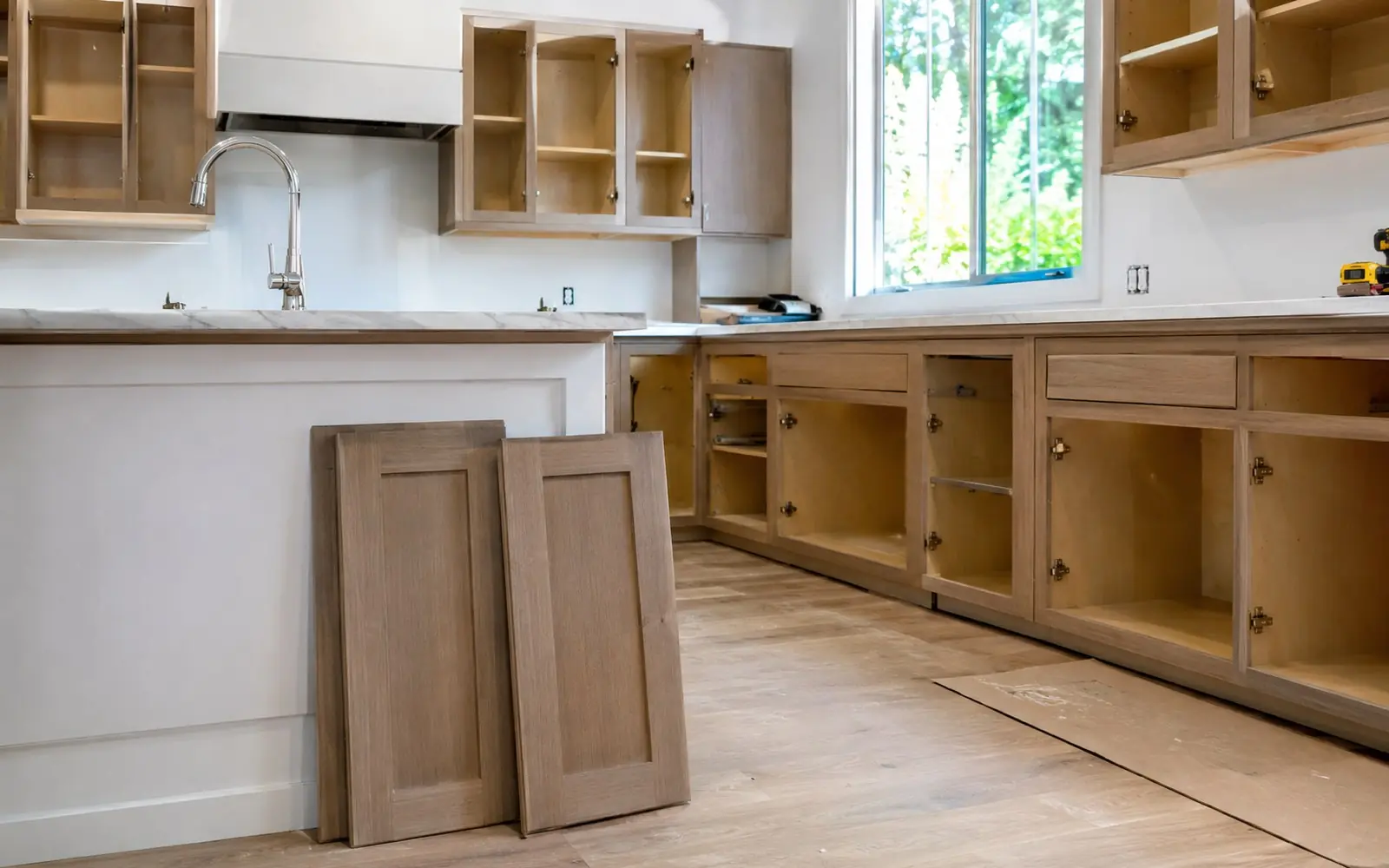
Cabinet Doors and Refacing
How doors are built, what refacing physically involves, and why no honest source publishes a price for either.
Refacing keeps the boxes, so the boxes decide whether it works
Refacing is a carpentry job with a marketing name. The crew removes your doors and drawer fronts, applies veneer or laminate to the exposed face frames and cabinet ends, then hangs new doors and fronts and usually new hinges. The boxes stay exactly where they are. Nothing behind the face changes.
That is the whole decision. If the boxes are square, dry and solidly attached, refacing gets you a new looking kitchen without moving plumbing or living without a sink. If a box is sagging, water damaged or hung badly, refacing wraps a good face around a bad cabinet and you will pay twice.
This guide covers how doors are built, what overlay and reveal mean, and what a refacing crew actually does. On price it is blunt: no government, association or manufacturer source publishes a cost for refacing, refinishing or door replacement in any unit. One adjacent project figure is published, and it is below.
Six ways to change how your cabinets look
These are ordered by how much of the existing cabinet survives, from all of it to none of it.
Refinish what you have
Strip or scuff sand, then stain or paint the doors and frames you already own. Nothing is replaced, so the door style and the reveal stay the same. Success depends almost entirely on preparation and on whether the existing finish will accept a new coat, which is why results vary so much between crews.
Doors and drawer fronts only
New doors and fronts on the existing boxes, leaving the face frames as they are. This changes the style but not the color of the frames, so it works best when the frames are already painted or will be painted to match. It is the smallest change that alters the actual door design.
Full refacing
New doors and fronts plus veneer or rigid laminate applied over the face frames and exposed cabinet ends, so every visible surface is new. Interiors stay original. Ask specifically what goes on the frames, since wood veneer, rigid thermofoil and pressure sensitive laminate age very differently around a dishwasher or a cooktop.
Slab doors
A single flat panel, usually veneered plywood or MDF, sometimes with an edge band. There is no joint to open up seasonally, which makes slab doors dimensionally forgiving and easy to clean. They also show any panel flatness problem immediately, and a cheap slab door telegraphs its substrate under a gloss finish.
Five piece frame and panel
Two stiles, two rails and a center panel, the construction behind shaker and raised panel doors. The center panel floats in a groove so it can move with humidity without splitting the frame. In a painted door the joints between stiles and rails are the place to inspect, because that is where a paint line cracks first.
Overlay and reveal
Full overlay leaves almost no frame showing, partial overlay leaves a visible band, and inset sets the door flush inside the frame. Inset looks the best and is the least forgiving, because every gap is on display and the boxes must be square. Refacing rarely converts an existing kitchen to inset.
What does it cost?
No price for refacing, refinishing or door replacement was found in any citable source. Home center pages block automated access, no manufacturer publishes a fetchable list, and every per door or per linear foot figure in circulation comes from sites that state no methodology. Rather than repeat one, here is the closest published project. Zonda's 2025 Cost vs Value Report puts a minor kitchen remodel at $28,458 in job cost against $32,141 in resale value, recouping 112.9 percent, and notes it is the only interior project in the top five1. Zonda does not publish the project scope on the free page, so treat that as a labelled national figure, not a description of your kitchen.
Two cautions on that number. Zonda's own report page says the data covers 115 local U.S. markets while its own press release for the same report, on the same date, says 11912. The results come partly from surveys of real estate professionals and partly from Verisk's XactRemodel estimating tool1. For a reality check on what people actually spend, the Census Bureau and HUD put the median homeowner outlay on a kitchen remodel at $8,000 and across all improvements at $6,5003. Both can be true at once: Harvard's JCHS finds owners spending $50,000 or more now account for 44 percent of the whole improvement market, which pulls every average upward while the median stays modest4.
Figures come from Zonda's 2025 Cost vs Value Report, the Census Bureau and HUD 2023 American Housing Survey, and Harvard JCHS. None of them prices refacing, which no source found publishes at all.
How to hire for cabinet doors and refacing
Who does the work
Refacing is finish carpentry, whether it is sold by a dedicated refacing franchise, a kitchen dealer or an independent carpenter. Door and drawer front manufacturing happens in a shop by cabinetmakers and bench carpenters, a separate federal occupation with only 77,170 people in it nationally6. A refacing crew is usually installing someone else's doors, so ask who makes them.
What pros will ask
Whether the boxes are face frame or frameless, since frameless has no frame face to veneer and the approach changes entirely. Your current overlay and desired overlay. Whether any box has water damage, sagging shelves or a loose hanging rail. Whether you are keeping the countertop, which constrains the drawer front heights. And whether interiors will be left original.
What to check before signing
Get the door construction in writing: five piece or slab, the species or substrate, and the finish. Get the face frame covering named as wood veneer, rigid thermofoil or laminate rather than just resurfaced. Confirm new hinges are included and named by brand and model. And confirm in writing what happens if a box is found damaged once the doors come off, because that discovery is common.
Related searches homeowners make
Pulled from the same demand data behind our Carpentry & Cabinets category.
Refacing questions, answered straight
What is the difference between refacing and refinishing?
Refinishing keeps your existing doors and changes their color, by stripping or sanding and then painting or staining. Refacing replaces the doors and drawer fronts entirely and covers the face frames and exposed cabinet ends with new veneer or laminate. Refinishing cannot change the door style or the reveal. Refacing can change both. Neither touches the box, the layout or anything behind the cabinet face, so both leave your existing plumbing and appliance positions alone.
Do I need a permit to reface cabinets?
Almost certainly not, though it is a local question. Austin lists painting, papering, tiling, carpeting, cabinets, countertops and similar finish work as exempt from a building permit, in both its residential and commercial lists5. The city still requires exempt work to comply with the building code and all other applicable ordinances5. The answer changes the moment the job includes moving a wall, altering structure or relocating plumbing or electrical for a new layout.
Is refacing actually cheaper than replacing?
It is usually presented that way, and this guide cannot confirm it with a source. No published figure for refacing exists, and none for installed new cabinets either, so any comparison is one estimate against another. What is knowable is the mechanism. Refacing buys no new interior, no layout change and no new boxes, and leaves you the storage you already have. Price two real quotes for your own kitchen instead.
Can frameless cabinets be refaced?
Yes, but it is a different job. A frameless box has no face frame to veneer, so the visible surfaces are the door fronts and the thin panel edges. That means new doors and drawer fronts plus edge treatment, and the finished result depends heavily on how well the new doors match the existing box color where any gap shows. Get the shop to confirm in writing that they have done frameless work and how they handle the exposed edges.
Will new cabinet doors help at resale?
Kitchen work as a category performs well on Zonda's resale measure. A minor kitchen remodel recouped 112.9 percent, $32,141 in value against $28,458 in cost, and it was the only interior project in Zonda's published top five1. Two caveats: that project is not refacing specifically, and Zonda's scope is not published on the free page. Harvard JCHS also classes kitchen and bath work as discretionary, which was 30 percent of improvement spending in 20234.
Where these facts came from
Every figure on this page was read out of the page linked below. We do not cite cost aggregators.
- Zonda, 2025 Cost vs Value Report
- Zonda, 38th annual Cost vs Value Report press release
- U.S. Census Bureau and HUD, 2023 American Housing Survey home improvements
- Harvard Joint Center for Housing Studies, Improving America's Housing 2025
- City of Austin, work exempt from building permits
- BLS OEWS 2025, Cabinetmakers and Bench Carpenters (SOC 51-7011), public API series
Get quotes for your cabinet doors and refacing project
Free for homeowners. No obligation. Up to four local pros compete.
Keep planning
More guides from the Carpentry & Cabinets hub.
Bathroom Vanities and Medicine Cabinets
Swapping a vanity in place is finish work. Moving the plumbing is a different job with a permit attached.
Read the guideCustom Cabinet Makers
How to tell a real shop from a rebadged box, what to settle before you pay a deposit, and what the trade actually earns.
Read the guideStorage and Filing Cabinets
Built-in storage is carpentry, filing cabinets are furniture, and knowing which one you want changes who you call.
Read the guide