
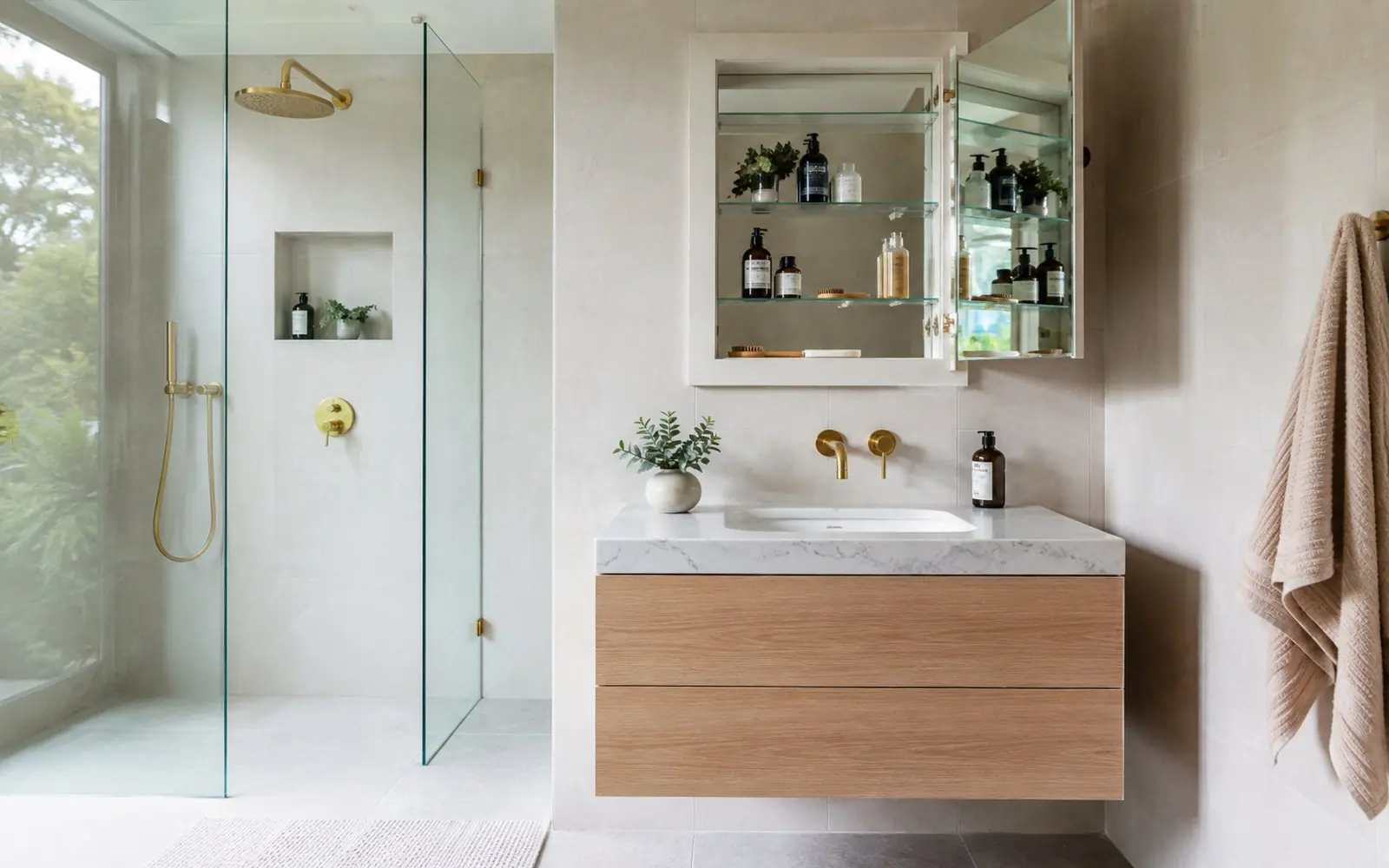
Bathroom Vanities and Medicine Cabinets
Swapping a vanity in place is finish work. Moving the plumbing is a different job with a permit attached.
One question decides this job: does the plumbing move?
A bathroom vanity is a cabinet with water running through it, and that fact reorganizes everything. Pull the old one out, set the new one on the same footprint, reconnect to the existing supply and drain, and you have done finish carpentry. Move the sink a foot to the left and you have opened a wall, altered drain and vent runs and probably triggered a permit.
Ask that question before you shop, because it decides your budget, your timeline and who you hire. It is also the question every quote you receive will quietly assume an answer to.
The federal picture is more modest than most published content suggests. The Census Bureau and HUD put the median bathroom remodel spend at $5,000, against $8,000 for kitchens1. Harvard's JCHS classes kitchen and bath work as discretionary, 30 percent of the improvement market in 2023, and finds home equity funded 15 percent of that spending2.
Six decisions inside a bathroom cabinetry job
The first three touch plumbing, the last three do not, and that division drives most of the cost difference.
Same footprint vanity swap
The new cabinet sits where the old one did and reconnects to the existing supply and drain. This is the version that stays finish work. Austin's exempt list names cabinets, countertops and similar finish work outright, so a like for like swap generally needs no building permit3. Match the width and the drain height before you buy.
Wall hung or floating vanity
The cabinet has no legs, so all its load and yours leaning on it goes into blocking behind the drywall. That usually means opening the wall to add backing, and often moving the drain up into the wall to clear the underside. Two jobs, not one.
Vanity top and sink type
Integrated tops arrive as one piece and are the simplest to fit. Undermount sinks need a stone or solid surface top fabricated with a cutout and a polished edge. Vessel sinks sit on top, which raises the rim height and changes the faucet you can use. Confirm faucet hole spacing before ordering anything.
Recessed medicine cabinet
Recessing means cutting the drywall and fitting the box into the stud bay. Depth is limited by the studs and by whatever pipes or wires run through the wall. Austin exempts gypsum board repair under 128 square feet unless it is part of a fire rated assembly, a shear wall, or a tub and shower surround3.
Surface mount medicine cabinet
The box hangs on the wall face and projects into the room. No wall gets opened, nothing structural is touched, and you can put it anywhere you can find a stud or use the right anchor. It is deeper storage than a recessed unit and the honest choice when the wall is masonry, tiled or full of pipes.
Linen towers and built in storage
A tall cabinet, an over toilet unit or a recessed niche between studs. These are pure carpentry with no plumbing involved. In California this falls squarely inside the C-6 scope, which covers cabinets, cases, trims and nonbearing partitions built and installed in structures6.
What does it cost?
No source publishes a price for a vanity or a medicine cabinet. Home center product pages block automated access and no manufacturer publishes a fetchable list, so any per unit figure you see elsewhere is unsourced. What is published is what homeowners spend on the whole room: the Census Bureau and HUD report a median bathroom remodel outlay of $5,000, against $8,000 for kitchens1. Half of all bathroom projects came in under that. Averages look higher because the market is concentrated, with owners spending $50,000 or more making up 44 percent of all improvement spending in 20232.
If the plumbing moves, add the permit stack, and read your own jurisdiction because they are not alike. Rockville, Maryland sets a $142 minimum residential permit fee, charges alterations at $0.28 per square foot of affected area, adds a $142 filing fee for work other than new construction, and applies a 10.25 percent automation fee on all permit and application fees4. A bathroom is small enough that the per square foot charge falls under the floor, so the arithmetic is $142 plus $142, then 10.25 percent of that $284, which is $29.11, for about $313. Wake County, North Carolina charges $75 plus $0.25 per square foot for residential alterations5.
Figures come from the Census Bureau and HUD 2023 American Housing Survey, Harvard JCHS, and the Rockville and Wake County fee schedules. The $313 is arithmetic on Rockville's own fee lines and covers permit fees only, not labor or materials.
How to hire for vanities and medicine cabinets
Who does the work
A like for like vanity swap is finish carpentry, so a carpenter or handyman can do it. Anything that moves a drain, vent or supply line is plumbing and licensed separately in most places. Cabinetmakers are a third occupation, 77,170 employed at a mean of $23.22 an hour8. KCMA, founded in 1955, represents makers of kitchen cabinets, bath cabinets and other residential cabinets7.
What pros will ask
Whether the sink stays in place. The existing vanity width, depth and the height of the drain stub out of the wall. Whether you want a wall hung unit, which needs blocking and often a relocated drain. Whether the medicine cabinet is recessed or surface mount, and what is inside that wall. Whether the floor continues under the vanity or stops at it.
What to check before signing
Get in writing whether the quote includes a permit and who pulls it, since that person carries the inspection. Confirm who supplies the top and whether the sink cutout is fabricated or field cut. Confirm the vanity gets sealed at the wall and the top. In California, verify a C-6 or plumbing license number against the board record before money moves6.
Related searches homeowners make
Pulled from the same demand data behind our Carpentry & Cabinets category.
Bathroom cabinetry questions, answered straight
Do I need a permit to replace a bathroom vanity?
If the sink stays exactly where it is and you reconnect to the existing supply and drain, usually not. Austin's exempt list names painting, papering, tiling, carpeting, cabinets, countertops and similar finish work, in both its residential and commercial lists3. Exempt work must still meet the building code and all other applicable ordinances3. Relocate the drain, vent or supply lines and you are altering plumbing, so the exemption stops. These lists are local, so check yours.
How much do people actually spend on a bathroom?
The Census Bureau and HUD report a median of $5,000 for bathroom remodels, against $8,000 for kitchens, $2,800 for doors and windows and $6,500 across all improvements1. Those are medians, rounded to the nearest $100, from a federal survey of what owners reported spending. They sit well below what most remodeling content quotes, because averages get pulled up by a few very large projects. Harvard JCHS puts owners spending $50,000 or more at 44 percent of the improvement market2.
Recessed or surface mount medicine cabinet?
Recessed looks cleaner and does not project into a narrow room, but it is limited by the stud bay depth and by whatever pipes, vents or wiring already run through that wall. It also means cutting and patching drywall. Austin exempts gypsum board repair under 128 square feet, except in fire rated assemblies, shear wall assemblies and tub and shower surrounds3. Surface mount holds more and is the right call on a tiled, masonry or crowded wall.
Can I install a floating vanity on any wall?
Not without preparation. A wall hung cabinet transfers all its weight, plus anything you lean on it, into blocking fixed to the studs, so the wall usually has to be opened and backing added. The drain typically moves up into the wall to clear the underside of the cabinet, which is plumbing work. Treat a floating vanity as a wall job and a plumbing job that ends with a cabinet, and price it that way.
Is a bathroom vanity built differently from a kitchen cabinet?
The construction is the same family, and KCMA represents makers of kitchen cabinets, bath cabinets and other residential cabinets together7. The difference is the environment. A vanity lives with standing humidity and an occasional leak at the trap, so the base panel and the back fail first. That argues for a moisture tolerant box material, a sealed toe kick, and a look under the sink once a year.
Where these facts came from
Every figure on this page was read out of the page linked below. We do not cite cost aggregators.
- U.S. Census Bureau and HUD, 2023 American Housing Survey home improvements
- Harvard Joint Center for Housing Studies, Improving America's Housing 2025
- City of Austin, work exempt from building permits
- City of Rockville, MD, FY2026 Inspection Services Division fee schedule
- Wake County, NC, permits and inspections fee schedule
- CSLB, C-6 Cabinet, Millwork and Finish Carpentry classification
- Kitchen Cabinet Manufacturers Association, about the association
- BLS OEWS 2025, Cabinetmakers and Bench Carpenters (SOC 51-7011), public API series
Get quotes for your bathroom vanities and medicine cabinets project
Free for homeowners. No obligation. Up to four local pros compete.
Keep planning
More guides from the Carpentry & Cabinets hub.
Custom Cabinet Makers
How to tell a real shop from a rebadged box, what to settle before you pay a deposit, and what the trade actually earns.
Read the guideStorage and Filing Cabinets
Built-in storage is carpentry, filing cabinets are furniture, and knowing which one you want changes who you call.
Read the guideCabinet Knobs, Hinges and Hardware
The cheapest part of a cabinet to change and the one you touch every day, plus how to specify it so quotes compare.
Read the guide