
Cabinet Knobs, Hinges and Hardware
The cheapest part of a cabinet to change and the one you touch every day, plus how to specify it so quotes compare.
Hardware is the only part of a cabinet you can change later
Everything structural about a cabinet is decided when it is built. Hardware is the exception. Hinges, slides, knobs and pulls can be swapped on a Saturday, which makes them the highest leverage change available to anyone who does not want a new kitchen.
It is also where quotes hide. Soft-close is a feature, not a specification. Two cabinets both described as soft-close can carry very different hinges, and the only reliable fix is to make the quote name the brand and model rather than the adjective.
This guide covers how each type mounts, what adjusts and what does not, and how to swap handles without a wall of filled holes. Where the research behind it could not verify a source, it says so rather than quoting a rating it cannot stand behind.
Six hardware decisions, and what each one commits you to
Mounting method comes first, because it determines what you can retrofit and what you cannot.
Face frame hinges
On a framed cabinet the hinge fastens to the frame, either as a visible barrel or knuckle, a semi concealed wrap that hooks the frame edge, or a concealed hinge on a face frame mounting plate. Which one you have decides your replacement options, so photograph the open door before you order anything.
Concealed cup hinges
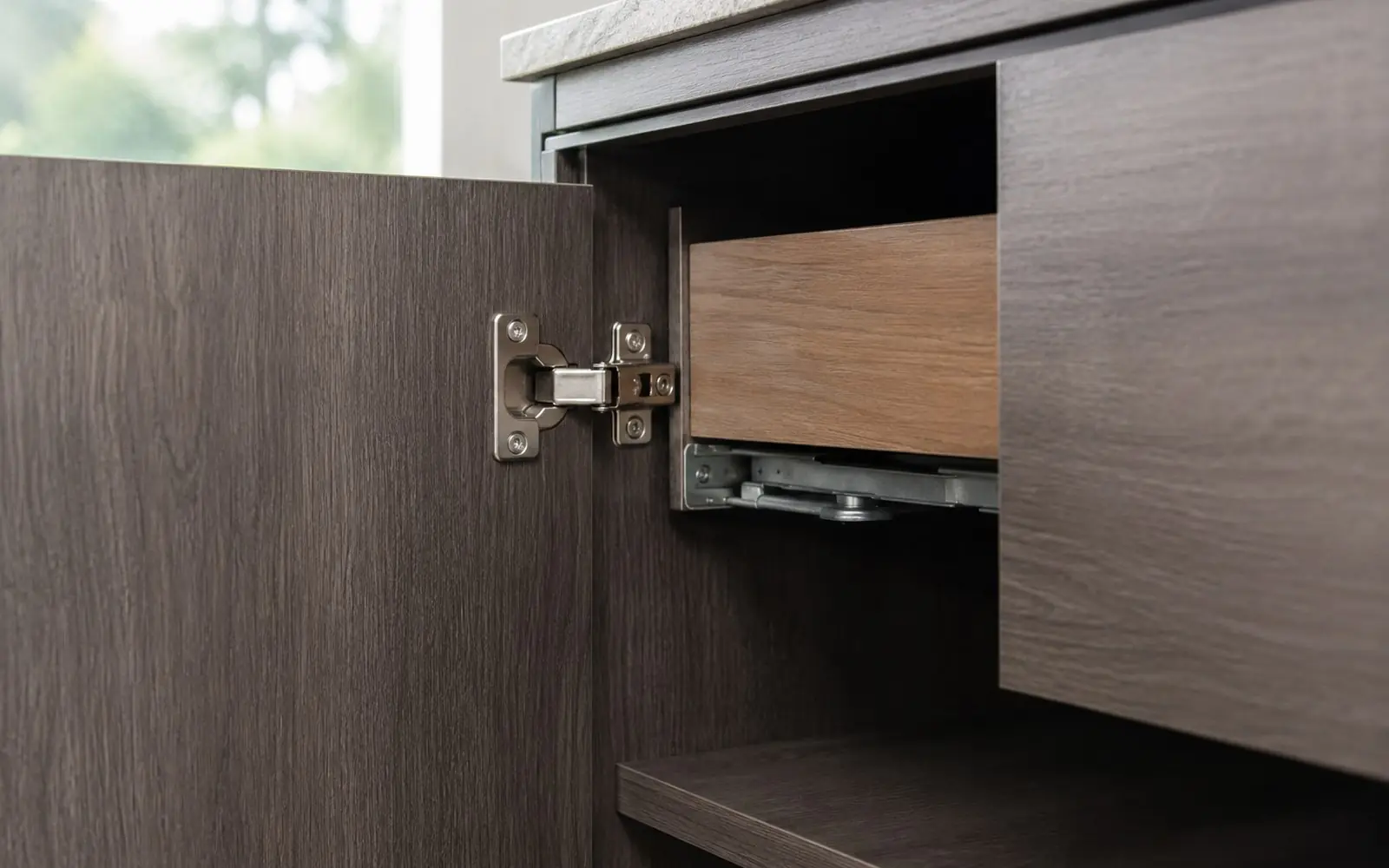
The standard on frameless cabinets. A cup is bored into the door and the arm fastens to a plate on the cabinet side. They adjust in three directions, so door alignment is a screwdriver job rather than a rebuild. The cup bore diameter and setback vary by system, so match the hinge to the existing hole.
Side mount drawer slides
Ball bearing slides fixed to the drawer sides and the cabinet sides. They are visible when the drawer is open, they cost the drawer some width, and they are the easiest type to retrofit because they need no modification to the drawer bottom. Full extension slides bring the whole drawer clear of the cabinet.
Undermount slides
The slide hides beneath the drawer box, so nothing shows when the drawer is open and the box can be full width. In return the drawer bottom and back must be built to suit the slide, with notches in specific places. That makes undermount a design decision at build time, not a later retrofit.
Knobs, pulls and hole spacing
A knob takes one hole. A pull takes two, and what matters is the center to center distance between them. Measure your existing holes center to center before shopping, and if a new pull does not match, you are choosing between filling and redrilling every door or fitting a backplate.
Interior organizers
Trash pullouts, corner carousels, drawer dividers, tray dividers and door mounted racks. Most are retrofittable into an existing box if the opening is wide enough and the door swings clear. Measure the clear opening, not the cabinet width, because on a face frame cabinet those are two different numbers.
What does it cost?
There is no honest answer to put in this box. No government agency, trade association or manufacturer publishes a price for cabinet hinges, slides, knobs or pulls that could be fetched and cited. Retail product pages block automated access. Nothing is estimated here to cover the gap, because a made up number would be worse than an empty one. What you can do instead is make the variables explicit: count your doors and your drawers separately, decide knob or pull for each, decide whether slides are being replaced or only hinges, and then price that exact list at two suppliers.
Two pieces of context are real. Hardware sits inside the cabinets and countertops line, which NAHB's builder survey puts at $19,056 per new single family home, 4.5 percent of construction cost6. And the manufacturers are in a soft patch: KCMA members reported overall cabinet sales down 3.5 percent in April 2026, 8.4 percent in May and 2.8 percent in June, each against the same month a year earlier1. That survey has run monthly for over 20 years and is managed by an independent third party research firm2. The published sentences do not say whether the decline is units or dollars1, so read direction rather than decimal.
The NAHB figure comes from its 2024 construction cost survey and the sales figures from KCMA's monthly Trend of Business report. Neither prices hardware, and no source found publishes hardware prices or durability ratings in citable form.
How to hire for cabinet hardware work
Who does the work
Swapping knobs and pulls is a homeowner job with a drill and a template. Replacing hinges or slides across a kitchen, or fitting organizers into existing boxes, is finish carpentry and worth a carpenter's time. Cabinetmakers and bench carpenters, the shop occupation that specifies hardware when boxes are built, number 77,170 nationally at a mean of $23.22 an hour5. KCMA represents almost 300 such manufacturers3.
What pros will ask
Whether your cabinets are face frame or frameless, since that decides the hinge family. Your door overlay. How many doors and how many drawers, counted separately. Whether existing handle holes are being reused, and the center to center measurement if so. Whether any drawer is a file drawer or holds heavy cookware, which changes the slide.
What to check before signing
Insist the quote names the hinge and slide brand and model number, not just soft-close, so two quotes can be compared. Confirm who fills and finishes old handle holes if spacing changes. Confirm the finish name on knobs and pulls, since brushed nickel and satin nickel are not the same across brands. Ask for a few spare pieces from the same batch.
Related searches homeowners make
Pulled from the same demand data behind our Carpentry & Cabinets category.
Cabinet hardware questions, answered straight
Can I add soft-close to cabinets I already have?
Often yes, and there are two routes. If your doors use concealed cup hinges, many systems offer a damper that clips onto the existing hinge arm, or a replacement hinge that takes the same cup bore and mounting plate. If you have visible or semi concealed face frame hinges, there is usually no clip on option and you are changing the hinge itself. Take one hinge off and photograph both sides before ordering, because the mounting plate matters as much as the hinge.
How do I match new pulls to my existing holes?
Measure center to center, from the middle of one hole to the middle of the other, and shop to that number. If nothing you like matches, your options are a backplate that covers both old holes, or filling and redrilling every door and drawer front. Filling is only invisible on painted work, so on stained or veneered fronts assume the old holes will show. Test the fill and finish on one door before committing to the whole kitchen.
Do I need a permit or a contractor to change hardware?
No permit. Austin's exempt list names painting, papering, tiling, carpeting, cabinets, countertops and similar finish work in both its residential and commercial lists, and hardware sits well inside that4. Exempt work still has to meet the building code and all other applicable ordinances4. As for a contractor, hardware swaps are the most approachable cabinet job there is. Use a template so every hole lands in the same place, and drill from the front with a backer block to stop blowout.
How do I compare hinge or slide quality?
Carefully, because the research behind this guide verified no durability rating or cycle test figure for cabinet hardware from any citable source. Treat any cycle count quoted at you as a claim to be documented, not a fact. Judge it two ways instead. Insist the quote names the brand and model so you can research the actual product. Then test it in a showroom: pull a drawer to full extension and check for droop and side play, and watch whether a door eases shut or hits the damper hard.
Undermount or side mount slides?
Undermount looks better and gives you a full width drawer box, because the mechanism hides underneath. Side mount is easier and cheaper to retrofit, since it needs no change to the drawer bottom or back. The deciding factor is usually whether the drawers already exist. Undermount slides require the drawer box to be built to suit them, with specific notches, so converting existing drawers normally means new drawer boxes rather than new slides.
Where these facts came from
Every figure on this page was read out of the page linked below. We do not cite cost aggregators.
- KCMA, June 2026 Trend of Business report
- KCMA, Trend of Business program description
- Kitchen Cabinet Manufacturers Association, about the association
- City of Austin, work exempt from building permits
- BLS OEWS 2025, Cabinetmakers and Bench Carpenters (SOC 51-7011), public API series
- NAHB, Cost of Constructing a Home in 2024
Get quotes for your cabinet knobs, hinges and hardware project
Free for homeowners. No obligation. Up to four local pros compete.
Keep planning
More guides from the Carpentry & Cabinets hub.
Carpenters and Carpentry Projects
What carpenters build, what federal wage data says about the trade, and which jobs need a license or a permit.
Read the guideCabinet Construction and Materials
How a cabinet box is actually built: frames, sheet goods, joinery and hardware, and the questions that expose a cheap one.
Read the guideCabinet Doors and Refacing
How doors are built, what refacing physically involves, and why no honest source publishes a price for either.
Read the guide