
Cabinet Construction and Materials
How a cabinet box is actually built: frames, sheet goods, joinery and hardware, and the questions that expose a cheap one.
Almost every cabinet difference you can feel is in the box
Two cabinet quotes can use the same words and describe very different objects. Both say soft-close. Both say plywood. One box is still square in twenty years, the other sags under a stack of plates. The difference is the frame type, the sheet goods, the corner joints, the drawer box and how the thing hangs on the wall.
That matters more than the door style, because the door is the part you can change later and the box is not. Cabinets and countertops run $19,056 in a new single family home, 4.5 percent of construction cost1. The median homeowner kitchen remodel is $8,0006, so a builder's allowance and a remodel budget describe different jobs.
Below is what to ask for, in the order a shop would build it. Where this guide cannot point to a primary source, it says so instead of naming a standard it did not verify. Ask any maker to put their claims in writing, then compare quotes on identical wording.
The six construction choices that decide cabinet quality
Ask for each in writing, then compare quotes line against line rather than by tier name.
Face frame boxes
A solid wood frame is fixed to the front edges of the box, and doors and drawers mount to that frame. The frame stiffens a thinner box and gives an installer something forgiving to scribe and fasten to. The trade off is that the frame narrows the opening, so drawer boxes come out narrower than the cabinet.
Frameless, or full access
No front frame. Doors mount straight to the box side with a cup hinge, and the whole interior width is usable. It puts all the load on the panel edges and the fasteners, so a frameless box needs thicker, flatter sheet goods and better joinery to stay square. Sloppy frameless is worse than good face frame.
The sheet goods themselves
Plywood, particleboard and MDF behave differently. Plywood holds a screw well and resists sagging. Particleboard is flat and stable but strips out under a screw and swells once water reaches the core. MDF machines cleanly and takes paint better than plywood, which is why many painted doors use it even in plywood boxes.
How the corners are joined
A dadoed or rabbeted joint captures the panel in a groove and carries load through wood. Dowels and confirmat screws are strong when drilled accurately. Cam locks and knockdown fittings assemble fast and rely entirely on the fastener. Ask which one you are buying, because the assembly method is rarely on a spec sheet.
Drawer boxes, judged separately
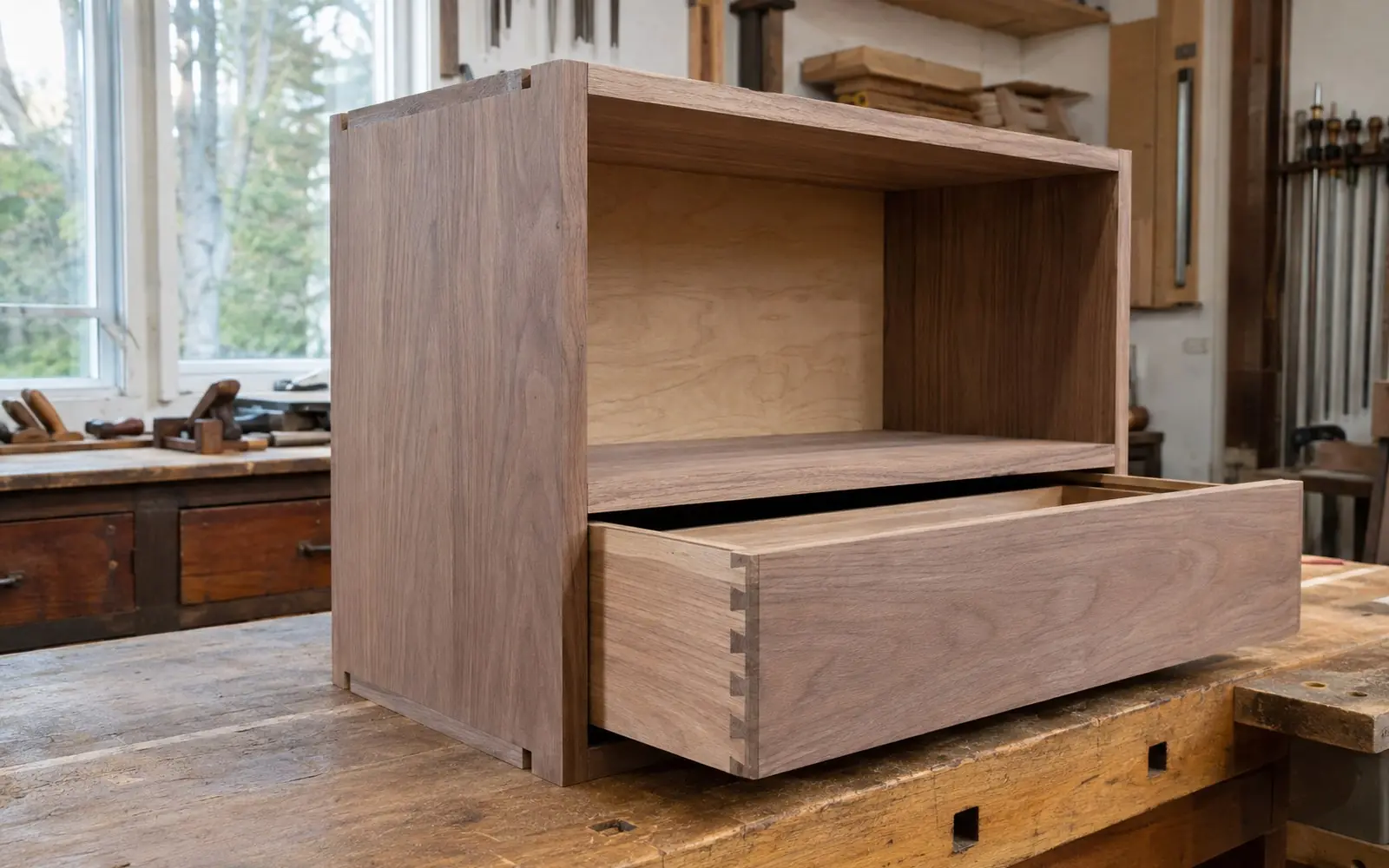
The drawer box is its own piece of joinery and it is where daily wear lands. Dovetailed solid wood, doweled ply, stapled ply and metal sided systems are all sold as drawers. Pull one out at the showroom, look at the corner, and check whether the bottom sits in a groove or is stapled underneath.
The back panel and hanging rail
A thin back stapled into a rabbet does almost nothing structurally. A full thickness back captured in a dado squares the box and carries weight. Behind it, a hanging rail transfers a loaded wall cabinet into the studs. Ask what the back is made of and how the cabinet fastens to the wall.
What does it cost?
There is no honest published price per box, per door or per linear foot, and this guide will not invent one. Home centers block automated access to their own product pages and no manufacturer found publishes a fetchable price list, so every stock, semi-custom and custom price ladder in circulation traces back to sources that state no methodology. What is real is the new construction line: NAHB's builder survey puts cabinets and countertops at $19,056 per single family home, 4.5 percent of a $428,215 average construction cost, in a house averaging 2,647 square feet1. That survey rests on usable responses from 41 builders1.
The labor side is public. Cabinetmakers and bench carpenters, the shop occupation, earn a mean of $23.22 an hour and a median of $22.44, with the 90th percentile at $30.64, and only 77,170 people hold the job nationally2. Those are employee wages, not shop billing rates, and no published multiplier between the two was found. On the demand side, the manufacturers' own monthly survey has been negative all spring: KCMA members reported overall cabinet sales down 3.5 percent in April 2026, 8.4 percent in May and 2.8 percent in June, each against the same month a year earlier5.
Figures come from NAHB's 2024 construction cost survey, the BLS OEWS 2025 public API and KCMA's monthly Trend of Business report. None is an installed cabinet price, and no such figure was found in any non-aggregator source.
How to hire for cabinet construction
Who does the work
Shop cabinetmakers build the boxes and finish carpenters install them, separate occupations in the federal data as well as in practice2. A dealer sells someone else's boxes and subcontracts the install. A custom shop does both. KCMA, founded in 1955, counts almost 300 member companies across North America, which is one way to check whether a brand actually manufactures3.
What pros will ask
Face frame or frameless. Full overlay, partial overlay or inset doors, since inset demands the tightest box tolerances. What the boxes and shelves are made of, and whether interiors are finished. Whether drawers are full extension. Whether you need a specific interior height for appliances or trash pullouts. And whether walls and floors are level, which decides how much scribing is needed.
What to check before signing
Get the specification in writing at panel level: box material and thickness, back panel construction, joinery method, drawer box construction, and the hinge and slide brand and model. Ask the maker to state which formaldehyde emissions standard the panels are certified to and to supply the certificate, since this guide could not verify a primary source on emissions limits and you should read the document yourself.
Related searches homeowners make
Pulled from the same demand data behind our Carpentry & Cabinets category.
Cabinet construction questions, answered straight
Is plywood always better than particleboard for cabinet boxes?
Not automatically. Plywood holds screws better and resists sagging over a long shelf span, which matters for wall cabinets and anything carrying real weight. Particleboard is flatter and more dimensionally stable, and a thick, well joined particleboard box beats a thin plywood one with stapled corners. The failure mode differs though: once water reaches a particleboard core it swells and never recovers. Under a sink, that decides it.
Face frame or frameless, which should I choose?
Frameless gives full interior width and a cleaner look, and it suits inset and full overlay doors. Face frame is more forgiving in an old house with wavy walls, and the frame adds rigidity to a thinner box. The real question is execution. A frameless box relies on panel flatness and joint accuracy for its strength, so it punishes a cheap build in a way face frame partly hides.
Do cabinets have to meet a formaldehyde emissions limit?
This guide will not answer that from memory. The research behind it did not verify any primary regulatory source on composite wood emissions, so naming a rule or a limit here would be guessing, which is worse than saying nothing. Handle it commercially instead. Ask the manufacturer which emissions standard the panels are certified to, request the certificate, and make the answer part of the quote. A real manufacturer has the document ready.
How do I judge hinges and drawer slides?
No hardware grading figure was verified for this guide, so ignore anyone quoting cycle counts at you without a document. Judge it by identity and behavior instead. Insist the quote names the hinge and slide brand and model number rather than saying soft-close. Then load a showroom drawer, pull it to full extension and check for droop and side to side play, and open a door to see whether the soft-close engages smoothly rather than slamming into the damper.
Is this a good time to buy cabinets?
Demand is soft, which is your leverage. KCMA runs a monthly Trend of Business survey of participating cabinet companies, managed by an independent third party data firm, and it has run for over 20 years4. Members reported overall cabinet sales down 3.5 percent in April 2026, 8.4 percent in May and 2.8 percent in June, each against the same month a year earlier5. The published figures do not say whether that is unit volume or dollar value, so read direction, not precision.
Where these facts came from
Every figure on this page was read out of the page linked below. We do not cite cost aggregators.
- NAHB, Cost of Constructing a Home in 2024
- BLS OEWS 2025, Cabinetmakers and Bench Carpenters (SOC 51-7011), public API series
- Kitchen Cabinet Manufacturers Association, about the association
- KCMA, Trend of Business program description
- KCMA, June 2026 Trend of Business report
- U.S. Census Bureau and HUD, 2023 American Housing Survey home improvements
Get quotes for your cabinet construction and materials project
Free for homeowners. No obligation. Up to four local pros compete.
Keep planning
More guides from the Carpentry & Cabinets hub.
Cabinet Doors and Refacing
How doors are built, what refacing physically involves, and why no honest source publishes a price for either.
Read the guideBathroom Vanities and Medicine Cabinets
Swapping a vanity in place is finish work. Moving the plumbing is a different job with a permit attached.
Read the guideCustom Cabinet Makers
How to tell a real shop from a rebadged box, what to settle before you pay a deposit, and what the trade actually earns.
Read the guide