
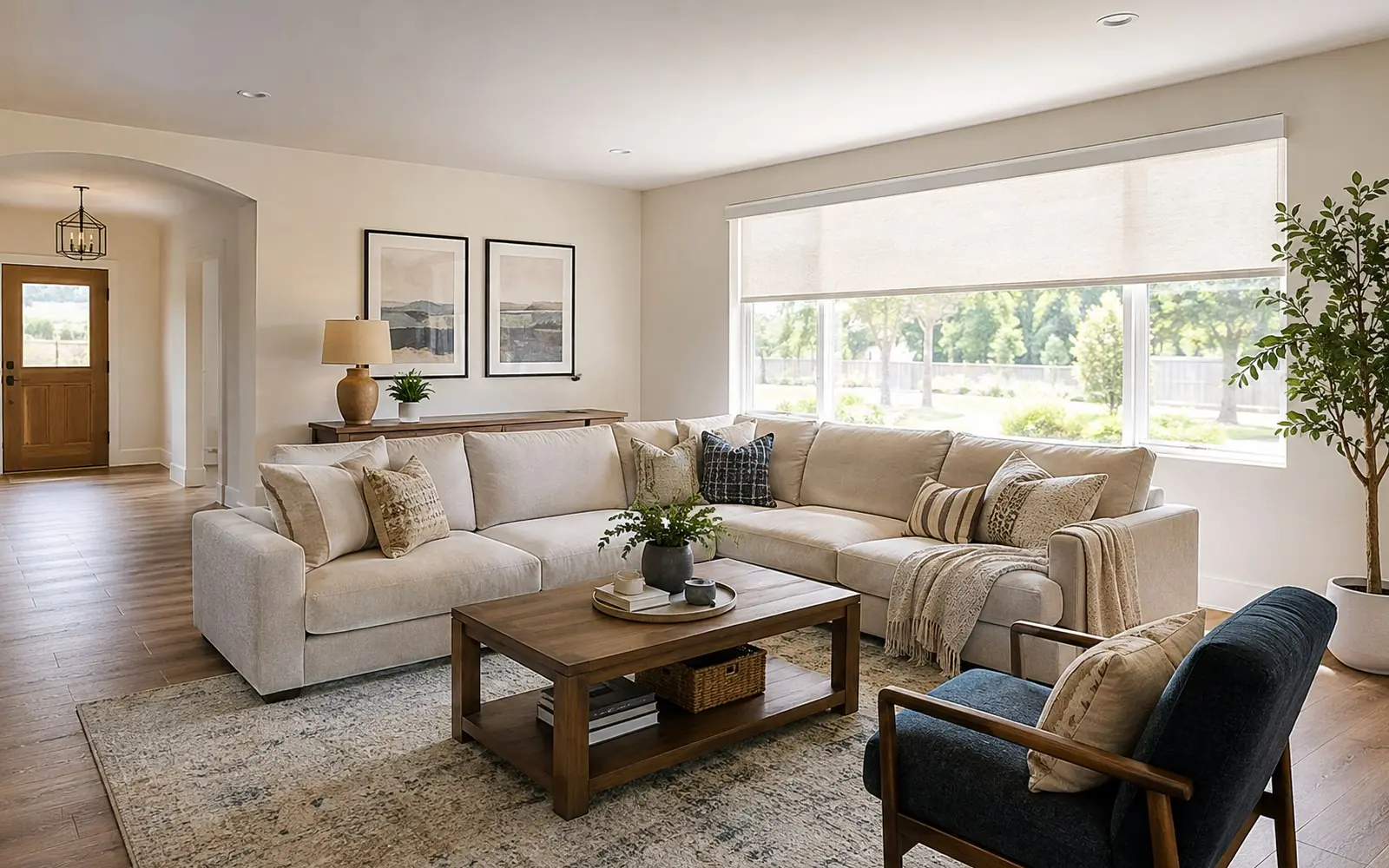
Living and Family Room Pictures and Decorating Ideas
What design photos leave out: the outlet the sofa cannot reach, the cord rule on those blinds, and how big the room in the picture really is.
Every styled room photo is hiding the same three things
The first thing missing from a design photo is cords, and the reason is structural rather than stylistic. NEC 210.52(A) requires receptacle outlets in habitable rooms so that no point measured horizontally along the floor line in any unbroken wall space is more than 6 feet from an outlet, with a receptacle in each wall space 2 feet or more wide.1 That provisions walls. The sofa in the photograph floats in the middle of the room, and the code has nothing to say about the middle of the room. Somebody solved that off camera.
The second is the window coverings, which are rarely the stock item you can pick up the same day. Custom window coverings have been a federally regulated category since the operating cord rule at 16 CFR 1260 took effect on May 30, 2023.2 The rule draws a specific line: a stock window covering is one substantially fabricated before distribution and carrying its own SKU, and it stays stock even when the seller adjusts it to size, attaches a rail or ties cords to secure the bottom rail. Online sales do not make it custom either.
The third is scale. The median new single family home fell to 2,150 square feet in 2024, from 2,200 in 2023, described as the lowest in 15 years after holding at 2,300 square feet from 2019 to 2022.3 Rooms photographed for design features are not sized to that. Before you copy a layout, measure your wall lengths and find your outlets, then work out which parts of the picture survive contact with your actual room.
Six ideas worth stealing, and what each one requires
Each of these is a common design photo move, checked against the rule or the published number behind it.
The floating sofa
It is the defining move of open plan family rooms and the one layout receptacle spacing does not serve. NEC 210.52(A) measures along the floor line of unbroken wall space and stops there.1 If you want the sofa off the wall with lamps beside it, bring an electrician into the plan before the furniture arrives.
Swapping almond outlets for white
It is the cheapest visual upgrade in the room and it is not purely cosmetic. NEC 406.4(D)(4) of the 2023 NEC requires replacement receptacles in dwelling units to be AFCI protected in the areas listed in 210.12, and living rooms, family rooms, dens and libraries are all named there.4
Cordless blinds across a whole wall
Since May 30, 2023 the federal operating cord standard has applied to custom window coverings.2 Whether your order counts as custom or stock turns on the rule's own definitions, not on how bespoke it feels. Adjusting a pre-assembled product to size still leaves it a stock product under 16 CFR 1260.1(b)(2).
The media wall
Worth doing, and the risk is no longer the screen. CPSC recorded only 3 tip over deaths involving a television between January 1, 2020 and July 31, 2023, against 103 television related fatalities across January 2013 to July 2023.5 The hazard moved to the console beneath it, and tables were the top injury category overall.
A rug that anchors the whole seating group
Size decides which federal rule it falls under. Over 6 feet in one dimension and over 24 square feet in area, it is a carpet under 16 CFR 1630 and must pass the burn test.6 Under both, it is a small carpet that may fail and still be sold if it carries the required label.
The room that looks bigger than yours
Because it usually is. Median new home size fell to 2,150 square feet in 2024, and preferences split by generation: millennials at 2,408 square feet, boomers at 1,869, Gen X and Gen Z around 2,250.3 No source publishes typical living room dimensions, so measure your own before committing.
What does it cost?
Window coverings are the one element of a styled room that a federal regulator has costed in public. CPSC worked from the data point that the average detached single family household has 12 window coverings, and stated that $23.67 is slightly more than 5 percent of the total cost of $448.32 that a household would spend to update their window coverings, about once every 10 years.2 The same analysis notes that retail prices vary substantially: the least expensive units for an average size window retail for less than $40, while some more expensive units may retail for several thousand dollars.
Scale matters for context. CPSC put approximately 145 million corded custom window coverings in use in the United States in 2020, with about 25 million custom window coverings shipped that year, about 15.9 million of them corded.2 Beyond windows, no authoritative figure exists for what it costs to reproduce a room from a photograph. There is no federal series, no trade association survey and no cost study with a stated method for living room decorating, and every average you have seen comes from a lead generation aggregator.
The $448.32, $23.67 and $40 figures are CPSC's own numbers from the regulatory analysis in 16 CFR 1260, not retail quotes we obtained. Home size figures are NAHB's. Nothing here includes installation labor, and no source publishes an installed price for any of it.
How to hire when you are working from pictures
Who does the work
A designer or decorator translates the photo into a plan and a specification. A licensed electrician owns anything that touches a circuit, including replacement receptacles, which carry an AFCI requirement in these rooms under the 2023 NEC.4 A window covering supplier handles measurement and install. Painters handle the wall color, and the 2025 OEWS counted 225,190 of them at a $23.75 median hourly wage.7
What pros will ask
Expect to be asked to point at the outlets you already have, because a floated layout sits outside NEC 210.52(A) entirely.1 Expect a window covering supplier to ask whether you want a stock or custom product, which is a regulatory distinction under 16 CFR 1260 and not just a lead time.2 Expect a designer to ask for your wall dimensions before anything else.
What to check before signing
Get the electrical scope written down, including who is responsible for AFCI compliance on replaced receptacles.4 Get window coverings quoted as stock or custom in writing. Ask for furniture prices as manufacturer list plus delivery, itemized. And do not accept a single project number described as typical, because no source publishes one for this work.
Related searches homeowners make
Pulled from the same demand data behind our Living & Family Rooms category.
Decorating idea questions, answered straight
Why are there never any cords in design photos?
Partly styling, partly because the layout in the picture is not one the wiring code provisions for. NEC 210.52(A) requires that no point measured along the floor line in any unbroken wall space be more than 6 feet from a receptacle, and that every wall space 2 feet or wider gets one.1 Nothing in that rule reaches the middle of the floor. A sofa floated off the wall with lamps beside it needs a supply planned with an electrician, or it ends up with a cord across the room.
Are the blinds in these photos custom, and does the difference matter?
It matters legally. The federal operating cord standard at 16 CFR 1260 applies to custom window coverings and took effect on May 30, 2023.2 The rule defines a stock window covering as one completely or substantially fabricated before being distributed and carrying its own SKU, and it stays stock even when the seller adjusts it to size, attaches a top or bottom rail, or ties cords to secure the bottom rail. Online ordering and bulk orders do not convert a stock product into a custom one.
What do window coverings actually cost?
CPSC published the only figures here with a method behind them. Its analysis assumes 12 window coverings in an average detached single family household and states that $23.67 is slightly more than 5 percent of the total cost of $448.32 a household would spend to update them, roughly once a decade.2 The same document says the least expensive units for an average size window retail for less than $40, while some more expensive units may retail for several thousand dollars. Those are regulatory analysis figures, not quotes.
Is a media wall with a mounted television a safety problem?
The television itself has largely stopped being the hazard. CPSC recorded only 3 tip over deaths involving a television between January 1, 2020 and July 31, 2023, against 103 television related fatalities across January 2013 to July 2023, with a caution that counts for 2021 to 2023 are incomplete because of reporting lag.5 The risk migrated to the furniture. Tables were the largest tip over injury category across all ages, and shelving and bookcases the second largest.
Are the rooms in decorating photos bigger than a real house?
Usually, and the trend is going the other way. NAHB reported the median new single family home size falling from 2,200 square feet in 2023 to 2,150 in 2024, the lowest in 15 years after holding at 2,300 from 2019 to 2022, with median lot sizes down about 1,000 square feet over 15 years to 8,400.3 The same release names the great room as a consistently popular feature but publishes no percentage for it, so treat any share you see quoted as invented.
Where these facts came from
Every figure on this page was read out of the page linked below. We do not cite cost aggregators.
- City of Saint Paul DSI, dwelling unit rough in electrical checklist
- 16 CFR 1260, operating cords on custom window coverings
- NAHB, home buyer preferences release, February 2025
- City of Saint Paul DSI, AFCI protection under the 2023 NEC
- CPSC staff, 2023 annual tip over report, February 2024
- 16 CFR 1630, surface flammability of carpets and rugs
- BLS OEWS 2025, painters construction and maintenance, median hourly wage
Get quotes for your living and family room pictures and decorating ideas project
Free for homeowners. No obligation. Up to four local pros compete.
Keep planning
More guides from the Living & Family Rooms hub.
Rug Flammability Standards
Two federal standards govern rugs, and which one applies to yours is decided purely by size. A small rug can fail the burn test and still be sold.
Read the guideLiving and Family Room Decorating and Design
The wiring code, the federal furniture rules and the published wage data behind a living room project, plus the number nobody actually publishes.
Read the guideLiving Room Furniture Sets
How to price a set against its own parts, which pieces carry a federal label, and which ones actually have to be anchored to the wall.
Read the guide