
Lawn Mowers
Buying a mower is buying back billable hours. Here is the wage data behind those hours, and the running cost nobody talks about.
A mower is a labour decision before it is an equipment decision
Buying a mower is a decision to do the work yourself instead of paying someone. The machine is the visible cost. The hours are the real one, and the hours are the part that is actually measured. In May 2025 the Bureau of Labor Statistics put landscaping and groundskeeping workers, the people who would otherwise be doing it, at a median hourly wage of $18.82, across 952,640 workers.1
Widen that out and grounds maintenance workers as a whole, 1,048,490 of them, earned a mean of $20.78 an hour and $43,220 a year, against $33.54 and $69,770 for all occupations.16 This is low-wage work by federal measure, which is precisely why the hire-or-own question is genuinely close for a small lot and why it is not close at all for a large one.
What no source publishes is the price of a mower. Not BLS, not EPA, not any regulator or trade association. The prices you find compared online come from retailers and from aggregators with no stated method, so this guide will not print a range. What it can do is set out the published figures on either side of the machine: the labour it replaces, and the water the lawn underneath it uses.
Six kinds of mower, and one alternative to owning any
The machines differ in what they need from you: fuel, charging, storage, maintenance, or nothing at all.
Reel mowers
A manual cylinder mower with no engine, no fuel and no battery. Cutting power comes from you pushing it, so the practical limit is the size of the lawn and the shape of the ground. Nothing to service beyond the blades, and nothing to store fuel for. Best considered for genuinely small, flat, obstacle-free turf.
Petrol walk-behind mowers
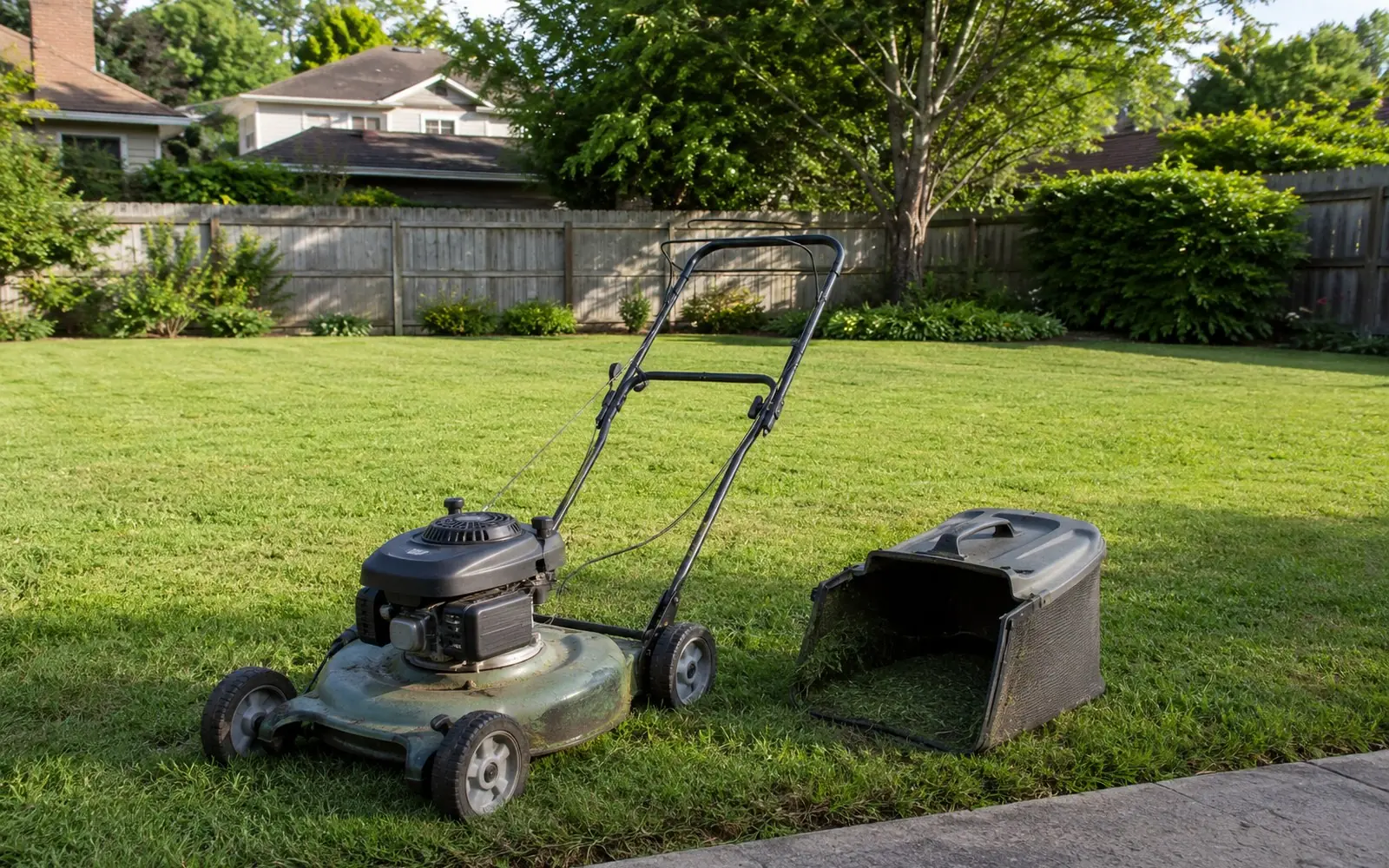
The standard machine for an ordinary lot, in push and self-propelled versions. Self-propel drives the wheels, which matters mostly on slopes and on long runs. Petrol machines add fuel storage, a carburettor and a fuel system to your life, and those are the components most likely to need attention after a winter standing idle.
Battery walk-behind mowers
Same body, different power source. The engine and fuel system are replaced by a removable battery pack, a charger and a controller, so the maintenance list changes rather than disappears. Run time is set by the pack, so the sizing question is whether your lawn fits inside one charge or needs a second pack.
Wide-deck and commercial walk-behinds
Heavier machines with a wider cut, built for repeated daily use rather than a weekly pass. This is the category a crew turns up with. BLS counts 952,640 landscaping and groundskeeping workers using equipment like it, at a $18.82 median hourly wage.1 For a homeowner the deciding factor is usually gate width and storage.
Robotic mowers
A scheduled machine that works inside a set boundary without an operator. It converts mowing from a weekly task into a piece of installed equipment with a setup step and a maintenance schedule. No authoritative source publishes purchase or running costs for these, so judge them on the specification sheet and the warranty terms.
Not owning one at all
Hiring the mowing out removes the machine, the fuel, the storage and the repair. What you take on instead is a labour rate. BLS puts the crew median at $18.82 an hour and their first-line supervisors at $28.09, about 49 percent higher, which is why a supervised crew and a solo operator quote differently.1
What does it cost?
No authoritative source publishes mower prices, so there is no honest range to give you. What is published is the value of the labour on the other side of the decision. Landscaping and groundskeeping workers had a $18.82 median hourly wage in May 2025, grounds maintenance workers as a group a $20.78 mean hourly and $43,220 mean annual wage, and their first-line supervisors a $28.09 median hourly wage.1 Across all occupations the median was $24.51 an hour.16 An hour you spend mowing is an hour of work the market prices in that region.
The recurring cost of a lawn that does have published figures is water, not fuel. EPA reports that outdoor water use accounts for more than 30 percent of total household use on average, and that the average family spends more than $1,000 a year on water.3 It also finds that homes with clock timer controlled irrigation systems use about 50 percent more water outdoors than homes without irrigation systems.4 Mowing itself has no published running cost, and BLS notes the work is seasonal, available mainly in spring, summer and autumn, so the machine sits idle for part of the year either way.2
The wage figures come from the Bureau of Labor Statistics May 2025 wage release and the water figures from EPA WaterSense, both cited; no source here publishes mower purchase prices, fuel costs or resale values, and none are estimated.
How to hire out the mowing instead
Who does the work
A crew, a solo operator, or you. BLS counted 1,048,490 grounds maintenance workers in its May 2025 wage survey, while its Occupational Outlook Handbook reports 1,296,400 grounds maintenance jobs in 2024 and projects 4 percent growth to 2034, a change of 45,900.12 Two different BLS programs, two different counts, so quote the source and the year.
What pros will ask
Total lot size and how much of it is actually turf. Gate width, because it decides which machine can reach the back garden. Slope and obstacles. Whether there are in-ground irrigation heads and where they sit. Preferred frequency and day. Whether clippings are bagged or mulched, and whether they expect you to have anywhere to put them.
What to check before signing
Get the visit scope written down: mowing, edging and clean-up are separate tasks that quotes often merge. Confirm who supplies and fuels the machine. If you irrigate, agree what happens to a damaged head. EPA's own end-of-season checklist is worth running yourself: inspect, connect, direct and select, and it flags water pooling between cycles as a possible underground leak.4
Related searches homeowners make
Pulled from the same demand data behind our Lawn Care & Handyman category.
Lawn mower questions, answered straight
What does a lawn mower actually cost?
No authoritative source publishes that. BLS publishes wages, EPA publishes water figures, and neither publishes equipment prices, so a range printed here would be invented. Retailer listings are the real answer and they are specific to model and season, which is why a general figure would mislead you anyway. Price the two or three machines that fit your lot, your gate and your storage, then compare those to the labour figures in this guide rather than to an online average.1
Is it cheaper to mow it myself?
The honest version of that arithmetic uses one published number and one you supply. The published one is the wage: $18.82 median hourly for landscaping and groundskeeping workers in May 2025, and $28.09 for their supervisors.1 The one you supply is how many hours your lawn takes and what your own time is worth. For all occupations the median hourly wage was $24.51.1 If your lawn takes an hour a week, that is the comparison, before the machine, fuel and maintenance are counted.
Battery or petrol?
Nothing in the federal sources used here compares them on running cost, emissions or lifespan, so this guide will not pretend to settle it. What is not in dispute is the maintenance profile. Petrol adds fuel storage and a fuel system, which is where machines that sat all winter usually fail. Battery moves the same problem to packs, chargers and controllers, and the pack is normally the most expensive single component. Decide on the specification and the warranty, not on a generic comparison.
How often should the lawn be mowed?
No source in this guide publishes a mowing frequency, and one that varies with grass type, season and rainfall would not travel well anyway. What EPA does publish is the watering side. A landscape typically requires one inch of water a week including rainfall, varying with location, weather and planting.5 EPA also warns that watering too frequently can drown plants or leave shallow roots.5 Get the watering right and the growth rate you are mowing to becomes a lot more predictable.
Does having a lawn raise my water bill much?
This is the one running cost with real numbers attached. EPA reports that outdoor water use is more than 30 percent of total household use on average, and that the average family spends more than $1,000 a year on water.3 It also states that homes with clock timer controlled irrigation systems use about 50 percent more water outdoors than homes without irrigation.4 Installing a timer-driven sprinkler system is, on EPA's own figure, a decision to use roughly half again as much outdoor water.
Where these facts came from
Every figure on this page was read out of the page linked below. We do not cite cost aggregators.
- BLS, Occupational Employment and Wage Statistics, May 2025, Table 1
- BLS, Occupational Outlook Handbook, grounds maintenance workers
- EPA WaterSense, statistics and facts
- EPA WaterSense, sprinkler spruce-up
- EPA WaterSense, watering tips
- BLS, Occupational Employment and Wages news release, USDL-26-0725
Get quotes for your lawn mowers project
Free for homeowners. No obligation. Up to four local pros compete.
Keep planning
More guides from the Lawn Care & Handyman hub.
Riding Lawn Mowers
You buy a rider for area, and area is what drives the two costs anyone actually measures: crew hours and water.
Read the guideHedge and Grass Trimmers and Edgers
Trimming, hedging and edging are three different jobs done by three different federal occupations, and the wage gap between them is real.
Read the guideLawn Mower Parts and Supply
Parts are the half of a repair bill you cannot benchmark. Here is how to read the estimate, and the one question that settles it.
Read the guide