
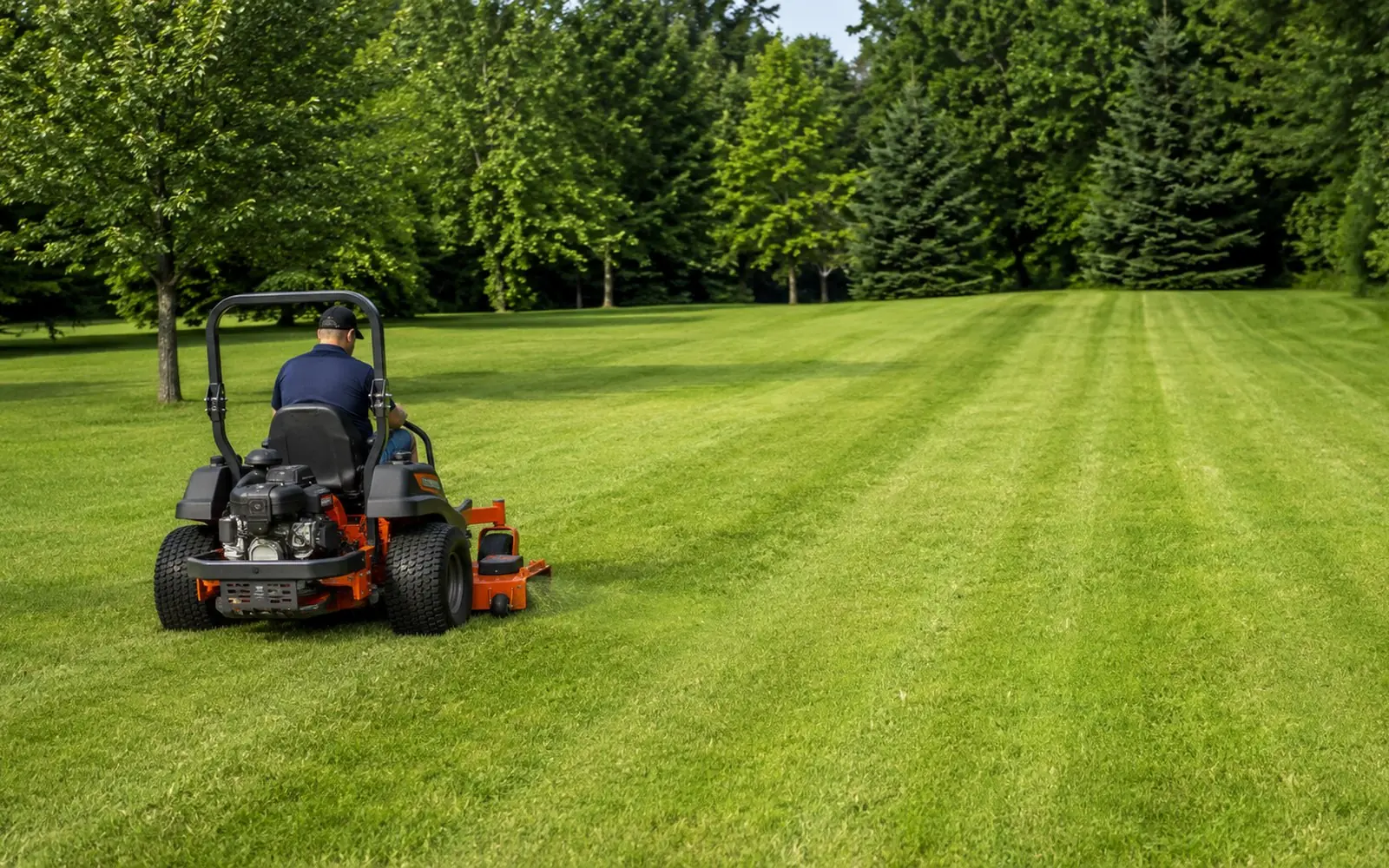
Riding Lawn Mowers
You buy a rider for area, and area is what drives the two costs anyone actually measures: crew hours and water.
A rider is bought for acreage, and acreage is what costs money
Nobody buys a riding mower for a courtyard. The machine exists because a property crossed a size where walking it stopped making sense, and that same size is what drives every other number attached to the lawn. Two of those numbers are published by the federal government, and neither of them is the price of the mower.
The first is labour. In May 2025 the Bureau of Labor Statistics put landscaping and groundskeeping workers at a $18.82 median hourly wage, and first-line supervisors of landscaping, lawn service and groundskeeping workers at $28.09, about 49 percent higher.1 A large property is usually cut by more than one person, so the mix of those two rates is what a quote is actually built from.
The second is water, and the figures are large. EPA reports that residential outdoor water use in the United States accounts for nearly 8 billion gallons of water each day, mainly for landscape irrigation, and that experts estimate as much as 50 percent of it is wasted through overwatering caused by inefficient methods and systems.3 A big lawn is a big share of that. What is not published anywhere authoritative is what a riding mower costs to buy, so this guide gives you the measured numbers and leaves the sticker price to the dealer.
Six ride-on machines, and what separates them
Riders split by how they steer, what they can pull, and whether they were built for a weekly pass or a daily one.
Lawn tractors
The familiar front-engine rider with a steering wheel, sized for open ground and gentle turns. It trades manoeuvrability for simplicity and for the ability to tow. On a property with wide, uninterrupted turf that trade is fine. On one broken up by beds, trees and hard edges, the turning circle is what you will notice.
Zero-turn mowers
Independent drive to each rear wheel, steered by levers, allowing the machine to pivot in place. The advantage shows up on properties full of obstacles, where a tractor has to make a second pass. The trade is behaviour on slopes and a steeper learning curve for the operator on the first few cuts.
Rear-engine riders
A compact rider with the engine behind the seat and a narrower deck. It is the smallest step up from a walk-behind, aimed at properties too big to walk comfortably but too tight for a full tractor. Narrow width also means it is the rider most likely to fit through a standard side gate.
Garden tractors and attachments
Heavier frames built to take implements as well as a mowing deck: carts, aerators, dethatchers, blades. This is the category to consider when mowing is only part of what the property needs. The attachments are the reason to buy it, so check which ones fit before buying the tractor rather than after.
Commercial stand-on and ride-on machines
Built for repeated daily use, which is why crews arrive with them on a trailer. BLS counts 1,048,490 grounds maintenance workers running equipment like this, at a $20.78 mean hourly wage.1 For a homeowner these are usually more machine, and more storage footprint, than a weekly cut requires.
Letting a crew bring their own
No purchase, no storage, no trailer, no winter maintenance. What you take on instead is a labour rate and a schedule. BLS describes this work as seasonal, available mainly in spring, summer and autumn, which is exactly the period a machine you own would be earning its keep.2
What does it cost?
No government agency, regulator or trade association publishes riding mower prices, and no honest range can be built from what is available, so none appears here. What scales with the property is labour and water, and both are measured. On labour, a supervised crew mixes the $18.82 crew median hourly wage with the $28.09 supervisor median, and grounds maintenance workers as a whole averaged $43,220 a year in May 2025.1 Treed acreage brings in another occupation again: BLS counts 55,160 tree trimmers and pruners at a $24.50 median hourly wage.1
On water, the numbers are worth more than any price estimate. EPA states that replacing a clock-based controller with a WaterSense labeled irrigation controller can cut an average home's irrigation water use by up to 30 percent and save up to 15,000 gallons a year.6 Managing an existing system properly, with no new hardware at all, saves nearly 8,800 gallons a year, which EPA compares to the water used for 500 showers.4 Nationally, EPA estimates that if every home with an automatic sprinkler system installed and properly operated a labeled controller, the country could save up to $4.5 billion in water costs and 390 billion gallons a year.3
The water figures are EPA WaterSense estimates and the wages are Bureau of Labor Statistics May 2025 figures, both cited above; no source here publishes riding mower purchase prices, fuel, storage or repair costs, and none are estimated.
How to hire for a large property
Who does the work
On acreage, normally a crew rather than a solo operator. BLS counted 1,048,490 grounds maintenance workers in the May 2025 wage survey, with 130,760 first-line supervisors among them at a $28.09 median hourly wage.1 If the property has mature trees, that work belongs to a different occupation again, with its own $24.50 median hourly wage.1
What pros will ask
Total acreage and how much of it is maintained turf rather than rough. Slope, because it changes which machine can be used safely. Gate and driveway access for a trailer. Obstacles, beds and tree wells, since those decide whether a zero-turn earns its keep. How many irrigation zones you run and where the heads sit. Whether tree and shrub work is in scope.
What to check before signing
EPA's advice for hiring landscape or irrigation help is to confirm the contractor is licensed and bonded, then ask what training and professional certifications they hold, specifically ones addressing water efficiency.4 On a big irrigated property, ask whether they audit, which EPA defines as testing the system to ensure it performs efficiently, as well as design, install and repair.4 Get the mowing frequency and the tree work written separately.
Related searches homeowners make
Pulled from the same demand data behind our Lawn Care & Handyman category.
Riding mower questions, answered straight
How much does a riding mower cost?
No authoritative source publishes it. BLS publishes wages and EPA publishes water figures, and neither covers equipment prices, so any range printed here would be made up. Dealer and retailer listings are the real answer, and they move with model, deck width and season. Get prices for the two or three machines that actually fit your access, your slope and your storage, then weigh them against the labour figures in this guide rather than against an online average.1
Zero-turn or lawn tractor?
Nothing in the sources used here compares them on cost, durability or cut quality, so this guide will not pretend otherwise. The difference that is not in dispute is mechanical: a zero-turn steers by driving each rear wheel independently and can pivot in place, while a tractor steers the front wheels and needs room to turn. Count the obstacles on your property. If most of the ground is open, the tractor's disadvantage largely disappears. If it is broken up, it does not.
How big does a lawn need to be before a rider makes sense?
There is no published threshold and anyone quoting one is guessing. Do it with your own numbers instead. Time one full cut with what you have now, multiply by the number of cuts in your season, and compare that to what the same hours are worth. BLS puts the median hourly wage for landscaping and groundskeeping workers at $18.82, and the all-occupations median at $24.51.1 That gives you a defensible value for the hours a rider would give back.
Does a big irrigated lawn really use that much water?
Yes, and this is the best documented part of owning one. EPA reports residential outdoor water use of nearly 8 billion gallons a day nationally, mainly for landscape irrigation, with as much as 50 percent wasted through overwatering.3 It also finds that homes with clock timer controlled irrigation systems use about 50 percent more water outdoors than homes without irrigation systems, and that the waste grows if the system is programmed wrongly, a head points the wrong way, or there is a leak.5
What is the cheapest way to cut the water use?
Maintenance first, hardware second. EPA puts the saving from simply managing an existing system properly at nearly 8,800 gallons a year.4 Its checklist is four steps: inspect, connect, direct and select.5 Two specifics are worth knowing. Each sprinkler should reach the head next to it, which EPA calls head-to-head coverage, and water pooling on the surface between irrigation cycles can indicate an underground leak.5 After that, a WaterSense labeled controller can cut irrigation use by up to 30 percent.6
Where these facts came from
Every figure on this page was read out of the page linked below. We do not cite cost aggregators.
- BLS, Occupational Employment and Wage Statistics, May 2025, Table 1
- BLS, Occupational Outlook Handbook, grounds maintenance workers
- EPA WaterSense, labeled irrigation controllers
- EPA WaterSense, hiring an irrigation professional
- EPA WaterSense, sprinkler spruce-up
- EPA WaterSense, statistics and facts
Get quotes for your riding lawn mowers project
Free for homeowners. No obligation. Up to four local pros compete.
Keep planning
More guides from the Lawn Care & Handyman hub.
Hedge and Grass Trimmers and Edgers
Trimming, hedging and edging are three different jobs done by three different federal occupations, and the wage gap between them is real.
Read the guideLawn Mower Parts and Supply
Parts are the half of a repair bill you cannot benchmark. Here is how to read the estimate, and the one question that settles it.
Read the guideLawncare Maintenance Services
What the crew earns, what chemical treatment legally requires, and why no honest source publishes a price for a mowing visit.
Read the guide