
Lawn Mower Parts and Supply
Parts are the half of a repair bill you cannot benchmark. Here is how to read the estimate, and the one question that settles it.
Parts have no published price, so make the estimate itemise them
A repair bill has two halves and only one of them can be checked against anything. The labour half has a published wage behind it: BLS put maintenance and repair workers, general, at a $23.84 median hourly wage and a $25.86 mean in May 2025, across 1,529,700 workers.1 The parts half has nothing at all. No government agency, regulator or trade association publishes what a blade, a belt, a spindle or a carburettor should cost.
That is not a gap peculiar to mowers. It runs through everything in this trade. EPA actively promotes WaterSense labeled irrigation controllers and quantifies exactly what they save, up to 15,000 gallons a year and up to 30 percent of a home's irrigation water use.45 The pages that publish those savings do not publish a purchase price. Public bodies measure outcomes. They do not price hardware.
So the practical move is not to hunt for a benchmark that does not exist. It is to make the estimate show its working: part numbers on one side, labour hours on the other. Then ask the one question that decides most of these jobs, which is whether parts for your machine are still supplied at all.
Six categories of parts, and how each behaves on a bill
Some parts are cheap and fitted in minutes, some are cheap and buried, and a few are worth more than the rest of the machine.
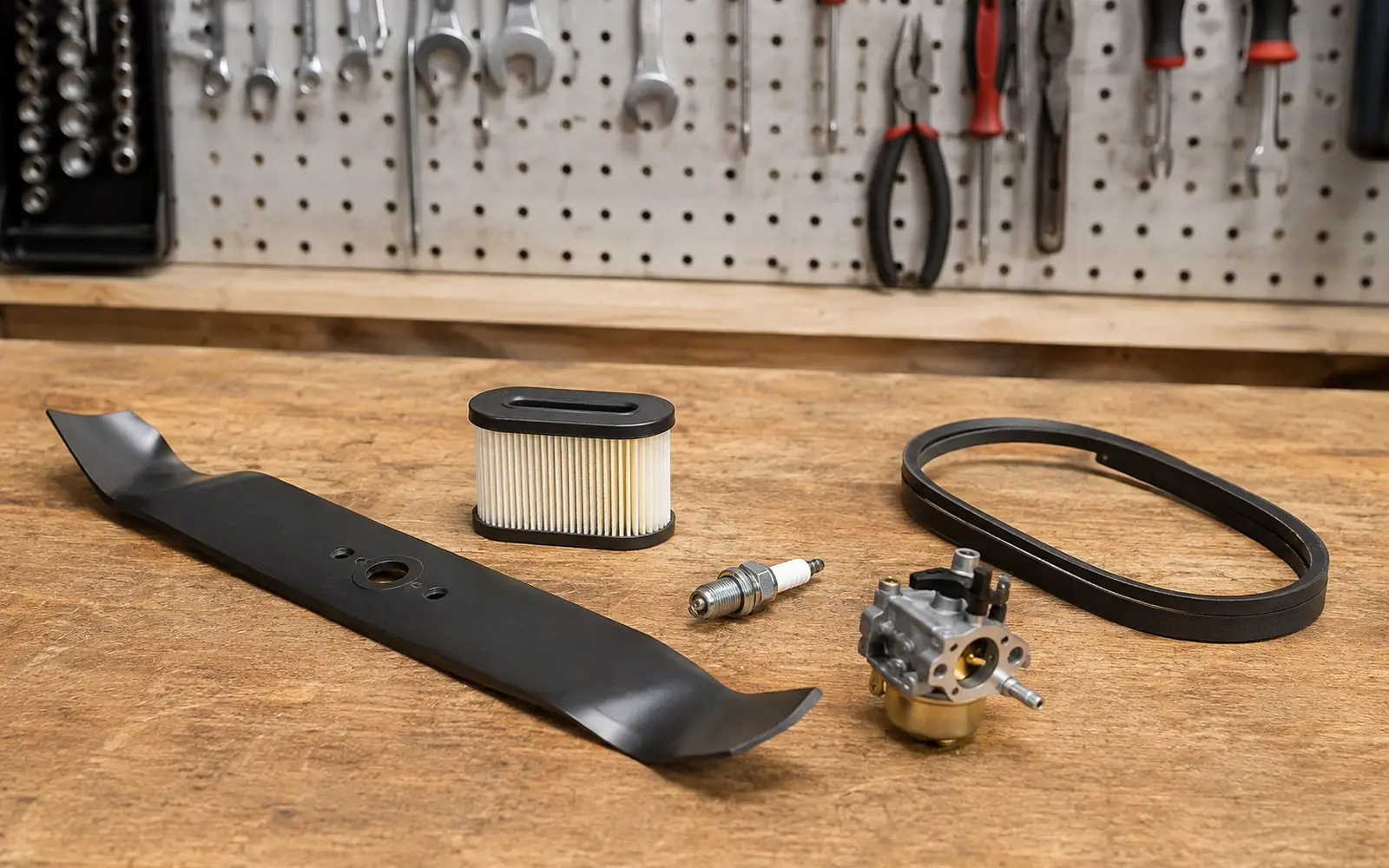
Blades and blade hardware
Blades, bolts, washers and adapters. Low parts cost, low labour on most walk-behinds, which makes this the job where the hourly rate dominates the bill. BLS puts the median hourly wage for maintenance and repair workers, general, at $23.84.1 A shop rate sits above that to cover premises and stock.
Service kit items
Air filters, fuel filters, spark plugs, oil. Individually small, and normally bundled into a scheduled service rather than itemised. Ask whether the service price is a fixed kit or an open list of parts, because that is the difference between a quote you can compare and one you cannot.
Belts, pulleys and spindles
Drive and deck components on riders and self-propelled machines. Parts cost is real and labour is the larger variable, because access decides how long the job takes. This is the category where an estimate should list part numbers, since the same symptom can be a belt or the assembly it runs on.
Carburettors and fuel system parts
Carburettors, fuel lines, tanks, primer bulbs and diaphragms. The estimate should distinguish a bench clean and rebuild from a full replacement, because the parts side of those two is not comparable. This is the most common spring failure on a petrol machine that stood through the winter.
Batteries, chargers and controllers
On cordless machines the battery pack is normally the single most expensive component, which makes correct diagnosis the whole game. Insist the shop establishes whether the pack, the charger or the tool has failed before anything is ordered, and ask what the return position is on an ordered pack.
Irrigation and yard supplies
Sprinkler heads, nozzles and controllers sit in the same supply aisle and behave the same way on price. EPA states a WaterSense labeled controller can cut a home's irrigation water use by up to 30 percent and save up to 15,000 gallons a year, and publishes no purchase price for one.5
What does it cost?
Parts prices are not published by any authoritative body, so this guide gives none. Retailers and dealers are the only real source and their prices move by model, by supplier and by season. The labour half is different. BLS tracks maintenance and repair workers, general, defined as workers who fix and maintain machines, mechanical equipment, and buildings, at a $23.84 median hourly wage and $25.86 mean in May 2025.16 Its Occupational Outlook Handbook, a separate program, reports $48,620 a year and $23.38 an hour for 2024 across 1,629,700 jobs.2 For scale, the same May 2025 table puts electricians at $30.38 median hourly and plumbers at $30.67.1
What you can actually control is the structure of the estimate. Insist on part numbers rather than descriptions, so you can price the same item yourself. Ask whether parts are original equipment or aftermarket, and what warranty attaches to each. Ask what the labour hours are, separately from the parts. Ask whether ordered parts can be returned if the diagnosis changes. And ask when the shop can do it, because BLS describes this work as seasonal, mainly spring, summer and autumn, and parts and bench time both get scarce at the same moment.3
The wage figures are Bureau of Labor Statistics May 2025 and 2024 figures and the water savings are EPA WaterSense estimates, all cited; no source used here publishes any part price, and none is estimated.
How to buy parts and hire the fitting
Who does the work
Dealer parts counters, independent shops, mobile technicians, and you. BLS reports that general maintenance and repair work typically requires a high school diploma or equivalent plus moderate-term on-the-job training, and projects 4 percent growth from 2024 to 2034, a change of 62,400 jobs.2 No federal source in this guide requires a licence to fit a part to a mower.
What pros will ask
Model number and serial number off the deck, and the engine numbers off the shroud, because those are what the parts lookup actually uses. Deck width. Roughly what year the machine is. Whether you want original equipment parts or will accept aftermarket. Whether you are fitting it yourself or want it fitted. What the machine is doing now, in case the part you asked for is not the fault.
What to check before signing
Get part numbers written on the estimate, not descriptions. Get parts and labour hours as separate lines. Confirm original equipment or aftermarket for each part, with the warranty on both the part and the fitting. Confirm the return position on anything ordered in. Then ask the question that settles most older machines: are parts for this model still supplied?
Related searches homeowners make
Pulled from the same demand data behind our Lawn Care & Handyman category.
Parts and supply questions, answered straight
How much should mower parts cost?
There is no authoritative answer, and this guide will not invent one. Federal agencies publish wages and outcomes, not hardware prices. The workaround is straightforward: get the part number on the estimate rather than a description, then price that same number yourself at a dealer or two. That turns an unverifiable line item into a comparable one. The labour beside it can be checked against the published $23.84 median hourly wage for maintenance and repair workers, general.1
Original equipment or aftermarket parts?
Nothing in the sources used here compares them on durability, fit or failure rate, so a confident answer would be invented. What you can do is make the difference visible. Ask which the estimate assumes, ask for the price of each, and ask what warranty attaches to the part and separately to the labour of fitting it. If a shop will not warrant its own fitting on an aftermarket part, that tells you something about how it rates the part.
How do I know if parts are still available for my machine?
Ask a dealer parts counter with the model number, serial number and engine numbers in hand. It is the single most useful call you can make about an older machine, because an unsupported model settles the repair-or-replace question no matter what the arithmetic says. Do it before you pay a diagnostic fee. No published dataset tracks parts availability by model, so there is no way to look this up other than asking someone who can run the lookup.6
Is it cheaper to fit parts myself?
It removes a labour charge whose published floor is a $23.84 median hourly wage, and $25.86 mean, for maintenance and repair workers, general.1 Treat that as a floor rather than a shop rate. It is a broad occupation covering machines, mechanical equipment and buildings, not a mower specialty.2 Against the saving, weigh the risk that you order the wrong part, and check the return terms first. Blade and filter work is a very different proposition from a spindle or a drive assembly.
Why do public sources publish savings but never prices?
Because that is what they are for. EPA measures outcomes: it states that a WaterSense labeled controller can reduce an average home's irrigation water use by up to 30 percent and save up to 15,000 gallons a year, and that if every home with an automatic sprinkler system installed and properly operated one, the country could save up to $4.5 billion in water costs and 390 billion gallons annually.45 What those same pages never carry is a purchase price. Prices come from sellers, and sellers are not a published dataset.
Where these facts came from
Every figure on this page was read out of the page linked below. We do not cite cost aggregators.
- BLS, Occupational Employment and Wage Statistics, May 2025, Table 1
- BLS, Occupational Outlook Handbook, general maintenance and repair workers
- BLS, Occupational Outlook Handbook, grounds maintenance workers
- EPA WaterSense, labeled irrigation controllers
- EPA WaterSense, statistics and facts
- BLS, Occupational Employment and Wages news release, USDL-26-0725
Get quotes for your lawn mower parts and supply project
Free for homeowners. No obligation. Up to four local pros compete.
Keep planning
More guides from the Lawn Care & Handyman hub.
Lawncare Maintenance Services
What the crew earns, what chemical treatment legally requires, and why no honest source publishes a price for a mowing visit.
Read the guideLawn Mower Repair
No source publishes a mower repair rate. Here is the federal wage data that gets closest, and how to read an estimate without one.
Read the guideHandyman Contractor Services
The dollar figure above which your handyman legally needs a contractor licence, quoted from statute in six states, and why no two match.
Read the guide