
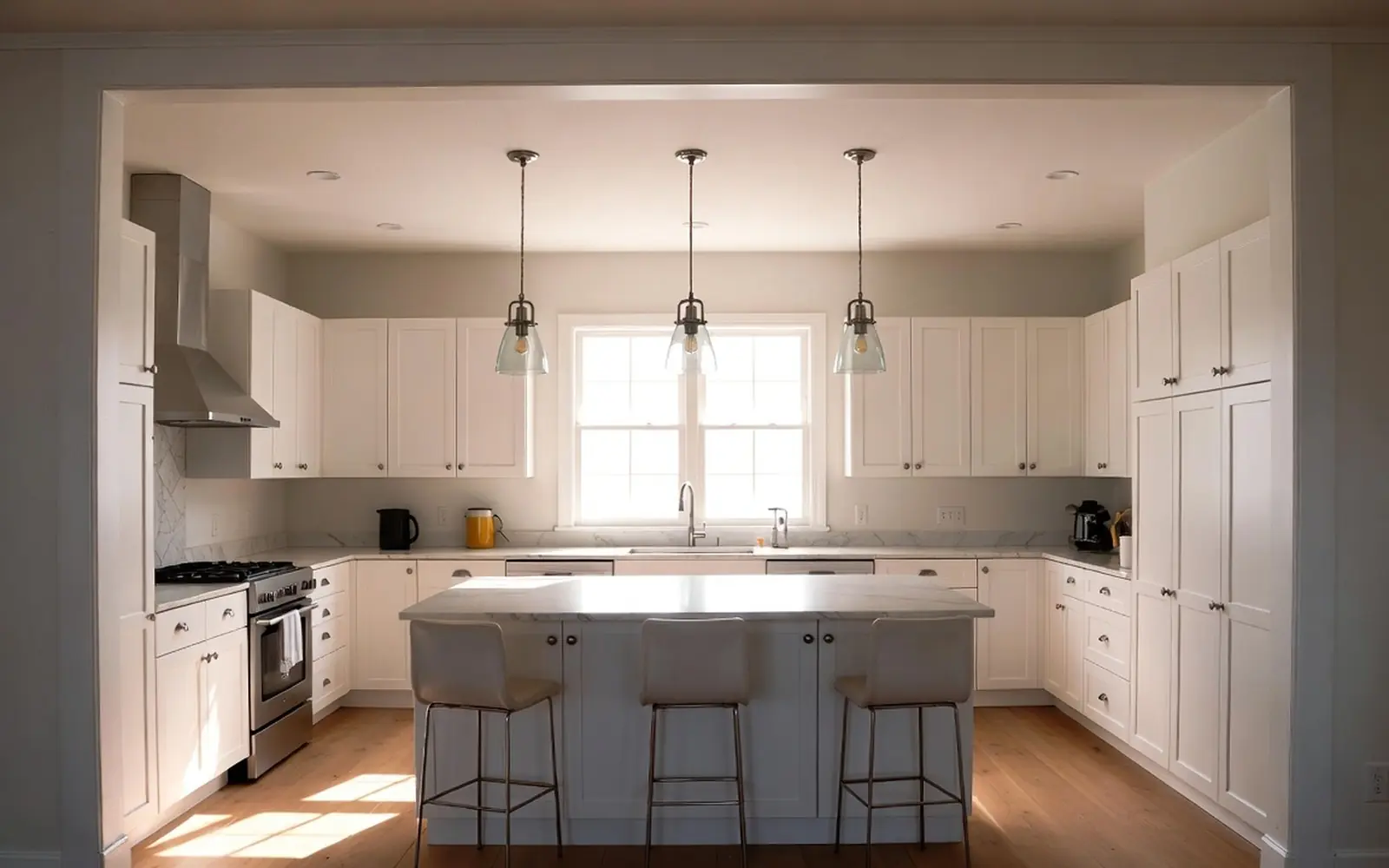
Kitchen Lighting
The cheapest upgrade with the biggest effect on how the room feels, and the one most kitchens get wrong.
One ceiling fixture is not a lighting plan
Most kitchens are lit by a single ceiling fixture that puts the cook's own shadow on the cutting board. Fixing that is the highest ratio of effect to cost in kitchen remodeling, which is why lighting holds its own block of demand in our keyword data.
Designers plan kitchens in three layers. Ambient light fills the room, usually from recessed cans or a central fixture. Task light hits the work surfaces: under-cabinet strips over counters, pendants over islands. Accent light adds depth: inside glass cabinets, above uppers, at the toe kick. A kitchen with all three layers on separate switches or dimmers feels custom even when nothing else changed.
Two practical notes before shopping. First, color temperature: keep every fixture in the room in the same range, usually 2700K to 3000K for warm or 3500K to 4000K for neutral; mixing them looks accidental. Second, most lighting work beyond swapping a fixture on an existing box is electrician territory, both for safety and because codes in kitchens are specific about circuits.
The fixture menu, layer by layer
Installed ballparks assume existing wiring nearby; cutting new circuits into a finished ceiling costs more than the fixtures.
Recessed cans and wafer LEDs
The ambient workhorse, roughly $100 to $300 each installed. Space them to wash counters, not the walkway, and dim them.
Island and peninsula pendants
Task plus style, commonly $100 to $350 each installed plus the fixture. Hang 30 to 36 inches above the counter; odd numbers read best.
Under-cabinet lighting
The single best task upgrade, roughly $200 to $500 per run installed. Hardwired LED strips beat plug-in pucks for looks and switching.
Ceiling and flush fixtures
A statement flush mount or semi-flush replaces the builder dome for the cost of the fixture plus a modest swap fee on an existing box.
Cabinet and toe-kick accents
LED strips inside glass uppers, above cabinets, or at the floor line. Pure atmosphere, cheap when wired during a remodel, fussy after.
Dimmers and smart switches
The multiplier for everything above. Separate switching per layer is the difference between a lighting plan and a light.
What does it cost?
Swapping one fixture on an existing box is a $150 to $400 handyman or electrician visit plus the fixture. A full lighting plan for a midsize kitchen, say six cans, three pendants and under-cabinet runs with dimmers, commonly lands between $2,000 and $4,000 installed when done during a remodel with ceilings open.
The same plan retrofitted into finished ceilings costs more because of access and patching. That is the argument for doing lighting during any remodel: the marginal cost of getting it right while walls are open is small.
Ballparks based on commonly published national averages, stated as assumptions, not measured local pricing. Your competing quotes set the real number for your home and ZIP.
How to hire for kitchen lighting work
Who does the work
Licensed electricians for anything involving new wiring, circuits or boxes. Handymen can swap like-for-like fixtures in most areas. In a remodel, the electrician works from the design plan before drywall closes.
What pros will ask
A sketch or photos of the kitchen, ceiling type and what is above it, panel capacity, which fixtures you have picked, and whether you want dimmers or smart switches. Fixture choices in hand mean firmer quotes.
What to check before signing
That the quote states fixture supply versus labor only, includes patching and paint for any ceiling cuts, and that the electrician is licensed and will pull a permit where required.
Related searches homeowners make
Pulled from the same demand data behind our Kitchen Remodeling category.
Kitchen Lighting questions, answered straight
What are the three layers of kitchen lighting?
Ambient fills the room (recessed cans, a central fixture), task lights the work (under-cabinet strips, island pendants), and accent adds depth (in-cabinet and toe-kick LEDs). Separate switches or dimmers per layer is what makes it feel deliberate.
How many recessed lights does my kitchen need?
A common rule of thumb is one 4 to 6 inch LED can per 20 to 30 square feet, placed so light lands on counters rather than behind the cook. A lighting layout from your electrician or designer beats any rule of thumb.
What height do island pendants hang?
Typically 30 to 36 inches from countertop to the bottom of the fixture. Size them so the group spans roughly two thirds of the island length; three smaller pendants usually read better than two large ones.
Do I need an electrician or can a handyman do it?
Like-for-like fixture swaps on existing boxes are handyman work in most places. New circuits, new boxes, under-cabinet hardwiring and anything touching the panel is licensed electrician work, and kitchens have specific code requirements, so do not improvise.
What color temperature should kitchen lights be?
Pick one range and stick to it everywhere: 2700K to 3000K for a warm look, 3500K to 4000K for a cleaner neutral. Mixed temperatures in one room is the most common giveaway of an unplanned lighting job.
Get quotes for your kitchen lighting project
Free for homeowners. No obligation. Up to four local kitchen pros compete.
Keep planning your kitchen
More guides from the Kitchen Remodeling hub.