
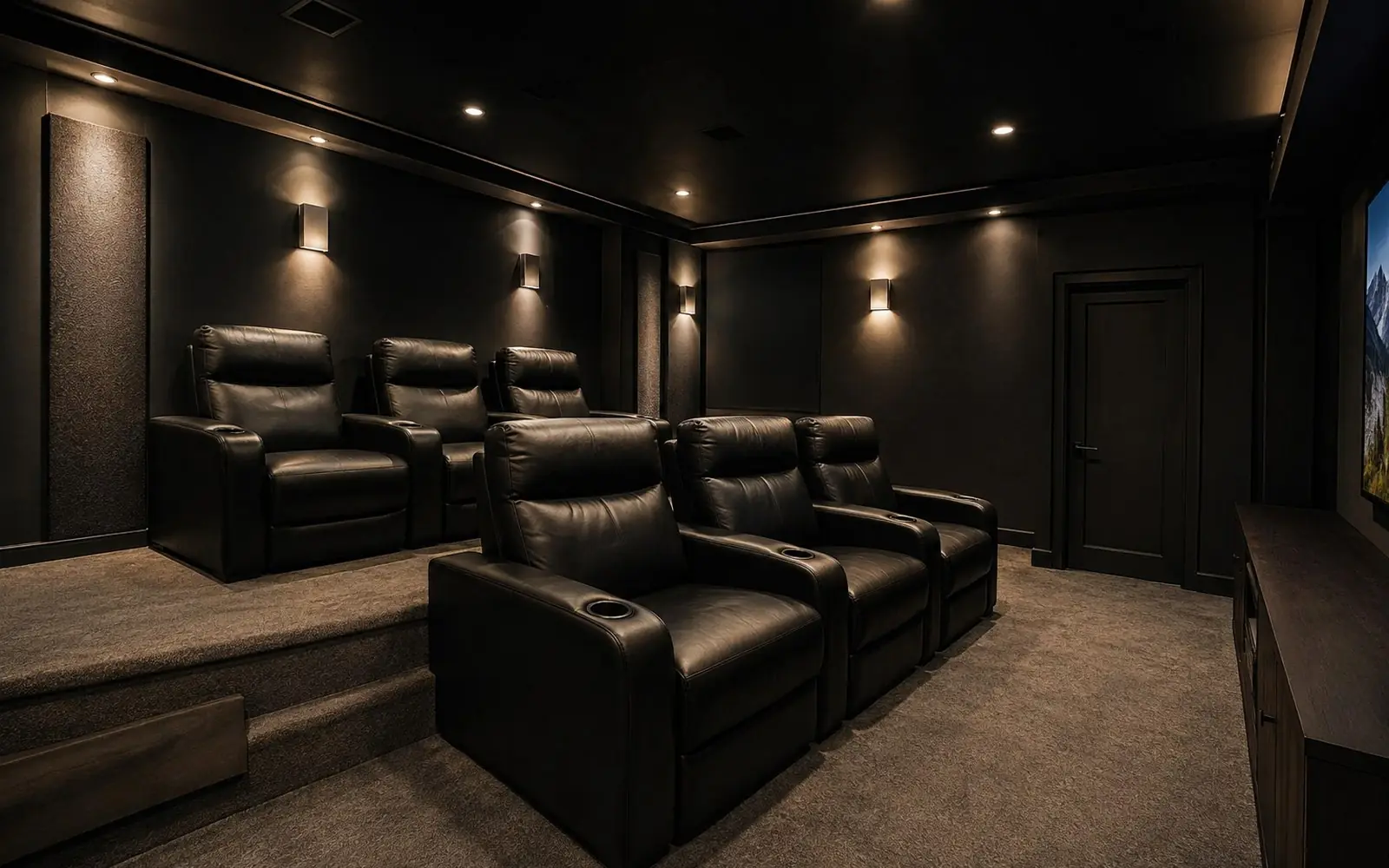
Home Theater Seating and Chairs
Why no seat price is published anywhere, and what a riser and powered recliners actually require from your electrical rough-in.
No manufacturer publishes a theater seat price you can check
Start with the honest part. No manufacturer or specialist retailer of home theater seating was found publishing a per seat price in a form that could be read and verified for this guide. Category pages render without prices, or direct you to a phone number. That is a real gap, and it is the reason every seating figure you see quoted online is a quote rather than a published price.
What can be pinned down is everything around the chair. Powered recliners need a 120 volt outlet at each seating position, and that outlet is ordinary branch circuit work. It is not covered by the low voltage exemption, which reaches only wiring operating at less than 25 volts and not capable of supplying more than 50 watts of energy3.
The riser is the other half. A stepped platform for a second row is carpentry, and carpenters have a 2025 median hourly wage of $29.12 across national employment of 670,09045. Building one also changes the room electrically, because a riser and a false wall change what counts as wall space under the receptacle spacing rule2.
Six things that decide your seating scope
None of these is about the chair. All of them change what it costs to install.
Rows, and whether you build a riser
One row needs no platform. A second row usually does, and that platform is framing work rather than AV work. Carpenters have a 2025 median hourly wage of $29.12 and an annual median of $60,58046. Decide row count before anyone frames a wall, because the riser has to be built into the room, not added to it.
Powered seats mean branch circuits
A motorised recliner draws mains power at the seat. That puts an outlet in the face of the riser or the floor beneath each chair, and it is regular 120 volt work. The IRC exemption for equipment under 25 volts and not capable of supplying more than 50 watts does not reach it3.
Those outlets need arc-fault protection
The 2023 NEC at 210.12(B) requires AFCI protection for branch circuits supplying all newly installed 120 volt, 15 and 20 amp outlets or devices in family rooms, recreation rooms and similar rooms1. Seating outlets are in that list, and the AFCI device itself has to sit somewhere readily accessible1.
A riser rewrites the 6 foot rule
NEC 210.52(A) requires that no point measured horizontally along the floor line in any unbroken wall space is more than 6 feet from a receptacle outlet, and a receptacle in each wall space 2 feet or more in width2. Add a riser or a false wall and you have changed the floor line the rule measures from.
Step and aisle lighting still needs a switch
Whatever scene control you buy, NEC 210.70(A) requires at least one listed wall-mounted control device to control lighting outlets in every habitable room, near the entrance2. A receptacle controlled by that device is permitted in a room like this2. Plan the switch location before the seating layout fixes the door swing.
Prices are quoted, not listed
Because no per seat price is published, the only defence is a written quote with model numbers on it, priced per seat and per row separately. Ask what the row price includes: arms, consoles, power, and whether the riser sits in the seating quote or the builder's scope.
What does it cost?
This guide cannot give you a per seat figure, because none is published in a checkable form. Seating brands either block automated retrieval or serve category pages with no price in them, and the specialist retailers expose no readable price list. Any confident per seat range you find online is either a dealer quote or an aggregator estimate with no stated methodology. Ask three dealers for written pricing on named models instead.
The parts around the seat can be reasoned about. The riser is carpentry, and carpenters have a 2025 median hourly wage of $29.12, an annual median of $60,580, and national employment of 670,090465. Those are wages paid to employees, not what a firm bills you, which also carries insurance, vehicles and margin. The electrical is a licensed electrician's scope, with a 2025 median hourly wage of $30.387. No source found states how many dedicated circuits a theater's seating, rack and subwoofers typically need, so ask your electrician to work it from the actual load.
There is no seating price here because none could be sourced from any manufacturer or retailer. Wage figures are BLS 2025 OEWS series, reporting employee earnings rather than billed rates. Code text comes from Saint Paul DSI handouts reproducing the 2023 NEC.
How to hire for theater seating and a riser
Who does the work
Often three parties. A seating dealer supplies and places the chairs. A carpenter frames the riser, at a 2025 median hourly wage of $29.12 across 670,090 people nationally45. A licensed electrician runs the seat outlets, at a $30.38 median hourly wage7. Where an integrator coordinates all of it, CEDIA reports the median firm employs five people8.
What pros will ask
Seat count and how many rows, then whether the chairs are powered or manual, because that decides if there is electrical work at all. Then riser height and depth, room width against seat width, whether the seats need power at the arm, where the door is and which way it swings, and whether the riser has to clear an existing floor duct.
What to check before signing
Insist on a written per seat price with model numbers, since nothing is published to check it against. Confirm in writing who builds the riser. Ask whether the seat outlets are arc-fault protected1, and whether receptacle spacing still meets the 6 foot rule once the riser changes the floor line2. Then confirm outlets are roughed in before the platform closes.
Related searches homeowners make
Pulled from the same demand data behind our Home Theater & Media category.
Seating questions, answered straight
What does home theater seating cost per seat?
No manufacturer or retailer price could be sourced for this guide, so there is no honest number to give you. Seating brands either refuse automated retrieval or publish category pages with no price in the markup, and the specialist retailers do not expose a readable price list. That is unusual for a product this common, and it is why online figures vary so wildly. Get three written quotes on named models, priced per seat, and compare those instead.
Do powered recliners need a dedicated circuit?
They need an outlet at the seat, and that outlet is ordinary 120 volt work, not exempt low voltage3. Whether it needs a dedicated circuit is a load question your electrician answers from the actual equipment. No authoritative source publishes a typical circuit count for a media room's seating, rack and subwoofers combined, so be wary of anyone who states one confidently. What is not optional is arc-fault protection on newly installed outlets in a room like this1.
Do I need a riser for a second row?
This guide will not give you a sightline formula, because no viewing standard was verified for it here and the rules of thumb in circulation are repeated far more often than they are sourced. What is verifiable is that a riser is a build item, not a furniture item. It is carpentry4, it has to be framed before finishes go on, and it changes the floor line that the receptacle spacing rule measures from2. Ask your installer to name the standard behind their recommendation.
Are outlets in the face of a riser subject to AFCI?
Yes, on the reading of the code in front of us. The 2023 NEC at 210.12(B) covers branch circuits supplying all newly installed 120 volt, 15 and 20 amp outlets or devices in family rooms, recreation rooms and similar rooms of a dwelling1. A riser outlet in a media room is a newly installed outlet in that kind of room. The requirement also reaches extensions and modifications to an existing branch circuit in those areas1, so partial work does not escape it.
Can I choose seating after the room is built?
You can choose the fabric later. You cannot choose the layout later without cost. The outlet positions for powered seats have to be roughed in before the riser is closed and before drywall, and the riser dimensions come from the seat dimensions. So the chairs need specifying, at least by size and power requirement, before framing. Get the manufacturer's dimensioned drawing to the builder early, even if the order is not placed.
Where these facts came from
Every figure on this page was read out of the page linked below. We do not cite cost aggregators.
- Saint Paul DSI, AFCI protection under the 2023 NEC
- Saint Paul DSI, dwelling unit rough-in electrical checklist
- 2021 IRC R105.2, electrical permit exemptions
- BLS OEWS, median hourly wage for carpenters
- BLS OEWS, employment for carpenters
- BLS OEWS, annual median wage for carpenters
- BLS OEWS, median hourly wage for electricians
- CEDIA, US professional smart home industry research
Get quotes for your home theater seating and chairs project
Free for homeowners. No obligation. Up to four local pros compete.
Keep planning
More guides from the Home Theater & Media hub.
Wireless Home Theater
Wireless removes speaker cable, not power. Here is what that means for outlet placement, arc-fault protection and what you can actually price.
Read the guideHome Theater Furniture
Racks, built-ins and acoustic panels: the one furnishing category with published prices, and the one that is really carpentry.
Read the guideMedia Center PCs
A media PC is a source device. The money is in configuration, the rack outlet behind it, and knowing which trade to call.
Read the guide