
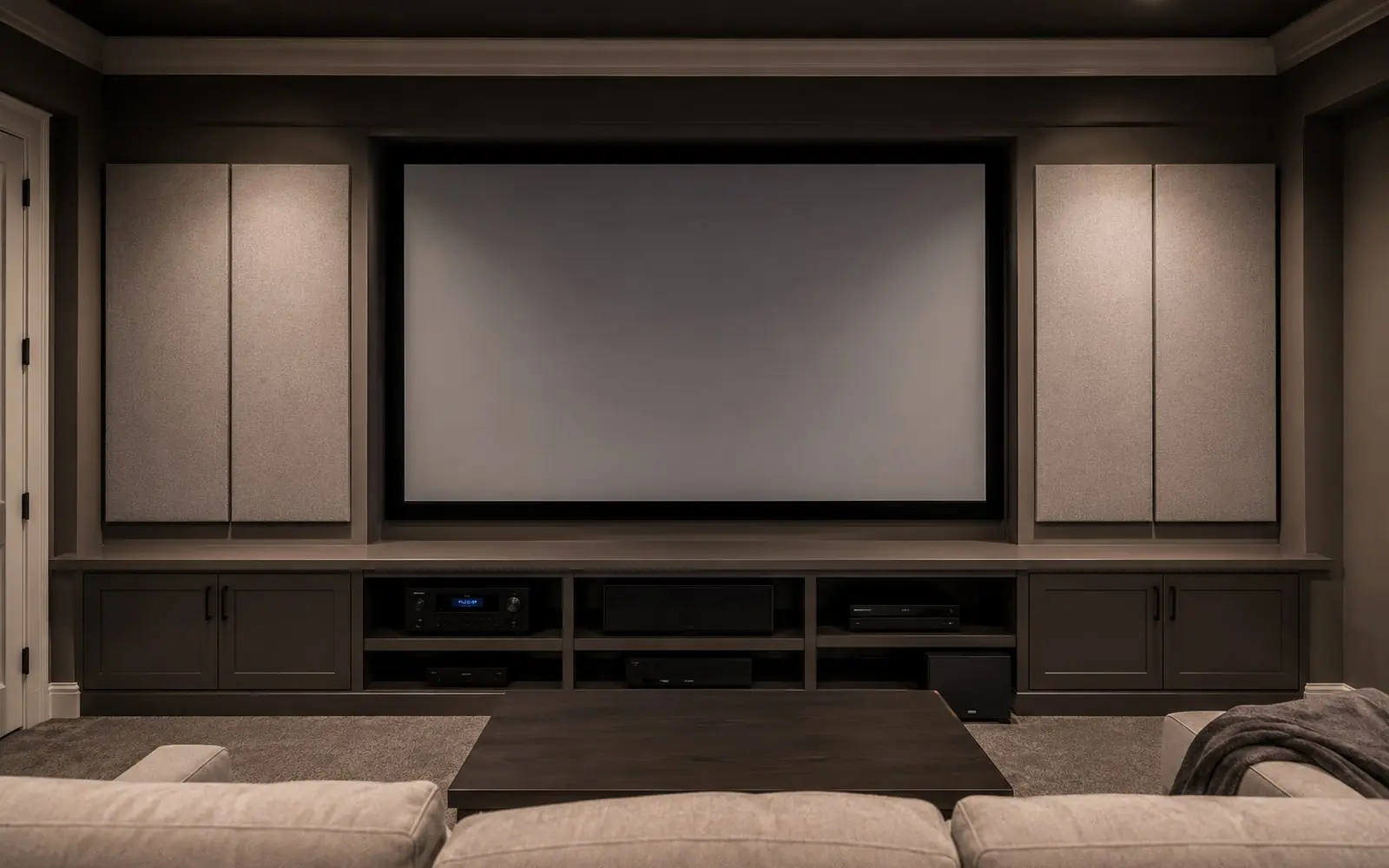
Home Theater Furniture
Racks, built-ins and acoustic panels: the one furnishing category with published prices, and the one that is really carpentry.
Most theater furniture is carpentry, and only panels have published prices
Home theater furniture splits into two groups that behave completely differently on a budget. The first is things a manufacturer sells with a price on them. In this category that is essentially acoustic panels, and GIK Acoustics publishes its whole range on its own product feed, from a GridFusor at $69.00 to Acoustic Art Panels reaching $619.001.
The second group is anything built into the room. Equipment closets, screen walls, soffits and risers are carpentry, not AV, and carpenters have a 2025 median hourly wage of $29.12 with an annual median of $60,580 across national employment of 670,090234. None of that comes with a catalogue price, because it is made to fit your walls.
Knowing which group a line item sits in tells you how to price it. Panels you can check against a published feed before you agree to anything. Millwork you price by getting three quotes on a drawing. Confusing the two is how furniture budgets drift, because a built-in gets quoted like a product and a product gets quoted like a build.
What you are actually buying, priced where possible
Four published price bands from one manufacturer, and two categories where nothing is published.
Acoustic panels, $69.00 to $619.00
GIK publishes GridFusor at $69.00, Ceiling Acoustic Panels from $74.00 to $159.00, DecoShape Acoustic Panels from $75.00 to $95.00, Amplitude Acoustic Panels from $104.00 to $219.00, and Acoustic Art Panels from $179.00 to $619.001. The spread inside one product line is mostly size and finish.
Bass traps, which live in corners
GIK lists Amplitude Bass Trap Panels at $134.00 to $349.00, TriTrap Corner Bass Traps at $179.00 to $299.00, SlatFusor Corner Bass Traps at $219.00 to $299.00, Amplitude Corner Bass Traps at $229.00 to $299.00, Soffit Corner Bass Traps at $249.00 to $459.00, Scopus Tuned Membrane Bass Traps at $349.00 and TurboTrap Cylindrical Bass Traps at $399.001.
Diffusers, the expensive end
Gotham Primitive Root Diffusers are $249.00, Q7D Quadratic Residue Diffusers run $299.00 to $449.00, and Q11D Quadratic Residue Diffusers run $399.00 to $599.001. GIK also lists SoundBlocks from $249.00 to $999.001. These are the items where a single decision moves a treatment budget by hundreds.
Room kits, $999.00 to $1,699.00
GIK publishes Room Kits at $999.00 to $1,699.001. This is the most useful figure in the category, because it is a manufacturer pricing a whole-room treatment package rather than a single panel. It gives you a benchmark to hold any bespoke treatment proposal against.
Built-ins and equipment closets
Screen walls, soffits, equipment closets and cabinetry are carpentry work, not AV work, and no published price exists for them because each one is made to a drawing. What is published is the wage side: a 2025 median hourly wage of $29.12 for carpenters, across 670,090 people nationally24.
Racks and media consoles
No manufacturer published price for an AV rack or a media console could be sourced for this guide, so any figure you are shown is a quote. Get it itemised, and get the rack's internal dimensions and the gear list in the same document, because a rack that does not fit the equipment is an expensive mistake.
What does it cost?
Here is a transparent bill of materials for one treatment set, using published prices only. Four Amplitude Acoustic Panels at $104.00 each is $416.00. Two TriTrap Corner Bass Traps at $179.00 each is $358.00. Two Gotham Primitive Root Diffusers at $249.00 each is $498.00. That totals $1,272.001. Set that against GIK's own Room Kits at $999.00 to $1,699.001 and you can see why the kits exist: they land in the same territory as a hand-picked set, without the guesswork.
Nothing about the built-in side can be priced this way. Equipment closets, screen walls and consoles are made to fit, so they are quoted, not listed. Budget them as carpentry, at a 2025 median hourly wage of $29.12 and an annual median of $60,58023, remembering that a wage is not a billing rate. And be clear what treatment is not: acoustic panels control how sound behaves inside the room, not how much of it reaches the rest of the house. That is isolation, a framing job, and no published price for it was obtainable.
Panel prices are manufacturer published figures from the GIK Acoustics product feed, read on 6 August 2026. The bill of materials is arithmetic on those prices, materials only, and excludes mounting, shipping, tax and labour. Wages are BLS 2025 OEWS series and report employee earnings, not billed rates.
How to hire for theater furniture and built-ins
Who does the work
Two different people, and you should know which one you are talking to. Built-ins, screen walls and equipment closets are carpentry, a trade of 670,090 people with a 2025 median hourly wage of $29.1224. The rack build and gear layout is AV work. Where one firm handles both, CEDIA reports the median integration firm employs five people7.
What pros will ask
The full equipment list first, because rack depth and the number of rack units come from it. Then whether the console is freestanding or built in, what the wall construction is, where cable enters the room, and how the doors on any cabinet will open once seating is in place. For panels, they will ask about room dimensions and wall surfaces.
What to check before signing
Ask for panels by product name and quantity, then check each price against the manufacturer's own published feed1. Refuse any proposal that describes acoustic treatment as soundproofing, because they are different jobs. Confirm who builds the millwork and to whose drawing. And check the outlet plan behind any built-in, since a cabinet changes usable wall space under the receptacle spacing rule5.
Related searches homeowners make
Pulled from the same demand data behind our Home Theater & Media category.
Furniture and treatment questions, answered straight
Will acoustic panels soundproof my room?
No, and this is the most common misunderstanding in the category. Acoustic treatment controls how sound behaves inside a room, reflections and resonances. Isolation stops sound leaving it, through decoupled framing, resilient channel, mass loaded vinyl and layered drywall, and it is decided before the walls close. They are different product categories doing different jobs. No published price for isolation assemblies was obtainable for this guide, so treat isolation quotes as quotes and never let a panel proposal be sold to you as soundproofing.
How many panels does a room need?
There is no published rule this guide can hand you, and anyone quoting a fixed panel count for an unseen room is guessing. What is useful is that the manufacturer answers the question itself with a package: GIK publishes Room Kits at $999.00 to $1,699.001. That is a treatment supplier pricing a whole room rather than a panel, which gives you a benchmark. If a bespoke proposal is far above it, ask what the extra items are doing that the kit does not.
What does a custom equipment closet or media cabinet cost?
Nothing authoritative is published, because every one of them is made to a drawing. Price it as carpentry and get three quotes on the same drawing rather than three descriptions. For context on the labour side, carpenters have a 2025 median hourly wage of $29.12, an annual median of $60,580, and national employment of 670,090234. Those are employee earnings, not what a cabinet shop bills, which also carries shop overhead, materials and margin.
Is it cheaper to buy panels individually or as a kit?
Work it through with published numbers. Four Amplitude Acoustic Panels at $104.00, two TriTrap Corner Bass Traps at $179.00 and two Gotham Primitive Root Diffusers at $249.00 comes to $1,272.001. GIK Room Kits are $999.00 to $1,699.001, so the hand-picked set sits inside the kit range rather than below it. Individual selection buys you control over what goes where. It does not reliably buy you a lower total.
Does a built-in cabinet change my electrical plan?
It can. NEC 210.52(A) requires that no point measured horizontally along the floor line in any unbroken wall space is more than 6 feet from a receptacle outlet, and that a receptacle is installed in each wall space 2 feet or more in width5. A run of built-in cabinetry redefines what that wall space is. Sort the outlet positions with the electrician while the millwork is still a drawing, and confirm who is applying for any permit the work needs6.
Where these facts came from
Every figure on this page was read out of the page linked below. We do not cite cost aggregators.
- GIK Acoustics, published product and price feed
- BLS OEWS, median hourly wage for carpenters
- BLS OEWS, annual median wage for carpenters
- BLS OEWS, employment for carpenters
- Saint Paul DSI, dwelling unit rough-in electrical checklist
- 2021 IRC R105.1, permits required
- CEDIA, US professional smart home industry research
Get quotes for your home theater furniture project
Free for homeowners. No obligation. Up to four local pros compete.
Keep planning
More guides from the Home Theater & Media hub.
Media Center PCs
A media PC is a source device. The money is in configuration, the rack outlet behind it, and knowing which trade to call.
Read the guideHome Theater Systems & Speakers
What a receiver and a speaker package actually cost, built from prices Denon, Marantz and SVS publish on their own pages.
Read the guideHome Theater Projectors and Mounts
Published projector and screen prices, plus the electrical code that decides what mounting a projector at the ceiling actually involves.
Read the guide