
Wireless Home Theater
Wireless removes speaker cable, not power. Here is what that means for outlet placement, arc-fault protection and what you can actually price.
Wireless removes the speaker cable, not the outlet behind it
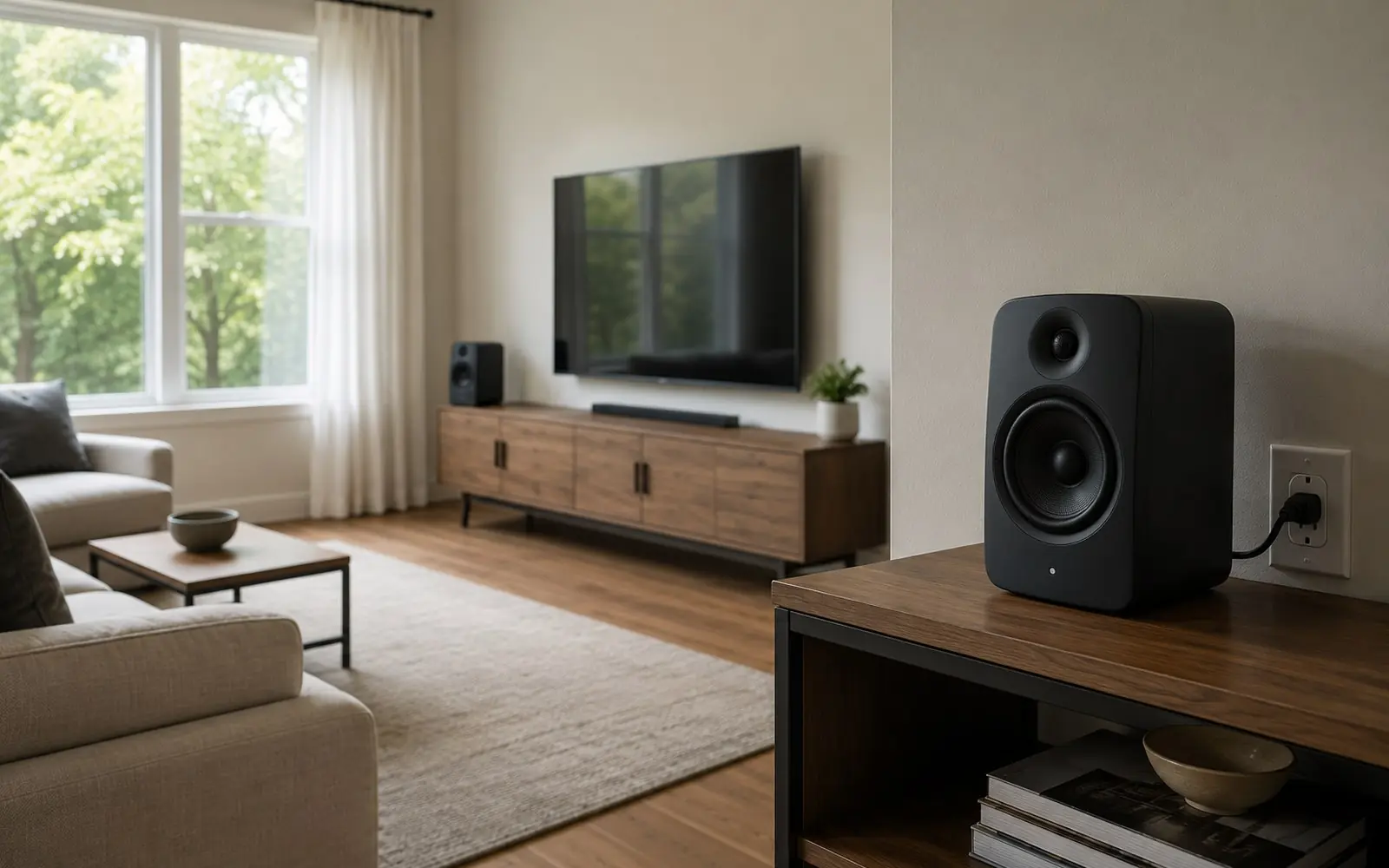
A wireless home theater is a system where audio travels to the speakers without speaker cable. Every one of those speakers is still a powered device, so each position needs a 120 volt outlet. That is the trade you are making: you delete a cable run through walls and you add an electrical requirement at each speaker location.
This matters because of where those locations are. NEC 210.52(A) requires that no point measured horizontally along the floor line in any unbroken wall space is more than 6 feet from a receptacle outlet, with a receptacle in each wall space 2 feet or more in width2. Surround positions are usually behind and beside the seating, which is exactly where a room is thinnest on outlets.
Prices in this category are hard to pin down. SVS publishes a Prime Wireless Pro Powered Speaker Pair at $899.99 on its own product feed1, and that is the one figure here that can be checked. No soundbar price could be sourced for this guide, and no whole-home control platform publishes end user pricing that was reachable, so treat every other number you are given as a dealer quote.
What wireless changes, and what it does not
Six practical consequences, mostly electrical, and one published price.
Powered speaker pairs, $899.99
SVS lists the Prime Wireless Pro Powered Speaker Pair at $899.99 in its published product feed1. Powered means the amplifier is in the cabinet, which is what lets the pair work without a receiver behind it. It is also why each cabinet has to reach a mains outlet.
An outlet at every speaker position
This is the requirement people discover after the drywall is up. A wireless surround behind the seating needs power there, and a rear wall in a finished basement often has one outlet on it. Adding a new one is branch circuit work, so it is planned with the electrician, not with the AV installer.
The 6 foot rule sets your options
NEC 210.52(A) requires no point along the floor line in unbroken wall space to be more than 6 feet from a receptacle, and a receptacle in each wall space 2 feet or more wide2. Read your room against that rule and you will know immediately which speaker positions are free and which cost money.
New outlets need arc-fault protection
The 2023 NEC at 210.12(B) requires AFCI protection for branch circuits supplying all newly installed 120 volt, 15 and 20 amp outlets or devices in family rooms, recreation rooms and similar rooms of a dwelling, with the AFCI in a readily accessible area3. Extensions and modifications to an existing branch circuit are covered too3.
The low voltage exemption will not save you
The IRC exempts wiring and equipment operating at less than 25 volts and not capable of supplying more than 50 watts of energy4. That is the basis for skipping a permit on signal wiring. It says nothing about the 120 volt outlets your wireless speakers plug into, which are ordinary permitted electrical work4.
Keeping a receiver is still an option
Wireless is not all or nothing. Denon publishes wired AV receivers from $449 for the AVR-S570BT upward, including the DRA-900H at $7995. A hybrid room, wired where cable is easy and wireless where it is not, is a legitimate design rather than a compromise, and it usually costs less than either extreme.
What does it cost?
One comparison can be built honestly from published prices. A powered pair, the SVS Prime Wireless Pro, is $899.991. A wired front pair using the SVS Ultra Evolution Bookshelf at $599.99 each is $1,199.98, and adding an entry Denon AVR-S570BT at $449 makes $1,648.9815. That is a $748.99 gap on the front of the room. It is not like for like, since a receiver drives many more channels than a stereo pair, but it does show why powered speakers look cheap at the start and stop scaling later.
The cost wireless adds is electrical, and it is published nowhere. An outlet behind the seating means a licensed electrician, arc-fault protection3, and possibly a permit4. What is published is context: audiovisual equipment installers had a 2025 median hourly wage of $25.29 across national employment of just 19,78067, and CEDIA counts roughly 20,000 integrators serving the US market8. It is a small trade, and small trades price accordingly.
Speaker and receiver prices are manufacturer published figures read on 6 August 2026, materials only, excluding labour and electrical work. No soundbar or control platform price appears because none could be sourced. Wages are BLS 2025 OEWS series, employee earnings rather than billed rates.
How to hire for a wireless system
Who does the work
Two trades, and people underestimate the second. Setup and configuration is AV work, done by audiovisual equipment installers, a trade with national employment of just 19,780 and a 2025 median hourly wage of $25.2967. Any new outlet at a speaker position is a licensed electrician's scope, and it should be quoted separately so you can see it.
What pros will ask
Where the seats go, then where each speaker has to sit, and then the honest question: what is already on that wall. They will ask about your network, since wireless audio rides on it, about wall construction, and about whether the room is finished, because that decides whether new outlets are a rough-in or a fishing job through closed walls.
What to check before signing
Ask for the outlet plan, not just the speaker plan. Confirm every new receptacle is arc-fault protected and that the device is readily accessible3. Check the layout still satisfies the 6 foot spacing rule once furniture and any riser are in2. And ask who is pulling the electrical permit, since that duty falls on the owner or their authorised agent4.
Related searches homeowners make
Pulled from the same demand data behind our Home Theater & Media category.
Wireless questions, answered straight
Is a wireless home theater really wireless?
No, and the distinction is worth being blunt about. Wireless means no speaker cable between the source and the speaker. Every powered speaker still plugs into the wall. So a system marketed as wireless can require more electrical work than a wired one, because a wired surround needs only a low voltage cable run while a wireless surround needs a 120 volt outlet at the same spot. The IRC exemption for equipment under 25 volts and not capable of supplying more than 50 watts covers the cable, not the outlet4.
Can I skip the AV receiver entirely?
For a stereo pair, yes. SVS publishes a Prime Wireless Pro Powered Speaker Pair at $899.99 with the amplification built in1. For a surround layout it is harder, and the price ladder shows why: Denon receivers start at $449 for the AVR-S570BT and run to $7,199, with channel count driving the steps5. If you think you will want surround or height channels later, buying a receiver now is usually the cheaper path to get there.
Where can I actually put wireless speakers?
Wherever there is an outlet, which is a smaller set of places than people expect. NEC 210.52(A) sets the baseline: no point along the floor line in unbroken wall space more than 6 feet from a receptacle, and a receptacle in every wall space 2 feet or more in width2. That rule assumes bare walls. Once bookcases, a riser and seating go in, some of those outlets become unusable in practice. Walk the room and mark the reachable positions before you buy.
How much does a wireless soundbar cost?
No soundbar price could be sourced for this guide. The manufacturer pages that were tried either refused automated retrieval or served no price in the markup, so there is no figure here to stand behind, and quoting one from memory would be inventing it. The same applies to whole-home control and automation platforms, which are dealer quoted rather than list priced. If a comparison matters to you, get written quotes on named model numbers and compare those.
Do I need a permit for wireless speakers?
For the speakers themselves, generally not, because signal and control wiring falls under the exemption for equipment operating at less than 25 volts and not capable of supplying more than 50 watts4. For new outlets, usually yes. The IRC requires a permit from anyone intending to install, alter, repair, remove, convert or replace an electrical system4, and the exemption preamble states plainly that being exempt does not authorise work done in violation of this code or any other law4.
Where these facts came from
Every figure on this page was read out of the page linked below. We do not cite cost aggregators.
- SVS, published product and price feed
- Saint Paul DSI, dwelling unit rough-in electrical checklist
- Saint Paul DSI, AFCI protection under the 2023 NEC
- 2021 IRC R105.1 and R105.2, permits and exemptions
- Denon, AV receiver category prices
- BLS OEWS, median hourly wage for SOC 49-2097
- BLS OEWS, employment for SOC 49-2097
- CEDIA, US professional smart home industry research
Get quotes for your wireless home theater project
Free for homeowners. No obligation. Up to four local pros compete.
Keep planning
More guides from the Home Theater & Media hub.
Home Theater Furniture
Racks, built-ins and acoustic panels: the one furnishing category with published prices, and the one that is really carpentry.
Read the guideMedia Center PCs
A media PC is a source device. The money is in configuration, the rack outlet behind it, and knowing which trade to call.
Read the guideHome Theater Systems & Speakers
What a receiver and a speaker package actually cost, built from prices Denon, Marantz and SVS publish on their own pages.
Read the guide