
Furniture Refinishing Supply
What a supply house can legally sell you now, what the label threshold actually means, and which supplies have no published price at all.
The classic furniture stripper is leaving the supply chain on schedule
If a product you used to buy is no longer on the shelf, this is usually why. Methylene chloride left the consumer market first: after November 22, 2019, EPA prohibited manufacturing, processing and distributing it for consumer paint and coating removal, prohibited distributing it to retailers for that use, and prohibited retailers from distributing it at all for that use1.
The commercial channel then closed in dated steps, and the dates are worth reading rather than summarising. After February 3, 2025, no distribution to retailers for any use. After May 5, 2025, no retailer distribution for any use, and no manufacture or import for the listed uses. After August 1, 2025, no processing. After January 28, 2026, no distribution in commerce. After April 28, 2026, no industrial or commercial use for the listed uses, subject to three narrow carve-outs1.
There is a threshold that changes how you read a label. The prohibitions in that subpart do not apply to products containing methylene chloride below 0.1 percent by weight, with one exception: that allowance does not apply to the consumer paint and coating removal rule1. So a trace level product can be lawful for some uses and still not for that one. Read the actual product label, not the marketing on the front.
Six categories of refinishing supply, and what is knowable about each
Only one of these six has prices published by the people who make it, which tells you something.
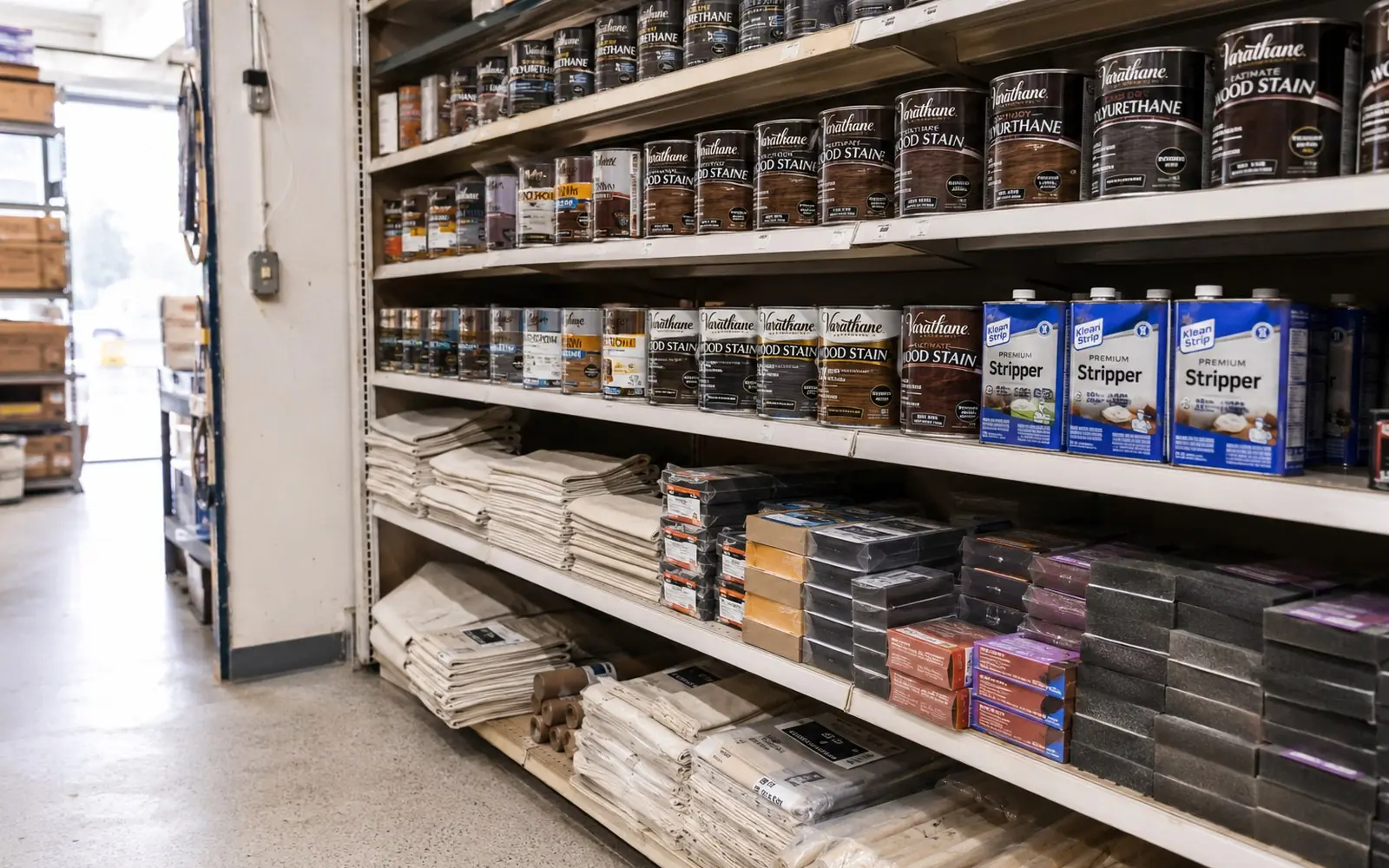
Strippers and finish removers
The regulated category. Methylene chloride products have been off the consumer market since November 22, 2019, and the commercial channel closed through 2025 and 2026 on published dates1. Ask what a replacement product is based on and how long it needs to dwell, because the working method changes with the chemistry.
Abrasives and surface prep
Sandpaper, scrapers, steel wool, tack cloths. Cheap, and the category where the hidden hazard sits. Furniture painted before February 27, 1978 falls outside the federal ban on lead-containing paint5, and sanding is precisely what turns an old painted surface into airborne dust you can breathe.
Stain, sealer and topcoat
Colour goes on, then the film that protects it. No manufacturer feed publishing prices for these was reached in this research, so we have no verified figure to give you. Buy the topcoat and the stain from the same system where you can, and test on the underside first.
Upholstery fabric
The one supply category with published manufacturer pricing. Revolution Fabrics lists yard goods from $8.95 to $55.95 with a median of $25.952. Folio Fabrics lists 54-inch yard goods from $44.00 to $136.00 with a median of $100.003. Both sell samples at $2.00.
Foam, batting, webbing and springs
The consumables that decide whether a rebuilt seat holds up: foam by density and thickness, dacron, cotton batting, jute or elastic webbing, sinuous springs, welt cord, tack strip and thread. No supplier publishing prices for any of these was sourced. Get a written materials list from your shop instead.
Shop safety equipment
Since July 8, 2024, anyone using methylene chloride for furniture refinishing must set up a regulated area, use local exhaust ventilation drawing outside air in and vapours away, and provide a NIOSH approved supplied-air or self-contained respirator with a full facepiece1. That is capital equipment, not a consumable.
What does it cost?
Fabric is the only refinishing and upholstery supply with prices published by the manufacturers themselves. Across 132 Revolution Fabrics products carrying a yard variant, the range runs $8.95 to $55.95 with a median of $25.95, and 51 of those 132 patterns sit at a single price of $12.95, which is exactly why the median is the honest number to quote rather than the average2. Folio Fabrics runs higher: across 250 products with a 54-inch by-the-yard variant, $44.00 to $136.00 with a median of $100.003. Samples are $2.00 at both23.
Everything else in this list has no published price we could verify. Not stripper, stain, sealer or topcoat. Not foam by density, dacron, batting, webbing, sinuous springs, welt cord, tack strip or thread. Not the supplied-air respirator or the ventilated regulated area that EPA has required for methylene chloride refinishing since July 8, 20241. That is a gap in what manufacturers publish, not a gap in what things cost, and the fix is to ask your supplier for a written quote by line item rather than trust a number from a page that did not source it either.
Fabric prices were read on 7 August 2026 from each manufacturer's own published product feed, cover the fabric only, and exclude thread, welt cord, foam, batting, freight, tax and all labour; retail prices move, so treat them as a dated observation.
How to buy refinishing and upholstery supply
Who does the work
Supply dealers are their own licensed category in California, at $625 per location for two years, alongside wholesalers at the same fee and custom upholsterers at $4206. If you are buying rather than doing, you are hiring one of the 14,480 furniture finishers in the country7, and their materials list is the thing worth reading in the quote.
What pros will ask
What the existing finish is, whether the piece has ever been painted, and how old it is. Whether it is going indoors or out. What sheen you want and whether the colour has to match something else in the room. For fabric, the width, the pattern repeat, and whether the piece is a seat, because that changes what is permitted.
What to check before signing
Read the product label and safety data sheet rather than the shelf talker, because the 0.1 percent by weight threshold means low content is not the same as none, and it does not apply at all to consumer paint removal1. Confirm fabric width is 54 inches, which is the standard in the United States48, and buy the $2.00 sample before the yardage.
Related searches homeowners make
Pulled from the same demand data behind our Furniture Repair category.
Refinishing supply questions, answered straight
Can I still buy methylene chloride paint stripper?
Not as a consumer. After November 22, 2019, EPA prohibited manufacturing, processing and distributing methylene chloride for consumer paint and coating removal, and prohibited retailers from distributing it for that use1. The commercial channel then closed in stages, ending industrial and commercial use for the listed uses after April 28, 2026, with a narrow carve-out for refinishing wooden furniture of artistic, cultural or historic significance that itself ends after May 8, 20291.
What does a methylene chloride free label actually mean?
Read the threshold carefully. The prohibitions in EPA's subpart do not apply to products containing methylene chloride at less than 0.1 percent by weight, but that allowance explicitly does not extend to the consumer paint and coating removal rule1. In plain terms, a trace quantity can be lawful in some contexts and still not in that one. If it matters to you, ask for the safety data sheet rather than relying on front-of-can wording.
How much does upholstery fabric cost per yard?
It depends enormously on the book you are shopping from, and both ends are published. Revolution Fabrics lists yard goods from $8.95 to $55.95 with a median of $25.952. Folio Fabrics lists 54-inch yard goods from $44.00 to $136.00 with a median of $100.003. Read together, that is roughly a fifteen times spread between the cheapest and the dearest yard on the same job, which is the single biggest reason two quotes on the same sofa look nothing alike.
Why will you not tell me what foam or stripper costs?
Because we could not verify it. No supplier publishing readable prices for foam by density, dacron, batting, webbing, sinuous springs, welt cord, tack strip, thread, stripper, stain or lacquer was reached in this research. Fabric manufacturers publish, and those numbers appear above. For the rest, ask your supplier or your shop for a line item materials list. A number we cannot point to a source for is worth less to you than the honest gap.
Is it safe to sand old painted furniture at home?
Check the age before you start. The federal ban on lead-containing paint on furniture articles applies to products manufactured after February 27, 1978, so anything painted before that sits outside it5. The rule sets the threshold in excess of 0.06 percent, reduced to 0.009 percent effective August 14, 20095, and lists beds, bookcases, chairs, chests, tables, dressers, desks and sofas as furniture articles5. Sanding is what makes old paint airborne, so test first.
Where these facts came from
Every figure on this page was read out of the page linked below. We do not cite cost aggregators.
- 40 CFR Part 751 Subpart B, EPA methylene chloride restrictions under TSCA
- Revolution Fabrics, published product feed, read 7 August 2026
- Folio Fabrics, published product feed, read 7 August 2026
- Revolution Fabrics, upholstery fabric calculator and 54-inch width note
- 16 CFR Part 1303, ban on lead-containing paint and furniture articles bearing it
- California Bureau of Household Goods and Services, licensing FAQ and fee table
- BLS OEWS, Furniture Finishers (SOC 51-7021), national employment, 2025 annual
- InteriorDecorating.com, upholstery yardage chart and fabric width note
Get quotes for your furniture refinishing supply project
Free for homeowners. No obligation. Up to four local pros compete.
Keep planning
More guides from the Furniture Repair hub.
Upholstery Fabric and Yardage
Published yardage by piece from two charts that disagree, real per-yard prices from two manufacturers, and the arithmetic in between.
Read the guideFurniture Refinishing and Strippers
Refinishing kept one narrow methylene chloride exemption and it expires in 2029. What that means for your piece and the shop you hand it to.
Read the guideAntique Furniture Restoration
Old furniture sits outside the lead paint ban, inside a narrow EPA exemption, and under a modern standard the moment you recover it.
Read the guide