
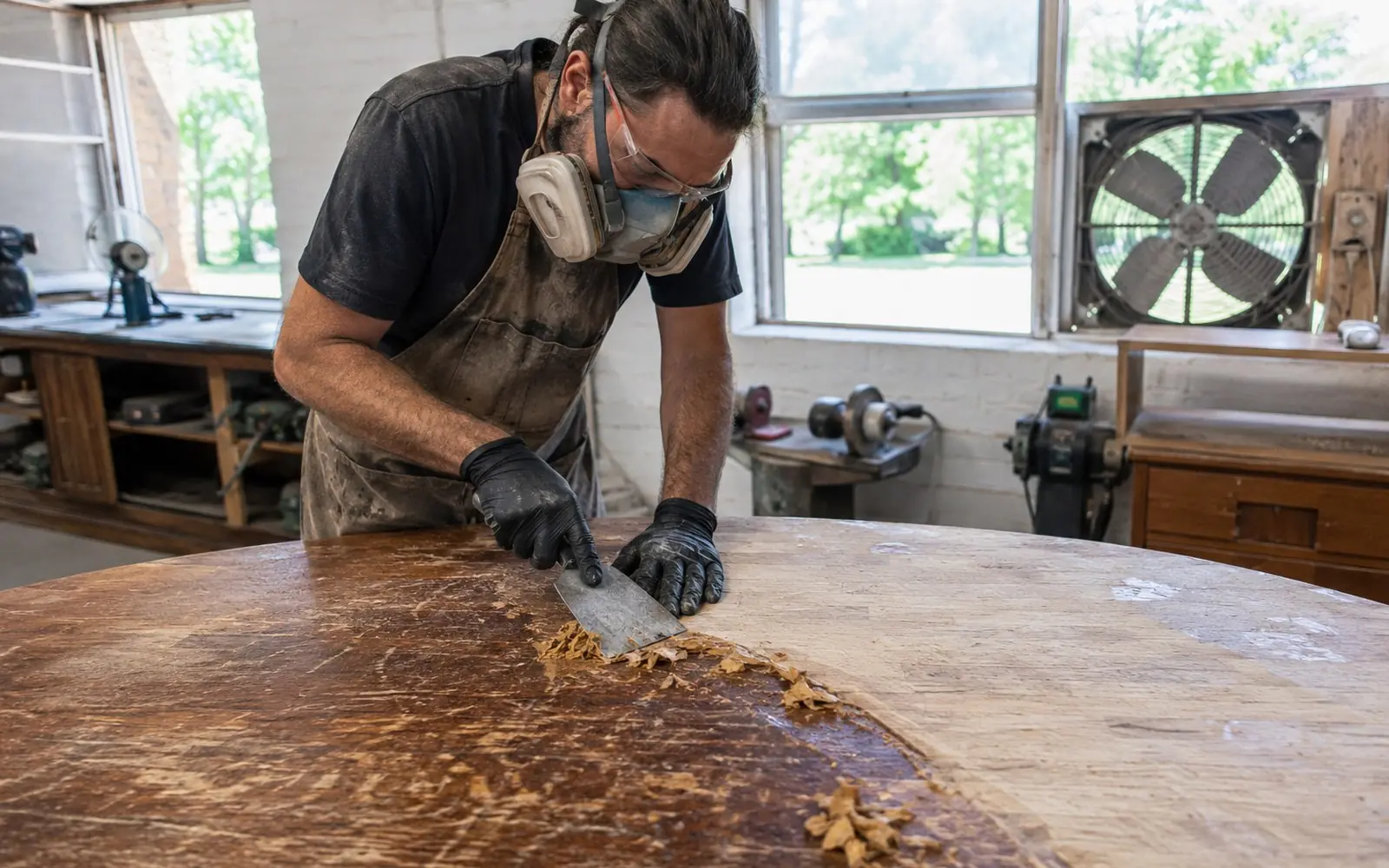
Furniture Refinishing and Strippers
Refinishing kept one narrow methylene chloride exemption and it expires in 2029. What that means for your piece and the shop you hand it to.
Refinishing kept a narrow exemption, and it runs out in 2029
When EPA closed off methylene chloride, furniture refinishing got one of only three carve-outs in the rule. It reads narrowly. After May 8, 2029, all persons are prohibited from manufacturing, processing, distributing or using methylene chloride for industrial or commercial paint and coating removal for refinishing of wooden furniture, decorative pieces and architectural fixtures of artistic, cultural, or historic significance1. That is the whole allowance, and it has a date on it.
The conditions attached to it are already live. Since July 8, 2024, any shop using methylene chloride for that work must establish a regulated area, use local exhaust ventilation that both brings outside air in and pulls vapours away from the person exposed, and provide at minimum a NIOSH approved supplied-air respirator in demand mode with a full facepiece, or a self-contained breathing apparatus in demand mode1.
Read that wording again, because it is narrower than it looks. It covers pieces of artistic, cultural, or historic value, and the shop must write down an explanation of that value for every job1. An ordinary dresser is not obviously inside it. Nothing published states how EPA applies that threshold in practice, so do not let anyone tell you the stripper is simply banned, or simply still available.
Six things to establish before you hand over a piece
Ask these on the phone, before the piece leaves your house. Every one of them changes the job.
What the existing finish is
Shellac, lacquer, varnish, oil, paint and modern conversion coatings all behave differently under a stripper, and identifying which one is the shop's first job. A shop that will not identify the finish before quoting is quoting a guess. Ask what test they used and what it showed.
Whether the piece is painted, and how old
This is the safety question. The federal ban on lead-containing paint applies to furniture articles manufactured after February 27, 1978, so anything painted before that sits outside it5. The rule counts beds, bookcases, chairs, chests, tables, dressers, desks and sofas as furniture articles5. Tell the shop the age before anyone sands.
Whether it qualifies for the exemption
The methylene chloride carve-out is for refinishing wooden furniture, decorative pieces and architectural fixtures of artistic, cultural, or historic significance1. That is a real threshold, not a formality, and the shop is the one carrying the compliance risk. If your piece is ordinary furniture, expect a different chemistry.
What the shop strips with now
Ask the direct question and get a direct answer. If the answer is methylene chloride, the dates in the rule apply and end after May 8, 20291. If it is something else, ask how long it dwells and how many passes it takes, because that is what drives the hours on your invoice.
Whether the shop has the required setup
For methylene chloride work the requirements are specific and have applied since July 8, 2024: a regulated area, local exhaust ventilation drawing air in from outside and vapours away, and supplied-air or self-contained respiratory protection with a full facepiece1. That is capital equipment. A shop that has it will tell you about it.
What record your name goes into
Every exempt job must be documented: the date, a description of the piece and an explanation of its artistic, cultural or historic value, the name of the owner, who did the work, and the product and quantity used1. Those records are kept at least five years1. The owner named is you.
What does it cost?
No authoritative source publishes a price to strip and refinish a piece of furniture. What is published is the labour input. Furniture finishers earn a median of $21.41 an hour and a mean of $21.78 in the 2025 OEWS annual estimates24. Those sit 37 cents apart: this trade has no long upper tail. Whatever makes a refinishing bill large, the wage of the person holding the scraper is not the explanation. These are employee wages, not a billed rate.
The rest of the number is shop overhead, and EPA has just added to it. A refinisher still working with methylene chloride has to run a regulated area, local exhaust ventilation and supplied-air respiratory protection1, and has to write and keep a per-job record for five years1. That is capital and administration rather than materials. We could not source a manufacturer price for a supplied-air respirator system or a ventilated regulated area, so we cannot tell you what that costs a shop, only that it is now a condition of the work.
Wage figures are the 2025 OEWS annual estimates read from the BLS public data API, they are employee earnings rather than a billed shop rate, and they exclude premises, insurance, equipment, materials, markup and margin; no source publishes an installed refinishing price and none is invented here.
How to hire a furniture refinisher
Who does the work
Furniture finishers are a separate federal occupation from upholsterers, SOC 51-7021, with 14,480 people nationally3. That is a small trade, so expect a queue. Licensing is patchy. California's household goods licence categories cover custom upholsterers, manufacturers, retailers, supply dealers, wholesalers, importers and sanitizers6, and refinishing is not named as its own category on that list.
What pros will ask
What the piece is, roughly when it was made, and whether it has ever been painted or previously refinished. Whether you want the original patina preserved or a clean new colour. Whether there is veneer, inlay or a stamped maker's mark to protect. And whether the piece has documented history, which determines which stripping chemistry is available.
What to check before signing
Ask what they strip with, in writing. If they are working under the methylene chloride exemption, ask to see how they meet the regulated area, ventilation and respirator requirements1, and understand that your name and a written explanation of your piece's value will sit in a record kept at least five years1. For anything pre-1978, ask how they handle lead5.
Related searches homeowners make
Pulled from the same demand data behind our Furniture Repair category.
Refinishing and stripper questions, answered straight
Is methylene chloride paint stripper banned?
Not with one word, which is why so many pages get it wrong. It has been off the consumer market since after November 22, 20191. Industrial and commercial use for the listed uses ended after April 28, 2026, with three carve-outs, one of which is refinishing wooden furniture of artistic, cultural, or historic significance1. That carve-out itself ends after May 8, 20291. So it is narrowing on a published schedule, not switched off.
Does my old dresser qualify for the refinishing exemption?
Possibly not, and the shop rather than you carries the risk of getting it wrong. The exemption covers pieces of artistic, cultural, or historic value, and the shop must record a written explanation of that value for each job1. Ordinary furniture is not obviously inside that wording. We found nothing published on how EPA applies the threshold in practice, so treat any shop that answers instantly and confidently either way with some caution.
What equipment does a shop need for this work?
Three things, all required since July 8, 2024 for methylene chloride refinishing. A regulated area. Local exhaust ventilation that both brings air in from outside and pulls vapours away from the person exposed. And at minimum a NIOSH approved supplied-air respirator in demand mode with a full facepiece, or a self-contained breathing apparatus in demand mode with a full facepiece or helmet1. A dust mask and an open window are not on that list.
Will my name end up in a compliance record?
If your piece is stripped under the exemption, yes. The shop must document each instance, including the date, a description of the piece and an explanation of its artistic, cultural or historic value, the owner's name, who performed the work, and the product and quantity used1. Those records must be retained at least five years1. It is the shop's record, and you are the named owner in it.
How worried should I be about lead in an old finish?
Worried enough to mention it before work starts. The federal ban on lead-containing paint on furniture articles applies to products manufactured after February 27, 19785, so most of what arrives at a shop as an antique is outside the ban. The rule sets the limit in excess of 0.06 percent, reduced to 0.009 percent effective August 14, 20095. Stripping and sanding are exactly the operations that put an old finish into the air.
Where these facts came from
Every figure on this page was read out of the page linked below. We do not cite cost aggregators.
- 40 CFR Part 751 Subpart B, EPA methylene chloride restrictions under TSCA
- BLS OEWS, Furniture Finishers, median hourly wage, 2025 annual
- BLS OEWS, Furniture Finishers (SOC 51-7021), national employment, 2025 annual
- BLS OEWS, Furniture Finishers, mean hourly wage, 2025 annual
- 16 CFR Part 1303, ban on lead-containing paint and furniture articles bearing it
- California BHGS, state licensing brochure and licence categories
Get quotes for your furniture refinishing and strippers project
Free for homeowners. No obligation. Up to four local pros compete.
Keep planning
More guides from the Furniture Repair hub.
Antique Furniture Restoration
Old furniture sits outside the lead paint ban, inside a narrow EPA exemption, and under a modern standard the moment you recover it.
Read the guideFurniture Repair and Refinishing Services
Furniture repair is two small trades with different rules. Who does what, what the law requires, and what nobody publishes.
Read the guideUpholstery and Leather Repair Services
Reupholstery is named in a federal safety standard. What that means for your fabric, your labels, and the questions to ask a shop.
Read the guide