
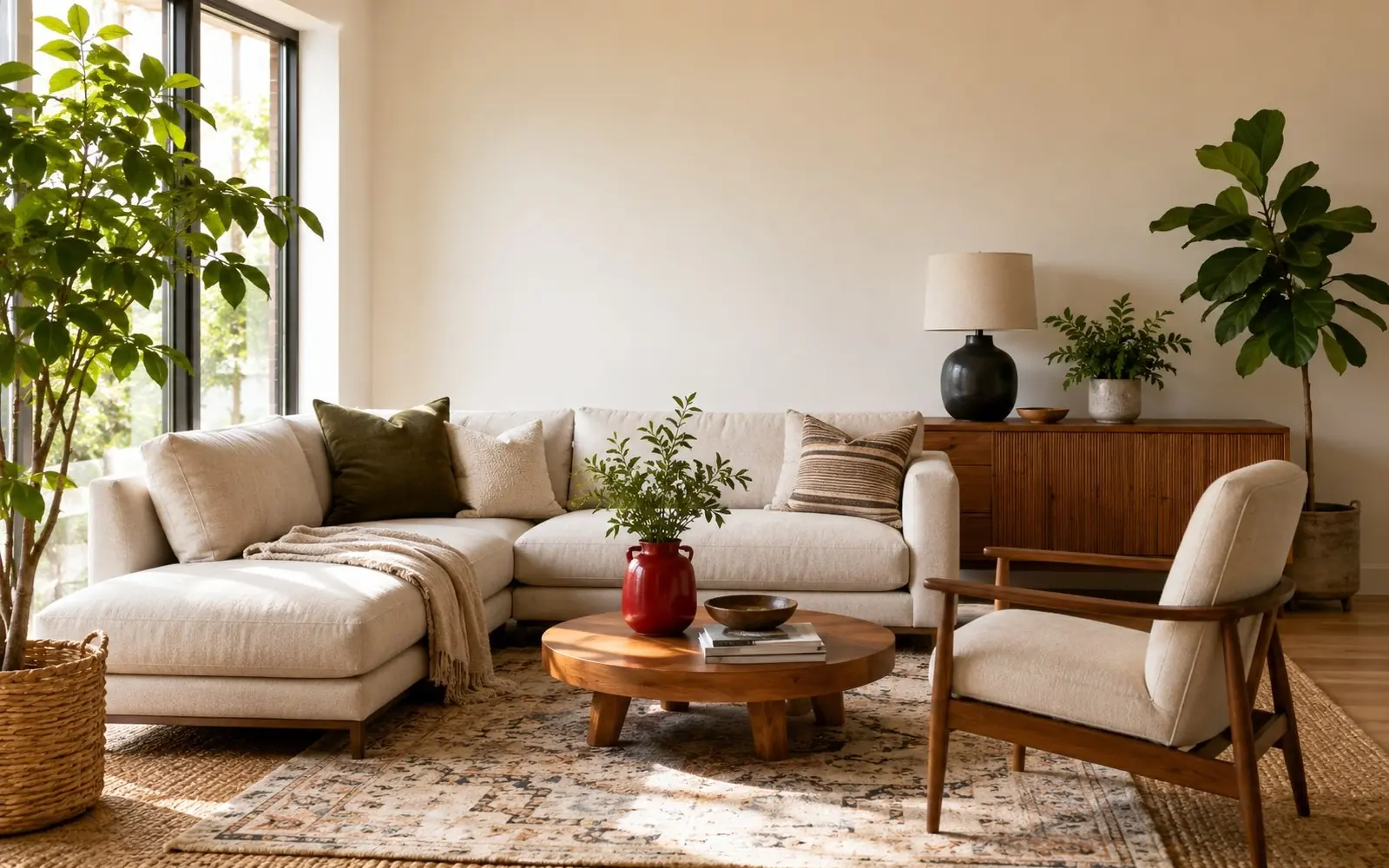
Interior Design Ideas
Everyone has three hundred saved images and no plan. Here is how ideas become a brief that produces a room.
Inspiration is data. Read it like a designer.
Interior design ideas are among the most searched phrases in this category, and the failure mode is universal: an ever-growing gallery of saved rooms and a home that stays the same. The fix is treating your collection as evidence. Spread out your thirty favorite images and audit them for repetition: the same warm woods, the same black window frames, the same low-slung sofas keep appearing. That repeated pattern, not any style name, is your actual taste.
Style vocabulary still earns its keep as shorthand. Knowing that your pattern reads as, say, warm minimalism or transitional or japandi lets you search better, brief professionals faster and filter purchases with a phrase instead of a paragraph. The names are compass points, not laws; nearly every good real home is a mix with one dominant note.
Then comes the translation step that separates ideas from outcomes: constraints. Your rooms have fixed light, floors, openings and budgets, and an idea only survives contact with those by being adapted, the palette borrowed rather than the architecture, the mood recreated at your ceiling height. This is precisely the skill designers sell, and precisely what a good brief lets them do quickly.
From saved images to executable plan
The working method, one step per card.
Audit your gallery
Pick your top thirty saved rooms and list what repeats: tones, materials, shapes, mood. Three honest sentences of pattern beat any style quiz.
Name the direction
Match your pattern to the nearest style vocabulary and note your deviation from it. That one line makes every search, store and designer conversation efficient.
Anchor each room
Choose the one thing each room organizes around, a rug, a paint color, a sofa, a view, and let it veto everything that fights it.
Map ideas to constraints
Your light, your floors, your ceiling heights, your budget. Adaptation is the craft: borrow the palette and mood, not the architecture you do not have.
Build the room board
One page per room: anchor, palette, three key pieces, lighting intent. If the board looks coherent, the room will; boards are cheap, sofas are not.
Sequence the purchases
Rug and large furniture first, paint matched to them second, lighting and textiles third, art and styling last. Order of operations prevents most regret.
What do ideas cost to execute?
The brief itself is free, and it multiplies every dollar after it: shops become filterable, sales become resistible, and a designer consultation spent reacting to your board delivers in one hour what unbriefed discovery takes weeks to reach.
Execution costs whatever your scope costs, but sequenced correctly, big anchors first, styling last, each phase leaves the room livable and the budget recoverable. Ideas executed out of order are how rooms end up owning three wrong rugs.
Ballparks based on commonly published national averages, stated as assumptions, not measured local pricing. Your competing quotes set the real number for your home and ZIP.
How to move from ideas to a room
Do the pattern audit
Thirty images, one list of repetitions, three sentences of conclusion. This is the whole secret; everything after is logistics.
Make the one-page board
Anchor, palette, key pieces, lighting for the target room. Test purchases against it and watch impulse buys fail the audition.
Buy a professional hour
Take the board to a design consultation, in person or e-design. Reacting to a real brief, a pro sharpens it dramatically in a single session, the best money in this field.
Related searches homeowners make
Pulled from the same demand data behind our Interior Design category.
Interior Design Ideas questions, answered straight
How do I figure out my interior design style?
Audit your own saved images for what repeats, tones, materials, shapes, then match the pattern to the nearest named style as shorthand. Your taste is the pattern; the name is just its address.
Why does my room not look like the pictures?
Usually lighting, scale and editing: photographed rooms have controlled light, correctly scaled furniture and everything nonessential removed. Fix lighting layers, size the rug up and remove five objects; the gap closes fast.
Can I mix styles without it looking random?
Yes, with a dominant note and a repeated connector: one style leading, the second as accents, and a recurring color or material tying them. Most beloved real homes are exactly this.
Where should ideas come from besides social feeds?
Hotels you loved, friends' homes that felt right, film interiors, and showrooms you can sit in. Physical spaces teach scale and comfort in a way images cannot, and your gallery gets smarter for it.
What is the cheapest idea with the biggest impact?
Paint chosen after the furnishings, corrected lighting, and one oversized piece of art or mirror. All three read as design rather than decoration, and none requires moving a wall.
Turn the idea board into a project
Free for homeowners. No obligation. Up to four local pros compete.
Keep planning your design project
More guides from the Interior Design hub.
Color in Design
How designers choose palettes, and why swatches lie in your lighting.
Read the guideHiring a Designer
Designer vs decorator, portfolios, fee models and the brief that gets results.
Read the guideResidential Design
How whole-home and room-by-room design engagements actually run.
Read the guide