
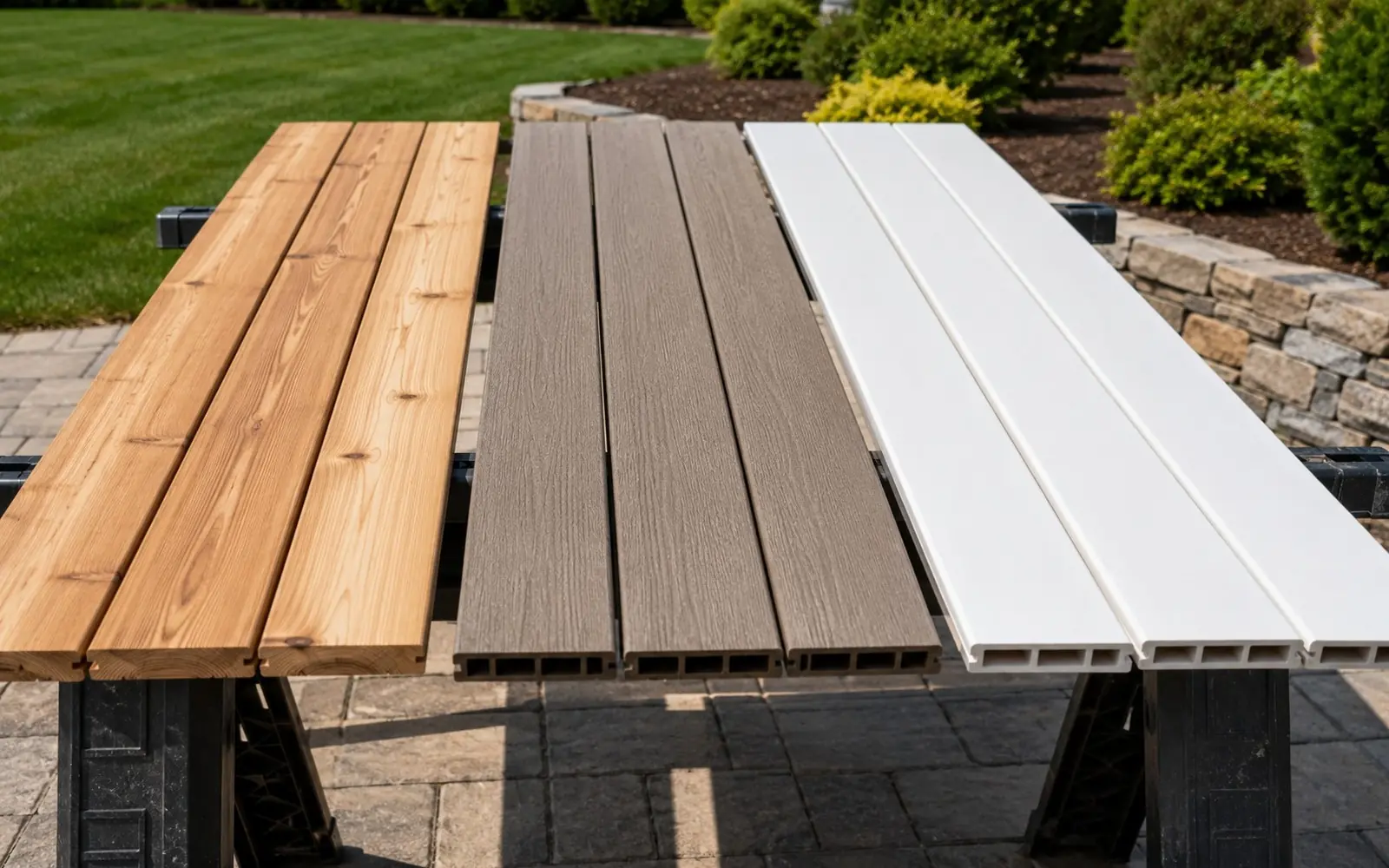
Decking Materials: Wood vs Composite
The board choice sets the budget, the maintenance calendar and how the deck looks in year ten. Compare honestly before you commit.
The decision every deck quote hinges on
Material questions run all through our demand data: deck wood, deck materials, composite decking and brand names like Trex show up thousands of times, and the wood versus composite debate is the first fork in every deck conversation. The framing underneath is pressure-treated lumber either way; the argument is about the surface you walk on and look at.
Wood wins the upfront price and the feel underfoot. Pressure-treated pine is the budget standard, cedar and redwood cost more and look better doing it, and tropical hardwoods like ipe sit at the top on both price and lifespan. Every wood deck signs you up for the same chore: cleaning and re-staining every two to three years, forever. Skip it and the surface grays, checks and splinters.
Composites and PVC flip the math. Boards cost roughly double budget wood, but maintenance drops to soap and water, colors hold for decades and warranties commonly run 25 years or more. Over a deck's life the totals converge, which is why the real question is whether you would rather pay upfront or pay in weekends.
The main decking options compared
Framing is treated lumber regardless; this is the walking surface.
Pressure-treated pine
The budget workhorse on most decks. Cheapest to install, fine for decades if maintained, but it moves, checks and demands regular stain.
Cedar and redwood
Naturally rot-resistant softwoods with real beauty. Mid-priced, gentler underfoot in heat, and still on the two to three year stain cycle.
Composite decking
Wood-plastic boards that never need stain. Higher upfront cost, long warranties and consistent color; quality varies meaningfully by line.
PVC decking
All-plastic boards, lightest and most moisture-proof of all. Top of the price range and the standard answer around pools and lake docks.
Tropical hardwoods
Ipe and its cousins: extremely dense, decades of life, gorgeous. Premium price, specialized fastening and oiling to hold the color.
Hidden fasteners and trim
Fastening systems, fascia and picture-frame borders are where composite decks earn their finished look, and a real chunk of the material bill.
What does it cost?
Commonly published ballparks put pressure-treated decks around $15 to $25 per square foot installed, cedar in the mid $20s to $30s, and composite or PVC around $30 to $60 depending on line and railing choices. Tropical hardwoods price with premium composites.
Add the maintenance ledger when comparing: a wood deck's wash-and-stain cycle costs several hundred dollars every couple of years, hired out, for the life of the deck. That is the line where composite claws back its premium.
Ballparks based on commonly published national averages, stated as assumptions, not measured local pricing. Your competing quotes set the real number for your home and ZIP.
How to hire for decking material work
Who does the work
The same deck builders and carpenters install every material, but composite lines have installation specs, gapping rules and hidden fastener systems that matter for warranty. Ask any bidder how many decks they have built in your specific product family.
What pros will ask
Deck size and framing condition if it is a re-deck, sun exposure, whether pets and pools are in play, and your appetite for maintenance. Resurfacing quotes also need joist spacing, since some composites require 12 inch centers on angles.
What to check before signing
That the quote names the exact product line and color, not just composite. That fastening method and board gapping follow the manufacturer spec, which protects the warranty. And on re-decks, that the framing gets inspected and priced separately.
Related searches homeowners make
Pulled from the same demand data behind our Decks, Fences and Patios category.
Decking Materials questions, answered straight
Is composite decking worth the extra cost?
If you plan to keep the home a decade or more, usually yes: no staining, long warranties and steady looks. If you are selling within a few years, pressure-treated wood delivers the same function for far less cash upfront. It is a time-horizon decision more than a quality one.
How long does each decking material last?
Common expectations: pressure-treated 15 to 25 years with maintenance, cedar 15 to 20, quality composite and PVC 25 to 50 under warranty, ipe 40 plus. Neglect shortens wood dramatically; composite mostly shrugs it off.
Can I put composite boards on my existing frame?
Often, yes. If the joists are sound and spacing meets the product spec, resurfacing swaps just the boards and railings for a fraction of a full rebuild. A builder should probe the framing first; rotten joists under new boards is money burned.
Does composite decking get hot in the sun?
Darker composite and PVC boards do get noticeably hot, hotter than wood in many cases. In full-sun yards, pick lighter colors, look at heat-mitigating lines, or plan shade. Sample boards left in the sun answer this question better than brochures.
What maintenance does a wood deck really need?
A wash and inspection every spring, and a clean plus stain or sealer every two to three years. Hired out, that stain cycle commonly runs several hundred dollars per visit depending on size. Budget for it honestly or buy the material that does not need it.
Get quotes for your decking project
Free for homeowners. No obligation. Up to four local deck, fence and patio pros compete.
Keep planning your outdoor project
More guides from the Decks, Fences and Patios hub.
Deck Repair, Staining and Sealing
The stain cycle, safety fixes and the restore vs rebuild call.
Read the guideWood and Privacy Fences
Privacy panels, pickets, cedar upgrades and property line rules.
Read the guideVinyl, Aluminum and Chain Link Fences
Vinyl privacy, aluminum, iron and chain link by the foot.
Read the guide