
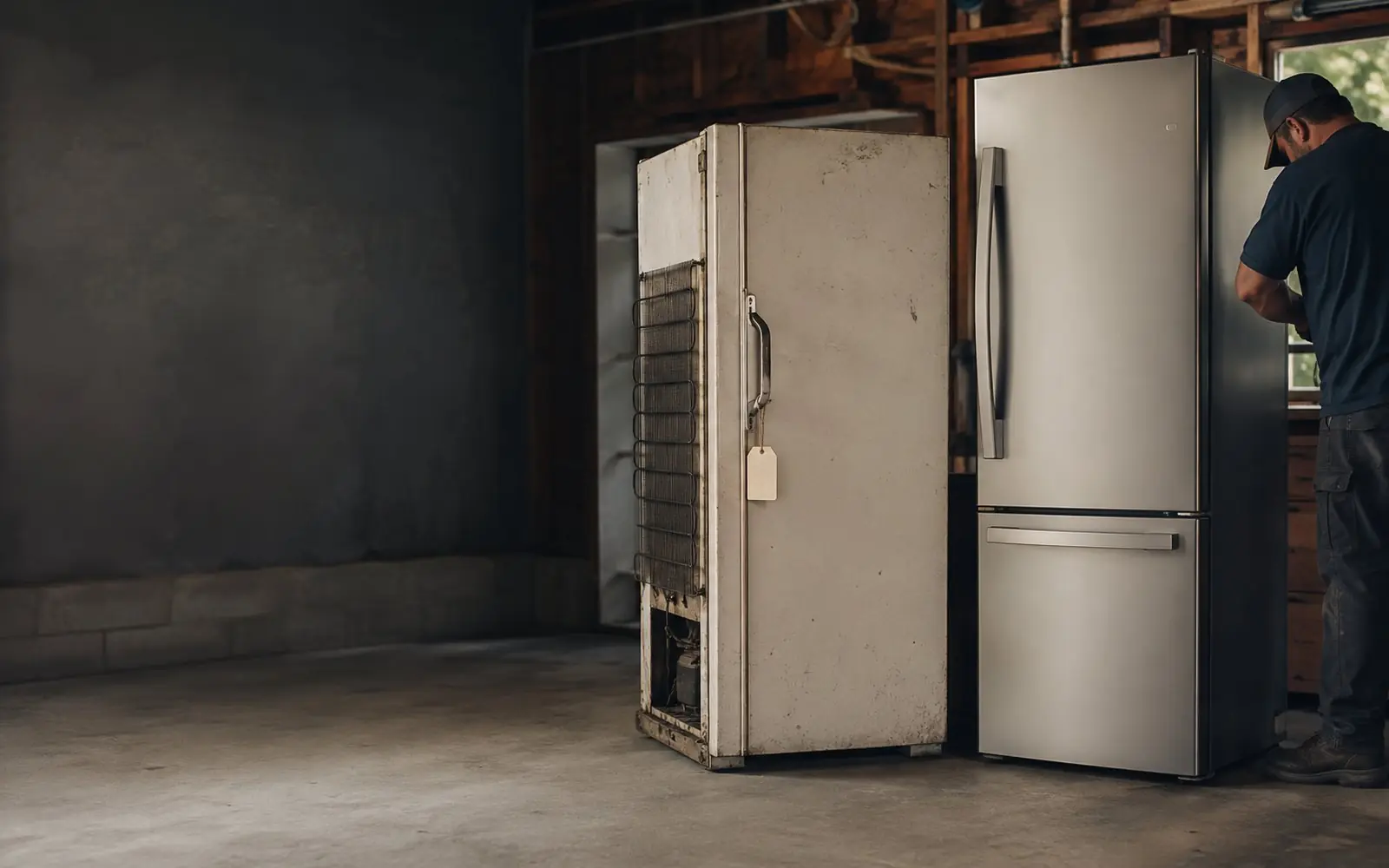
Repair or Replace
The inputs to this decision that are actually published, the ones that are not, and why the rule of thumb everyone quotes has nothing behind it.
Only one number in this decision comes from a government source
The decision has a clean shape and a dirty data set. You are weighing the repair quote against the replacement price, the remaining life of the machine against the life of a new one, and the running cost of the old unit against the new one. Four inputs. Three of them are not published by anybody.
Here is the exception, quoted as ENERGY STAR prints it, grammatical slip included: "Refrigerators over 15 years old could be costing you more about $95 per year to run." The same page adds that on average, an old refrigerator uses about 20% more energy than a model that has earned the ENERGY STAR1. That is the whole of the official arithmetic available to a homeowner making this call.
So this page does two things. It hands you the inputs you can establish yourself, and it names the ones nobody can. It also declines to repeat the rule of thumb you have read a hundred times, the one about repairing only when the repair costs less than half the replacement. No primary source for it was located and no agency publishes any threshold at all.
Six inputs to the repair or replace decision
Two carry published numbers. The rest are questions you can answer at home this evening.
What the old machine burns
ENERGY STAR puts refrigerators over 15 years old at about $95 per year to run, and says an old refrigerator uses about 20% more energy on average than one that has earned the label1. If your unit is past that age, it is already losing money quietly, before any technician turns up.
What that figure does not tell you
The ENERGY STAR page does not state the electricity price used, the baseline model, or the year the estimate was calculated1. It cannot be recomputed for your tariff or your house. Use it as a direction of travel rather than a line item, and check your own meter if the number matters.
Whether the part still exists
In California, covered products wholesaling at $100 or more carry a seven-year parts, tools and documentation duty running from the last date the model or type was manufactured3. Minnesota excuses a manufacturer from supplying anything no longer available to it6. No part means the decision is already made.
Whether it is sealed-system work
Refrigerant work requires EPA Section 608 certification, and a household refrigerator falls under Type I, the small appliance certification5. That narrows who can quote you and moves the job toward a better paid trade. A door seal or a fan motor does not do either of those things.
The fifty percent rule is folk wisdom
Repair if the repair costs under half the replacement, replace if the machine is past half its expected life. You have read that everywhere. No primary source for it was located, and no government agency or trade body publishes a repair-versus-replace threshold of any kind. Treat it as a saying, not a standard.
The nudge somebody else built in
The FTC found that repair restrictions have diluted the effectiveness of Section 102(c) and steered consumers into manufacturers' repair networks or to replace products before the end of their useful lives2. A federal agency is saying the replace decision is being manufactured, not merely calculated. Notice when you are being steered.
What does it cost?
The comparison everyone wants is a repair quote against the price of a new machine. Only one side of that is easy. Retail prices you can check yourself in an afternoon at three shops. Repair quotes you have to collect, in writing, one visit at a time. What does not exist is a national average for either side. No government agency, regulator or trade association publishes a repair price for any appliance, and every average cost to repair figure in circulation comes from a lead-generation site that states neither method nor sample. Collect two or three written quotes and compare them with a price you checked yourself.
Two figures can be put in front of you honestly. The first is the ENERGY STAR running cost above1. The second is labour market data: BLS counted home appliance repairers at $26.94 mean hourly and $56,040 mean annual, against heating, air conditioning, and refrigeration mechanics and installers at $31.14 mean hourly and $64,780 mean annual4. A wage is not an hourly rate charged to you, and it excludes the truck, parts, insurance and warranty. It does tell you which kind of repair sits on the expensive side of the labour market.
The electricity figure comes from the ENERGY STAR refrigerators page and the wages from BLS Occupational Employment and Wage Statistics, May 2025. Neither is a repair price or a replacement price. Nobody publishes either.
How to hire for a repair or replace decision
Who does the work
You want a diagnosis before you want a recommendation, so hire for the diagnosis. If the fault is in the refrigerant circuit, the person must hold EPA Section 608 certification, and for a household refrigerator that is Type I5. Ask for the failed component identified by part number in writing. A verbal suggestion that you should just replace it is not a diagnosis.
What pros will ask
How old the machine is, the model and serial from the plate, what the symptom is and how it has changed, whether it has been repaired before and for what, and whether the unit sits in a hot garage or a normal kitchen. Some will ask whether you are remodelling or moving, because a machine you are about to leave behind changes the answer.
What to check before signing
Confirm the part is available and priced before anyone starts. In California the duty to supply runs seven years from the last date that model or type was manufactured, so ask for that date3. Check whether the diagnostic charge stands if you decline the repair, and what workmanship warranty covers a second failure of the same component.
Related searches homeowners make
Pulled from the same demand data behind our Appliance & TV Repair category.
Repair or replace questions, answered straight
Is there an actual rule for when to repair and when to replace?
No. The one you have read, about repairing only when the repair comes in under half the replacement price, has no authority behind it. No primary source for it was located and no agency publishes a threshold of any kind. What you can do instead is answer three questions with real evidence: is the part available, what is the machine costing to run, and what exactly failed. Those three usually decide it without a formula.
How long should an appliance last?
We could not find a current service-life table from any source that states its method and its sample, and the numbers circulating online do not carry either. So this page does not publish a lifespan figure. Use the machine's own history instead. A first failure on a machine with available parts is a different situation from a third failure on a model that went out of production years ago, and you already know which one you have.
How much is my old refrigerator costing me to run?
ENERGY STAR publishes the only official figure we found, printed exactly as it appears: refrigerators over 15 years old could be costing you more about $95 per year to run, and an old refrigerator uses about 20% more energy on average than an ENERGY STAR model1. The page does not state the electricity price, the baseline model or the year of the estimate1, so treat it as an order of magnitude and check your own bill if the number is decisive.
The technician said replace it. Should I trust that?
Trust it when it comes with a named failed component and a parts answer, not before. Bear in mind what the FTC told Congress: repair restrictions have diluted the effectiveness of the anti-tying provision and steered consumers into manufacturers' repair networks or to replace products before the end of their useful lives2. Ask which part failed, ask for the part number, and ask whether it can be bought. If all three answers arrive, the advice is probably sound.
What if the part simply is not available?
Then the decision is made, and the only remaining question is whether it should have been. In California a covered product wholesaling at $100 or more carries a parts duty for at least seven years after the last date that model or type was manufactured3, so ask for that date before accepting a refusal. Minnesota, by contrast, excuses a manufacturer from supplying a part that is no longer available to the manufacturer itself6, which is a wide door.
Where these facts came from
Every figure on this page was read out of the page linked below. We do not cite cost aggregators.
- ENERGY STAR, Refrigerators
- FTC, Nixing the Fix: An FTC Report to Congress on Repair Restrictions, May 2021
- California Public Resources Code section 42488.2
- BLS, Occupational Employment and Wage Statistics, May 2025, Table 1
- EPA, Section 608 technician certification requirements
- Minnesota Statutes section 325E.72, Digital Fair Repair Act
Get quotes for your repair or replace project
Free for homeowners. No obligation. Up to four local pros compete.
Keep planning
More guides from the Appliance & TV Repair hub.
Finding a Repair Technician
Which certification matters, what the card cannot prove, and what federal wage and employment data says about the trade you are trying to hire.
Read the guideRefrigerator and Appliance Repair Services
Why a refrigerator call is a different job from a washer call, who is legally allowed to open the sealed system, and what nobody publishes.
Read the guideTV, Radio and Electronics Repair Shops
What the state repair laws actually say about televisions, the date cutoffs that exclude older sets, and why no shop price is published anywhere.
Read the guide