
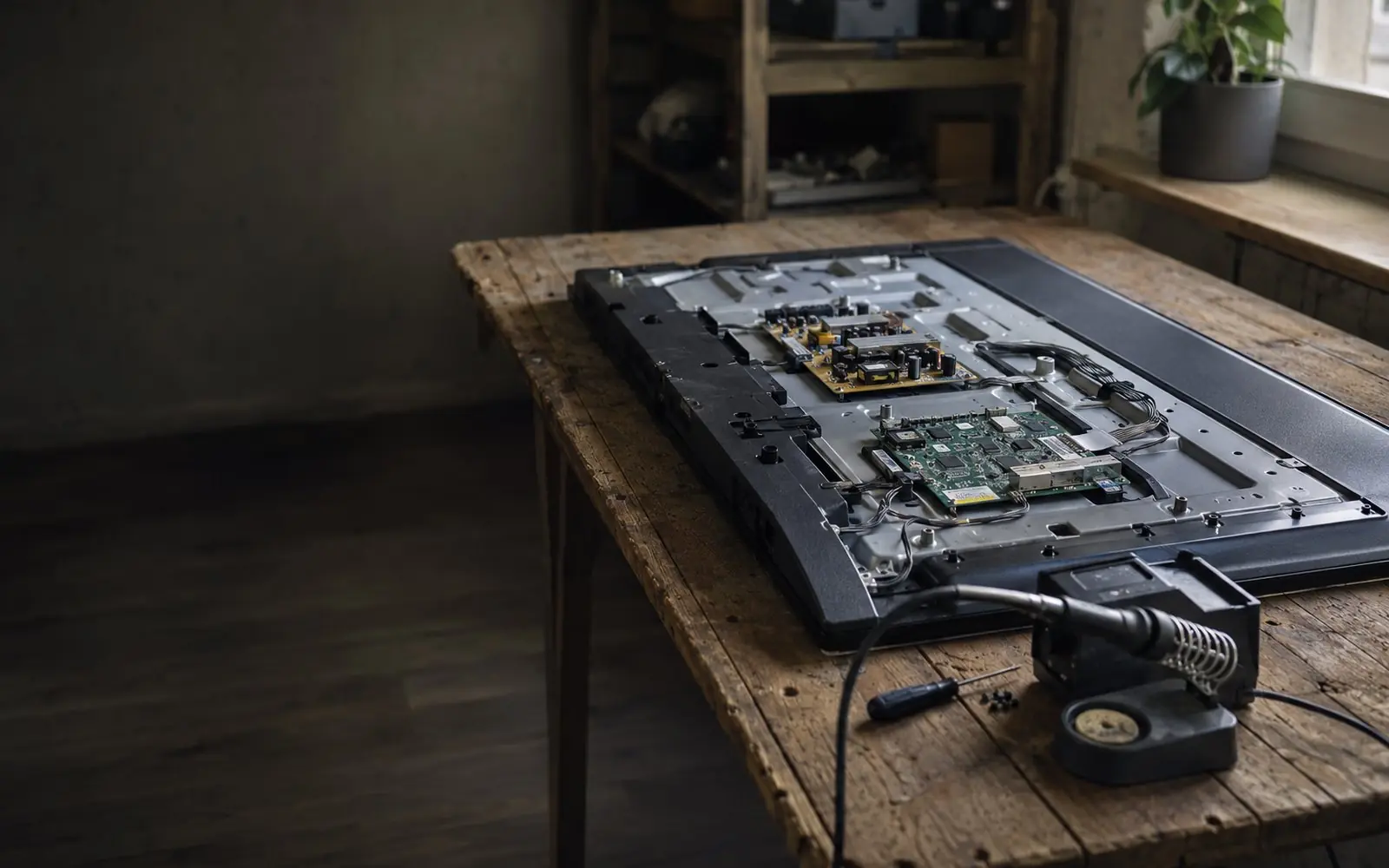
TV, Radio and Electronics Repair Shops
What the state repair laws actually say about televisions, the date cutoffs that exclude older sets, and why no shop price is published anywhere.
Minnesota and Oregon never name televisions in their repair laws
A five-year-old television with a dead backlight or a dead board is now partly a legal problem. Whether a shop can obtain the part depends on which state you are in, when the set was first manufactured, and whether a statute written about electronics was drafted widely enough to reach it. On that last point the honest answer for televisions is that it is unresolved.
Minnesota's Digital Fair Repair Act defines its subject as any hardware product that depends, in whole or in part, on digital electronics embedded in or attached to the product in order for the product to function, for which the original equipment manufacturer makes available tools, parts, or documentation to authorized repair providers1. That plainly describes a modern television. The statute never says so. Oregon does the same thing with consumer electronic equipment, and it does not name televisions either2.
California's Right to Repair Act covers an electronic or appliance product3, but its definition of a covered product routes through a section of the Business and Professions Code that we did not read, so this page does not assert that California covers televisions. Where the text is solid we quote it. Where it is not, we say so. What no source of any kind publishes is a price for a television repair.
Six things that decide whether a TV repair is even possible
Whether the shop can get the board matters more than what the shop charges per hour.
Minnesota's definition, in its own words
The Minnesota duty covers digital electronic equipment, meaning hardware that depends on embedded or attached digital electronics in order to function, and for which the manufacturer already supplies tools, parts or documentation to authorized repair providers1. Every modern set fits that description. No enforcement action confirming it was located.
Oregon's date cutoff is the sharp edge
Oregon's act does not apply to consumer electronic equipment other than a cell phone that was manufactured for the first time, and first sold or used in the state, before July 1, 20152. If your television predates that line, the law does nothing for you no matter where you live in Oregon.
In Oregon, free means free
Fair and reasonable terms in Oregon means documentation at no charge, and tools for diagnosing, maintaining, repairing or updating at no charge and without impeding access2. The manufacturer may recover only the reasonable and actual costs of printing or shipping a physical item you asked for. Nothing else.
Game consoles are carved out
If the dead box is a games console rather than a television, expect nothing. California's covered-product definition excludes a video game console3, and Minnesota separately defines and carves out video game consoles1. The exclusion is deliberate and it appears in both texts we read.
The sticker on the back panel
FTC has warned companies to stop placing seals on their products stating warranty void if seal removed, or similar language4. Its report records that the practice persisted after those letters, and that the Commission takes continuing allegations seriously4. A sticker is not the same thing as a legal bar.
California makes the shop declare itself
A repair facility that is not an authorized repair provider must give you written notice of that fact before it repairs the product, and must disclose if it uses used replacement parts or parts from a supplier other than the manufacturer3. No notice means you were not given what the statute requires.
What does it cost?
There is no published figure for a bench fee, a panel swap, a power board or a mainboard, and no agency, regulator or trade body collects one. Every average in circulation comes from a lead-generation site with no stated method and no stated sample, so we are not repeating any of them. What can be stated is which costs the law has already pushed to zero. Oregon defines fair and reasonable terms as making documentation available at no charge, except for the reasonable and actual costs of printing, preparing and sending documentation that someone requests in print, and making diagnostic, maintenance, repair and update tools available at no charge and without impeding access, except for the reasonable and actual costs of preparing and shipping a physical tool2.
Parts are the other half of the invoice. Oregon requires parts to be made available directly or through an authorized service provider at costs and terms equivalent to the most favorable costs and terms at which the manufacturer offers them to an authorized service provider2. Treat that as a control on the shop's input price, not on your bill. Outside those states, or for a set that falls before the cutoff, the part price is whatever the manufacturer decides. If no part is available at any price, the repair does not happen, and the shop's hourly rate never enters the conversation.
The charging rules come from the enrolled text of Oregon Senate Bill 1596, passed in 2024. They govern what manufacturers must supply and at what charge. They are not a repair price, and no repair price is published anywhere.
How to hire a TV or electronics repair shop
Who does the work
Two kinds of shop will answer the phone: an independent bench technician and a manufacturer's authorized service provider. The repair statutes draw exactly that line, running the duty to supply parts, tools and documentation to any independent repair provider or to the owner of the equipment1. Ask which one you are calling, ask whether they are authorized for your brand, and ask who physically opens the set.
What pros will ask
Brand, model number and the panel or chassis code from the rear label, roughly when it was made, and the symptom in detail. No picture but sound present. No power at all. A standby light blinking in a pattern, and how many blinks. Lines, bands or blocks on the screen. Whether it was dropped, moved, or hit by a surge, and whether anyone has already had the back off.
What to check before signing
Get the part confirmed available, with a price, before the set is dismantled. In California, look for the written notice that the shop is not an authorized repair provider, plus the disclosure about used or non-manufacturer parts3. Ask what happens to your set if the part never arrives, who pays the return freight, and how long they will hold it.
Related searches homeowners make
Pulled from the same demand data behind our Appliance & TV Repair category.
Electronics repair questions, answered straight
Is my television actually covered by a right to repair law?
Probably in Minnesota and Oregon, but neither statute says the word. Minnesota's functional definition of digital electronic equipment reaches anything that needs embedded digital electronics to work1, and Oregon's consumer electronic equipment definition works the same way2. California uses the phrase electronic or appliance product3, with the detailed definition sitting in a code section we did not read, so we will not claim California coverage here. Nobody should tell you a television is definitely covered without pointing to the exact definition.
My set is from 2013. Does Oregon's law help me?
No. Oregon's requirement does not apply to consumer electronic equipment other than a cell phone that was manufactured for the first time, and first sold or used in Oregon, before July 1, 20152. A 2013 television falls outside it. Two further timing details matter. The covered product has to have been sold, used or supplied in the state a year or more after it was first manufactured and first sold, and the enforcement section applies only to violations occurring on or after July 1, 20272.
Can a manufacturer refuse to sell parts to my local shop?
In Minnesota the duty runs to any independent repair provider or to the owner, on fair and reasonable terms1, but the same subdivision says nothing requires a manufacturer to supply a part, tool or documentation that is no longer available to the manufacturer itself1. That is a wide door. Enforcement in Minnesota is a state matter: a violation is an unlawful practice and the attorney general's remedies apply1. In California, a city, county, city and county, or the state may sue for $1,000 per day for a first violation5.
Will opening the television void my warranty?
Not automatically. The anti-tying provision, Section 102(c) of the Magnuson-Moss Warranty Act, prohibits a warrantor from conditioning its warranty on your use of an article or service identified by brand name, unless it is provided free or the warrantor has a waiver from the Commission4. FTC has warned companies to stop using warranty void if seal removed seals4, and its report notes commenters claiming that warrantors continued to condition coverage anyway4. Read the warranty terms, and photograph the set before it goes to any bench.
Why will nobody quote me a price over the phone?
Because the two numbers that decide it are unknown until someone looks. The first is whether the failed part can be bought at all, which depends on your state, the age of the set and whether the manufacturer still stocks it1. The second is which part failed, and that usually needs the back off. No government agency, regulator or trade association publishes a television repair price, so any figure you find online is somebody's estimate rather than collected data.
Where these facts came from
Every figure on this page was read out of the page linked below. We do not cite cost aggregators.
- Minnesota Statutes section 325E.72, Digital Fair Repair Act
- Oregon Senate Bill 1596 (2024), enrolled text
- California Public Resources Code section 42488.2
- FTC, Nixing the Fix: An FTC Report to Congress on Repair Restrictions, May 2021
- California Senate Bill 244 (2023), Right to Repair Act, bill text
Get quotes for your tv, radio and electronics repair shops project
Free for homeowners. No obligation. Up to four local pros compete.
Keep planning
More guides from the Appliance & TV Repair hub.
Do it Yourself Appliance Repair
What you are allowed to repair yourself, what federal law puts out of reach, and how to make a manufacturer hand you the part and the manual.
Read the guideAppliance Repair Parts and Supply
How long manufacturers must keep parts available, the date that clock actually starts, and what they are still allowed to refuse you.
Read the guideRight to Repair Laws
What California, Minnesota and Oregon each require of manufacturers, when the duties started, who enforces them, and which states we could not verify.
Read the guide