
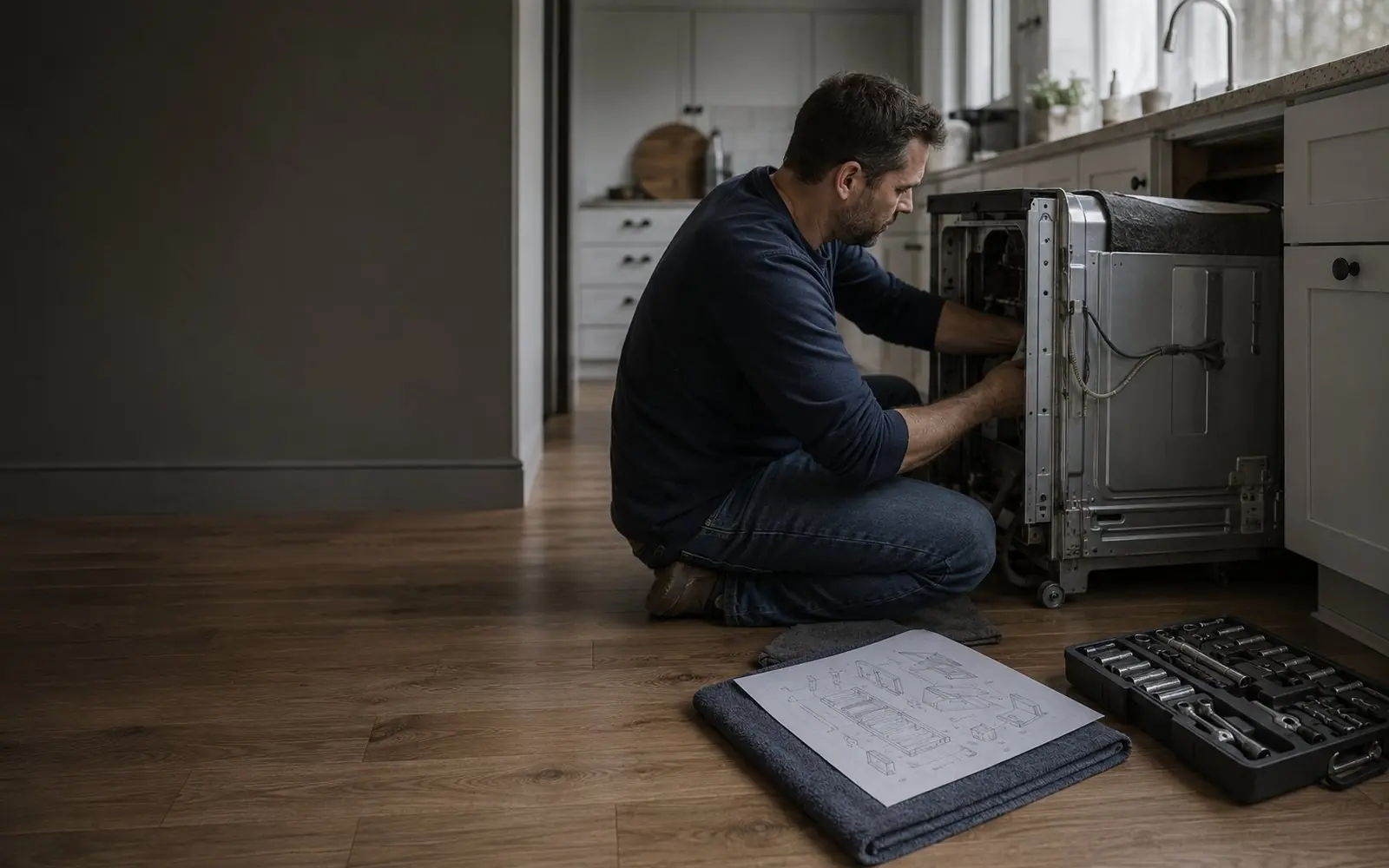
Do it Yourself Appliance Repair
What you are allowed to repair yourself, what federal law puts out of reach, and how to make a manufacturer hand you the part and the manual.
The law now hands parts and manuals to owners, not just shops
Doing it yourself used to be limited less by skill than by supply. You could not buy the board, and you could not get the diagram. Two things have changed that. Three states now put a duty on manufacturers to supply parts, tools and documentation, and the FTC has told Congress there is scant evidence to support manufacturers' justifications for repair restrictions5. One thing has not changed. You still may not touch refrigerant.
Read the California text closely. Every covered manufacturer shall make available to owners of the product, service and repair facilities, and service dealers sufficient documentation and functional parts and tools, inclusive of any updates, on fair and reasonable terms2. Minnesota runs its duty to any independent repair provider or to the owner of the equipment3. The word owner is doing real work in both.
What follows is the line between the jobs that are yours and the ones the law puts out of reach, what a self-repair does to your warranty, and what it does to the manufacturer's liability. There are no prices below, because no manufacturer or agency publishes appliance parts pricing in aggregate and nobody publishes a labour rate to compare it against.
Six rules for repairing your own appliance
Three are about what you may do. Three are about what happens when it goes wrong.
The refrigerant circuit is closed to you
EPA defines a technician to include anyone attaching and detaching hoses and gauges to and from an appliance to measure pressure, adding or removing refrigerant, or otherwise violating the integrity of a small appliance1. Certification is required for all of it1. Measuring the pressure is already the regulated act.
Working under someone else does not count
The one exemption on EPA's page is for apprentices, and it holds only while they are closely and continually supervised by a certified technician1. A friend who once had a card, watching from the kitchen doorway, is not that. Certification credentials themselves never expire1.
Ask for the manual, not only the part
California's duty covers documentation, functional parts and tools, including updates2. Oregon goes further on price: documentation at no charge, and diagnostic, maintenance, repair and update tools at no charge and without impeding access, aside from actual printing or shipping costs4. Ask for all three by name.
Seven years, counted from the wrong date
California requires seven years of parts, tools and documentation for products with a wholesale price of $100 or more, and three years for the $50 to $99.99 band2. The clock runs from the last date the model or type was manufactured, not from the day you bought yours2.
What they never have to give you
California's section does not require a manufacturer to divulge a trade secret, license any intellectual property, or distribute a product's source code2. Minnesota adds a wide escape hatch: nothing requires supplying a part, tool or document that is no longer available to the manufacturer itself3.
Fix it yourself and they are off the hook
Minnesota states that no manufacturer or authorized repair provider is liable for damage or injury to the equipment, a person or property resulting from repair, diagnosis, maintenance or modification performed by an independent repair provider or owner3. That is the honest other half of owner access.
What does it cost?
The saving from self-repair is labour, and no authority publishes an appliance repair labour rate, so the saving cannot be put in figures. The parts side is no better: no manufacturer and no agency publishes parts pricing in aggregate. What the law does say about charging is narrow but real. Oregon requires documentation at no charge and tools at no charge, except for the reasonable and actual costs of printing or shipping something you asked for physically, and requires parts at costs and terms equivalent to the most favorable terms offered to an authorized service provider4. California and Minnesota both use the phrase fair and reasonable terms, and neither text we read puts a number on it23.
One running cost does have an official figure. ENERGY STAR publishes the line, exactly as written including its grammatical slip, that refrigerators over 15 years old could be costing you more about $95 per year to run, and that on average an old refrigerator uses about 20% more energy than a model that has earned the ENERGY STAR6. The page does not state the electricity price, the baseline model or the year of the estimate, so it cannot be recalculated for your house. It is still the only official number anywhere near this decision.
Charging rules come from the enrolled text of Oregon Senate Bill 1596 (2024) and the electricity figure from ENERGY STAR. Neither is a repair price. No source publishes appliance parts pricing in aggregate or a labour rate to compare against.
How to hire when the do-it-yourself repair stops
Who does the work
You, up to the sealed system. Anything involving refrigerant needs EPA Section 608 certification, and a household refrigerator sits under Type I, the small appliance certification1. Everything outside that circuit is yours if you can get the part and the diagram, and in California and Minnesota the duty to supply those runs to owners directly, not only to shops23.
What pros will ask
When you give up and call, be straight about what you did. Which panels came off, what you replaced and with which part number, what you measured and with what, whether power was isolated, and whether anything is still disconnected. Photograph every stage before you unplug it. The technician will find your work during diagnosis anyway, and hiding it only lengthens the visit.
What to check before signing
On a parts order, match the part number to the model plate, not to the model name, and check the return policy on electrical components before you buy. Ask whether the part is new, refurbished or used. In California, a shop that is not an authorized repair provider must tell you so in writing before it works on the product, and must disclose used or non-manufacturer parts2.
Related searches homeowners make
Pulled from the same demand data behind our Appliance & TV Repair category.
Do it yourself questions, answered straight
Can I recharge my own refrigerator?
No. EPA regulations under Section 608 of the Clean Air Act require certification for technicians who maintain, service, repair, or dispose of equipment that could release refrigerants, and the definition of technician includes attaching and detaching hoses and gauges to measure pressure and adding or removing refrigerant1. Buying a can and a hose does not change that. The only exemption on the page is for apprentices who are closely and continually supervised by a certified technician1, which is not a description of you working alone in your kitchen.
How do I get the service manual for my appliance?
Ask the manufacturer, and if you live in a covered state, cite the statute by name. California requires documentation, functional parts and tools to be made available to owners on fair and reasonable terms2. Minnesota requires documentation, parts and tools for independent repair providers and owners3. Oregon requires documentation at no charge apart from actual printing and sending costs4. What none of them require is a trade secret, licensed intellectual property or source code2.
If my repair damages the appliance, who is responsible?
You are, and Minnesota says so in the statute. No manufacturer or authorized repair provider is liable for damage or injury to the equipment, a person or property caused by repair, diagnosis, maintenance or modification performed by an independent repair provider or the owner3. That shield sits in the same law that gets you the parts. Nothing we read obliges a warrantor to cover damage you cause yourself, so treat the repair as yours from the moment the first screw comes out.
How cold should the refrigerator be before I decide it is faulty?
ENERGY STAR's guidance, quoted as published, is to make sure you keep your fridge in an ambient temperature of 35 to 38 degrees Fahrenheit6. Put a thermometer in a glass of water in the middle shelf overnight rather than trusting the dial. If it holds that range, the complaint you called about may be a door seal, a defrost cycle or a fan rather than the sealed system, and those are all jobs you are allowed to do yourself.
Is doing it myself actually worth it?
Nobody can answer that with numbers, because no repair prices or parts prices are published. What is on the record is the FTC's finding that there is scant evidence to support manufacturers' justifications for repair restrictions, and that those restrictions steered consumers into manufacturers' repair networks or to replace products before the end of their useful lives5. Decide on three things instead: whether the fault touches refrigerant, whether the part exists for your model, and whether you can get the documentation.
Where these facts came from
Every figure on this page was read out of the page linked below. We do not cite cost aggregators.
- EPA, Section 608 technician certification requirements
- California Public Resources Code section 42488.2
- Minnesota Statutes section 325E.72, Digital Fair Repair Act
- Oregon Senate Bill 1596 (2024), enrolled text
- FTC, Nixing the Fix: An FTC Report to Congress on Repair Restrictions, May 2021
- ENERGY STAR, Refrigerators
Get quotes for your do it yourself appliance repair project
Free for homeowners. No obligation. Up to four local pros compete.
Keep planning
More guides from the Appliance & TV Repair hub.
Appliance Repair Parts and Supply
How long manufacturers must keep parts available, the date that clock actually starts, and what they are still allowed to refuse you.
Read the guideRight to Repair Laws
What California, Minnesota and Oregon each require of manufacturers, when the duties started, who enforces them, and which states we could not verify.
Read the guideRepair or Replace
The inputs to this decision that are actually published, the ones that are not, and why the rule of thumb everyone quotes has nothing behind it.
Read the guide