
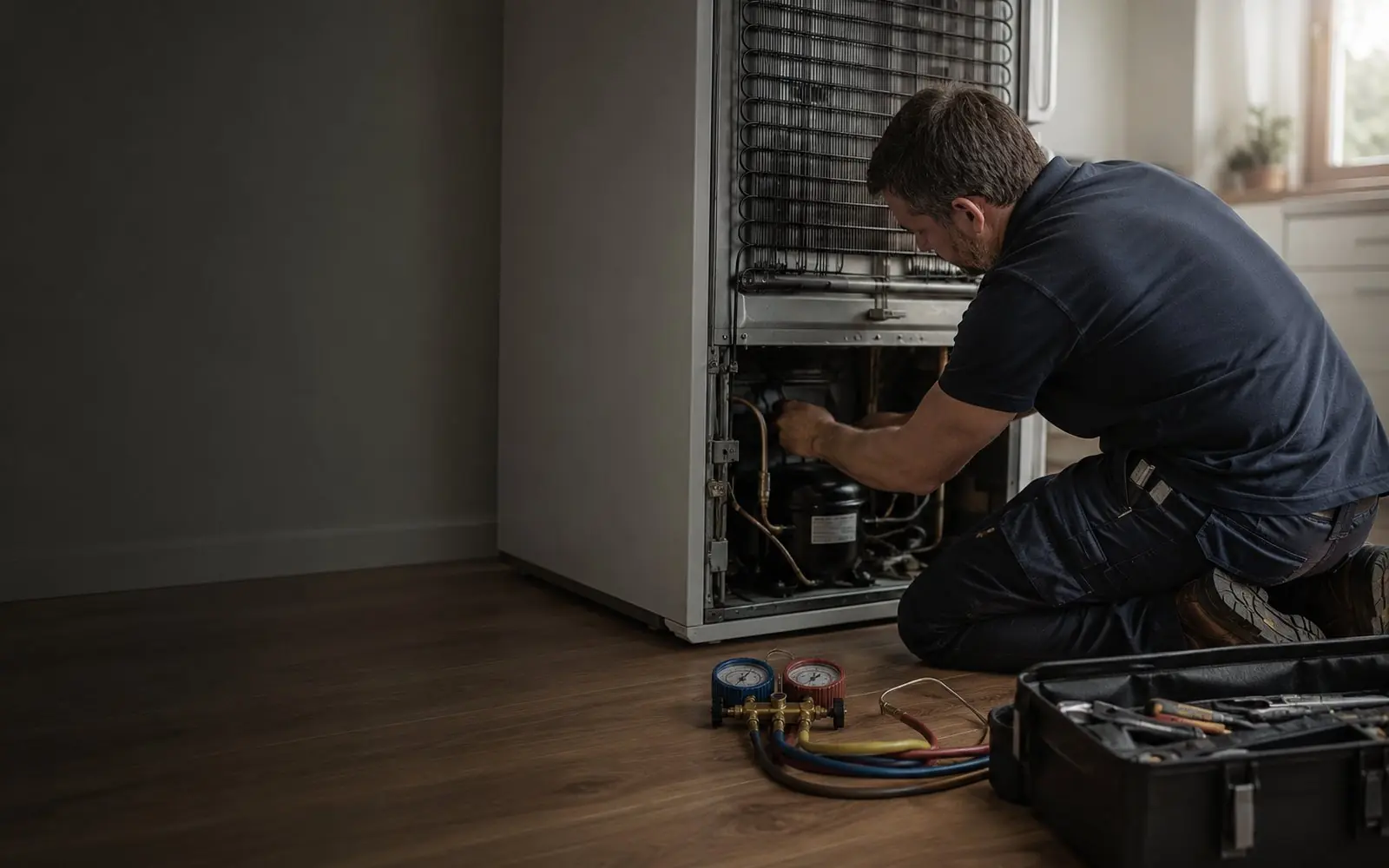
Refrigerator and Appliance Repair Services
Why a refrigerator call is a different job from a washer call, who is legally allowed to open the sealed system, and what nobody publishes.
Refrigerator work is federally regulated, washer work is not
Two appliances break in the same week. The washer and the refrigerator. You call for both, and the refrigerator quote comes back higher. That is not automatically a rip-off. The refrigerator has a sealed refrigerant circuit, and federal law puts a certification requirement on anyone who touches it.
EPA regulations under Section 608 of the Clean Air Act require that technicians who maintain, service, repair, or dispose of equipment that could release refrigerants into the atmosphere must be certified, and the test is specific to the type of equipment the technician seeks to work on1. Household refrigerators fall under Type I, the small appliance certification1. A washer, a dryer, a dishwasher and an oven carry no equivalent federal requirement.
This page covers what that split means for the work, the parts and the person you let into your kitchen. What it does not contain is a price. No government agency, regulator or trade association publishes a service call fee, a diagnostic fee or an hourly rate for appliance repair. Every average you have seen traces to a lead-generation site with no stated method or sample.
Six things that decide how an appliance repair call goes
Each one changes who is allowed to do the work, how long it takes, or whether the part still exists.
Sealed system, or everything else
Ask one question first. Does the fault involve the refrigerant circuit? Compressor, evaporator, condenser, capillary tube, any leak. If yes, the person doing it needs a federal certification. If it is a door gasket, a fan motor, a defrost heater or a control board, it does not.
Measuring the pressure is already regulated
EPA defines a technician as an individual who performs activities including attaching and detaching hoses and gauges to and from an appliance to measure pressure within the appliance1. Read that again. Checking the pressure is itself the regulated act, so nobody can lawfully check your refrigerant level without the card.
Four certifications, not one
EPA has developed four types: Type I for servicing small appliances, Type II for high or very high pressure appliances, Type III for low pressure appliances, and Universal for servicing all types of equipment1. A household refrigerator sits in Type I. A card that only says Type II is not the card you need.
The card never expires
Section 608 Technician Certification credentials do not expire1. There is no renewal cycle, no continuing education requirement and no recurring competency test sitting behind the card. One earned decades ago is still valid. Treat it as proof somebody passed a test once, not as proof of current practice.
Apprentices can be on your job
Apprentices are exempt from certification requirements provided they are closely and continually supervised by a certified technician1. So an uncertified person can lawfully be in your kitchen with a gauge set on your refrigerator. What the rule demands is that the certified technician is supervising closely and continually.
An old refrigerator is already costing you
ENERGY STAR says refrigerators over 15 years old could be costing you about $95 per year to run, and that on average an old refrigerator uses about 20% more energy than a model that has earned the ENERGY STAR4. That running cost sits on the replace side of the ledger before any quote arrives.
What does it cost?
There is no honest answer, and you should be wary of anyone who gives you one. What exists is wage data. BLS counted 32,150 home appliance repairers at $26.94 mean hourly, $56,040 mean annual and $24.51 median hourly2. The same table puts all occupations at $33.54 mean hourly, $69,770 mean annual and $24.51 median hourly2. The trade sits below the national average on both mean measures and exactly at the national median hourly wage. Figures cover May 20253.
Here is the number that explains a sealed-system quote. Heating, air conditioning, and refrigeration mechanics and installers, the trade called for refrigerant work, number 409,670 at $31.14 mean hourly and $64,780 mean annual2. That is roughly 12.7 of them for every home appliance repairer, and they are the better paid occupation. A wage is not a price. Your quote also carries the truck, the parts, insurance and the warranty on the work, and none of those are published anywhere either.
Wage and employment figures come from the BLS Occupational Employment and Wage Statistics survey, May 2025, Table 1. They describe what technicians earn, not what a repair costs, and they exclude parts, travel, overheads and markup.
How to hire for a refrigerator or appliance repair
Who does the work
For a sealed-system fault on a household refrigerator, the person needs EPA Section 608 certification, and for that equipment it is Type I1. For a washer, dryer, dishwasher, oven, or a refrigerator fault outside the refrigerant circuit, no federal certification applies. Ask what licence your own state or city requires on top of that, then verify it with the issuing body rather than with the contractor.
What pros will ask
Model and serial number, roughly when you bought it, what the symptom is and when it started, whether the compressor runs at all, whether the freezer stays cold while the fresh food side does not, and whether anyone has worked on it already. Photograph the model plate before you call. On a refrigerator, say whether the fault started after a power cut or a house move.
What to check before signing
Ask to see the Section 608 card and which type it carries, and ask whether an apprentice will do the work and who is supervising1. In California, a shop that is not an authorized repair provider must give you written notice of that before it repairs the product, and must disclose if it uses used replacement parts or parts from a supplier other than the manufacturer5.
Related searches homeowners make
Pulled from the same demand data behind our Appliance & TV Repair category.
Refrigerator repair questions, answered straight
Why does a refrigerator repair cost more than a washer repair?
Because the labour pool is different. Refrigerant work requires EPA Section 608 certification1, which pushes the job toward the refrigeration trade. BLS puts heating, air conditioning, and refrigeration mechanics and installers at $31.14 mean hourly against $26.94 for home appliance repairers2. Add the recovery equipment and you have a structurally more expensive visit. The size of the gap on your invoice is not published anywhere, so compare written quotes rather than a national average.
Can a technician just top up the refrigerant?
Not casually, and not without certification. EPA counts attaching and detaching hoses and gauges to and from an appliance to measure pressure within the appliance as one of the activities that makes someone a technician, along with adding refrigerant to or removing refrigerant from an appliance1. Measuring the level is already the regulated activity. If someone offers to check or top up the gas and cannot produce a Section 608 card, they are describing work they are not certified to do.
How do I verify a Section 608 certification?
Ask for the card, ask which of the four types it carries, and ask which organization issued it. EPA requires that tests be administered by an EPA-approved certifying organization1. Remember that the credential does not expire1, so the issue date tells you nothing about current skill. We could not locate a national public lookup of certificate holders, so verification means seeing the card and contacting the organization named on it.
Is an old refrigerator worth repairing at all?
Part of that is answerable. ENERGY STAR says refrigerators over 15 years old could be costing you about $95 per year to run and that an old refrigerator uses about 20% more energy on average4. The FTC has separately found that repair restrictions steered consumers into manufacturers' repair networks or to replace products before the end of their useful lives6. What nobody publishes is a threshold. The widely repeated rule about repairing only if the repair is under half the replacement price has no authority behind it.
Does using an independent repairer void my warranty?
The federal anti-tying provision, Section 102(c) of the Magnuson-Moss Warranty Act, prohibits a warrantor from conditioning its warranty on your using an article or service identified by brand name, unless it is provided free or the warrantor has a waiver from the Commission6. FTC has also warned companies to stop placing seals on products reading warranty void if seal removed6. Read your own warranty, keep receipts and parts records, and treat a blanket claim that any outside repair voids everything as something to challenge.
Where these facts came from
Every figure on this page was read out of the page linked below. We do not cite cost aggregators.
- EPA, Section 608 technician certification requirements
- BLS, Occupational Employment and Wage Statistics, May 2025, Table 1
- BLS, Occupational Employment and Wages news release, May 2025
- ENERGY STAR, Refrigerators
- California Public Resources Code section 42488.2
- FTC, Nixing the Fix: An FTC Report to Congress on Repair Restrictions, May 2021
Get quotes for your refrigerator and appliance repair services project
Free for homeowners. No obligation. Up to four local pros compete.
Keep planning
More guides from the Appliance & TV Repair hub.
TV, Radio and Electronics Repair Shops
What the state repair laws actually say about televisions, the date cutoffs that exclude older sets, and why no shop price is published anywhere.
Read the guideDo it Yourself Appliance Repair
What you are allowed to repair yourself, what federal law puts out of reach, and how to make a manufacturer hand you the part and the manual.
Read the guideAppliance Repair Parts and Supply
How long manufacturers must keep parts available, the date that clock actually starts, and what they are still allowed to refuse you.
Read the guide