
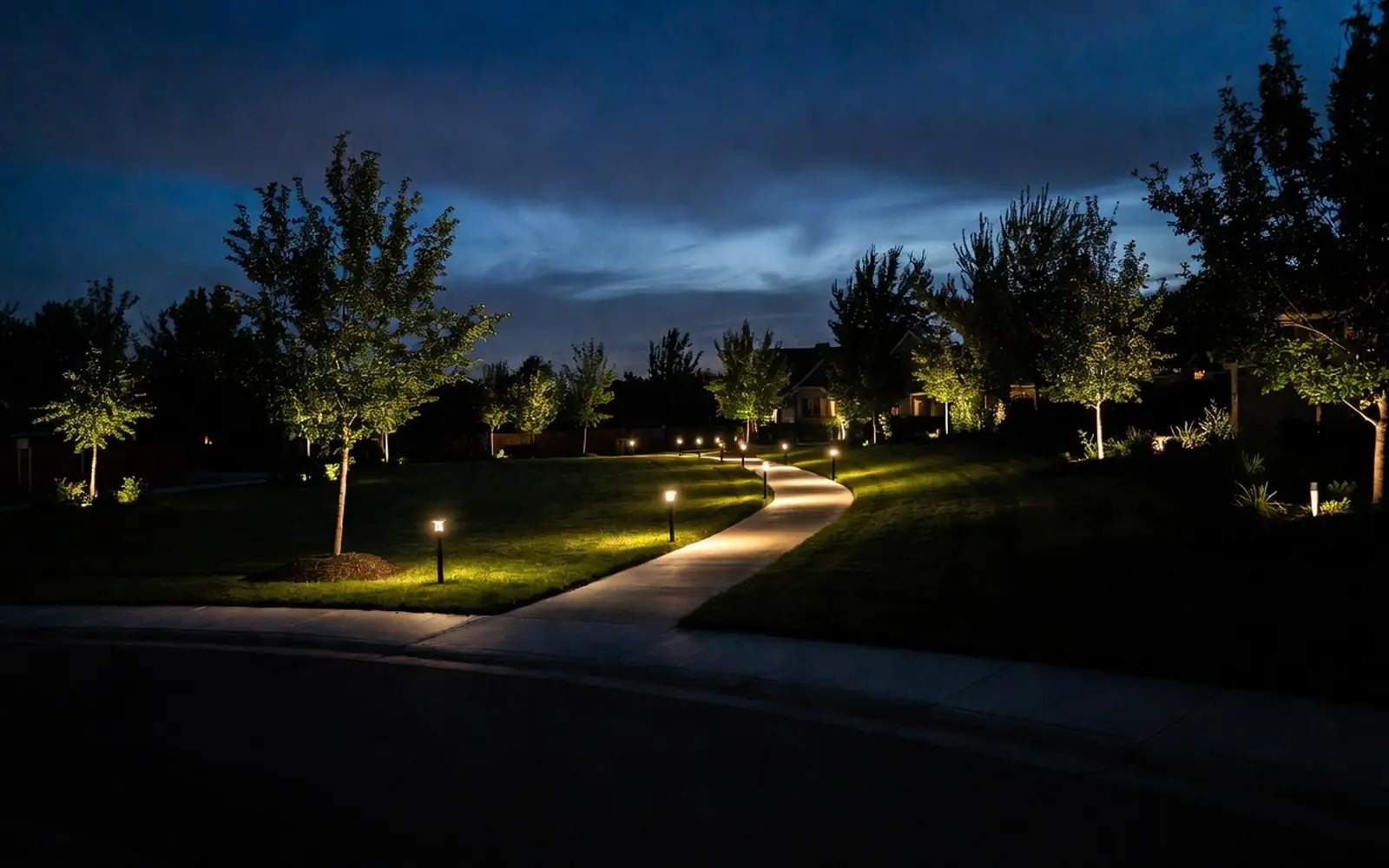
Landscape Lighting
Nearly fourteen thousand searches for the layer that makes the yard work after dark. Design first, fixtures second.
The after-dark half of the landscape budget
Landscape lighting draws close to fourteen thousand tracked searches in our demand data, with low voltage and design variants adding steady long-tail demand. It earns the interest: lighting is what makes patios usable after dinner, paths safe, entries welcoming and the landscape you paid for visible more hours than daylight ever gives it.
Nearly all residential work is low voltage: a transformer steps house power down to twelve volts, cables run shallow, and LED fixtures sip power. That architecture keeps installation friendly to existing yards and makes systems endlessly editable. The craft is in the design vocabulary: uplighting trees and facades, path lights that guide without runway vibes, downlighting from trees for moonlight effects, and grazing light across stone and texture.
Quality separates at the fixture and the plan. Contractor-grade brass and copper fixtures cost multiples of big-box plastic and outlast them by decades outdoors. And a designed system, where someone stood in the yard at night and decided what deserves light, reads instantly different from a row of stakes along the walk. Smart control via app scheduling and astronomical timers is now standard on professional installs.
Techniques and system pieces
A few fixtures placed well beat many placed evenly.
Path and area lighting
Guiding light along walks and steps, spaced for pools of light rather than runway rows. The functional baseline.
Uplighting and facade lighting
Fixtures grazing trees, columns and stone from below. The technique that gives a house its evening presence.
Moonlighting and downlighting
Fixtures mounted high in trees casting soft dappled light down. Premium labor, most natural effect in the catalog.
Patio, deck and step lights
Built-in and surface fixtures where people gather and stairs demand it. Cheapest to run during hardscape construction.
Transformers and smart control
Sized transformers, marine-grade connections and app or astronomical-clock control. The invisible half of reliability.
Fixture quality tiers
Brass and copper bodies with replaceable LEDs versus disposable plastic. Outdoors, the premium tier is the economy tier over a decade.
What does it cost?
Commonly published ballparks: professionally designed and installed systems commonly run $2,000 to $6,000 for typical front-and-back scopes, or roughly $150 to $400 per fixture installed including transformer, wire and labor shares. Large properties and tree-mounted moonlighting go beyond that.
Systems expand gracefully: a well-sized transformer and mainline let you add fixtures by phase, which is the sane way to light a big yard.
Ballparks based on commonly published national averages, stated as assumptions, not measured local pricing. Your competing quotes set the real number for your home and ZIP.
How to hire for landscape lighting work
Who does the work
Dedicated landscape lighting companies and landscape contractors with lighting crews design and install low voltage systems. Line-voltage work, new outdoor circuits and transformer outlets are licensed electrician territory; good lighting firms coordinate that.
What pros will ask
What you want lit and why: entertaining, safety, curb appeal or all three. Photos of the house and yard, existing outdoor outlets, and trees or features you consider the stars. Night walk-throughs are standard for serious designers; take one.
What to check before signing
That the quote itemizes fixtures by model and material, transformer capacity with headroom for expansion, wire gauge and connection type. That a nighttime aiming visit after install is included. And that fixture and LED warranties are stated, because outdoor electronics live hard lives.
Related searches homeowners make
Pulled from the same demand data behind our Landscaping category.
Landscape Lighting questions, answered straight
How much does landscape lighting cost?
Commonly cited professional installs run $2,000 to $6,000 for typical homes, or $150 to $400 per fixture all-in. The spread is mostly fixture count and quality tier: brass fixtures with replaceable LEDs cost more upfront and dramatically less over a decade outdoors.
Is low voltage lighting safe to run in a yard?
Yes: twelve volt systems are safe around kids, pets and gardening, and cables bury shallow without conduit in most cases. That safety is exactly why the low voltage architecture dominates residential landscape lighting, with the transformer as the only line-voltage connection.
Are solar path lights good enough?
For a rental or a quick test of where light helps, fine. Against wired low voltage they disappoint on brightness, consistency and lifespan, especially under trees and in winter. Our demand data shows plenty of solar interest, but wired systems are what the after photos come from.
Can lighting be added to an existing landscape?
Easily; it is one of the few upgrades that barely disturbs a finished yard. Cables tuck under mulch and turf edges, and fixtures place among mature planting. The main planning note is transformer placement near an outdoor outlet, or an electrician visit to add one.
What maintenance does landscape lighting need?
A seasonal walk: re-aim fixtures knocked by mowing and growth, trim plants swallowing lights, clean lenses and check connections. Quality LED systems otherwise run years untouched. An annual service visit from the installer is a common and worthwhile plan.
Get quotes for your landscape lighting project
Free for homeowners. No obligation. Up to four local landscaping pros compete.
Keep planning your landscaping project
More guides from the Landscaping hub.
Water Features, Ponds and Fountains
Fountains, pondless falls and ponds, ranked by upkeep.
Read the guideLandscape Architecture
The licensed tier: grading, walls, permits and fees.
Read the guideLandscaping Ideas and Project Planning
Turning inspiration into phased, biddable scopes.
Read the guide