
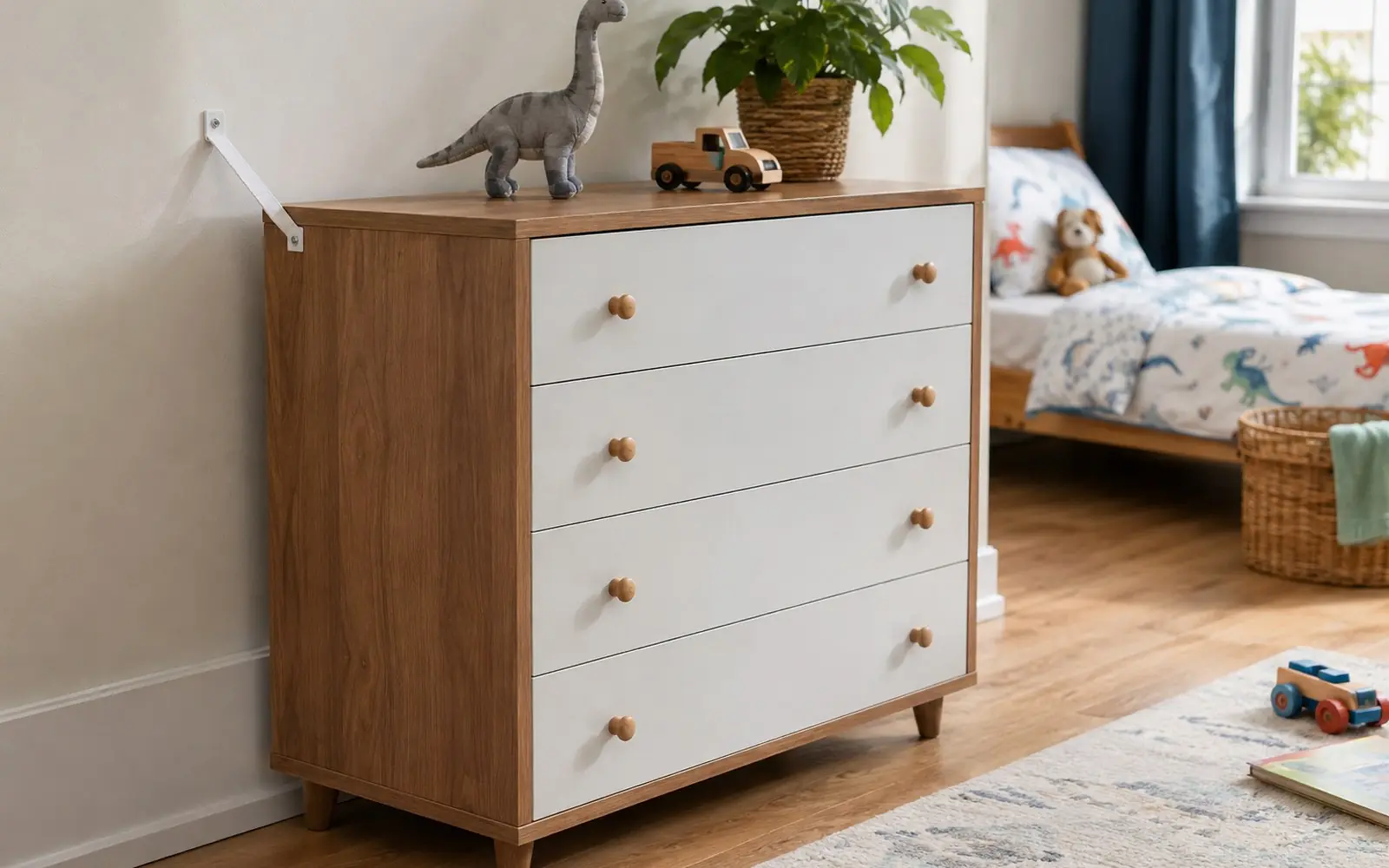
Furniture Tip-Over Safety
What CPSC actually counted, which furniture and which ages, and the limits of the federal standard that took effect in September 2023.
Nearly half of reported tip-over deaths happen in a bedroom
CPSC staff analyzed an estimated annual average of 17,800 emergency-department-treated tip-over injuries for 2020 through 2022, and 217 reported tip-over fatalities from January 1, 2013 to July 31, 2023.1 Of those reported deaths, 44 percent took place in bedrooms, 15 percent in living or family rooms, 16 percent in other rooms and 25 percent in unknown locations.1
The age profile says whose bedroom. Children under 18 years are 22 percent of the population and suffered 7,800 of the injuries, 44 percent.1 They account for 155 of the 217 reported deaths, 71 percent.1 Among children, victims aged 1 to 4 years account for 60 percent of all tip overs, and one-year-olds and two-year-olds sustain the highest rates in their own age groups, 46 and 32 injuries per 100,000.1
Since September 1, 2023, every clothing storage unit manufactured has had to comply with ASTM F2057-23, under a rule written to protect children up to 72 months of age from tip-over-related death or injury.2 It reaches new production, not the dresser already standing in the room.
Six findings from the CPSC tip-over report
These are the report's own numbers, with the periods they cover.
The room
Of reported tip-over fatalities, 44 percent happened in bedrooms, against 15 percent in living or family rooms and 16 percent in other rooms.1 A further 25 percent were recorded in unknown locations, so the bedroom share is a floor, not a ceiling.1 A plan that starts in the living room starts in the wrong room.
The age
Among children, victims aged 1 to 4 years account for 60 percent of all tip overs.1 For furniture specifically, one-year-olds and two-year-olds account for the highest number of estimated injuries, 1,200 and 1,100, and the highest rates in their own age groups, 46 and 32 injuries per 100,000.1 The peak arrives with walking and climbing.
The product
Children suffer an estimated 6,400 furniture tip-over injuries a year: 2,400, or 38 percent, involving a table; 1,800, or 28 percent, a chest, bureau or dresser; 1,000, or 16 percent, shelving or a bookcase; 1,200, or 18 percent, other furniture.1 Deaths rank differently. Of 16 furniture-related child fatalities reported since January 1, 2020, 13 involved a chest, bureau or dresser.1
The mechanism
Among 72 known furniture-related child scenarios, in 56 deaths, 78 percent, the victim or another child was climbing on the television or furniture, and in 14, 19 percent, a child was applying force some other way.1 Of the 155 child deaths, 59, or 38 percent, had unknown hazard scenarios, commonly because the child was alone with no eyewitness.1
The silence
This is the finding that should end the supervision argument. Among known response times in child fatalities, a caregiver responded within 10 minutes in 74 out of 76 television-related deaths, 97 percent, against 23 out of 45, 51 percent, for furniture-only tip overs.1 Roughly half of those children were not found for more than ten minutes.
The rule, and its edge
A clothing storage unit means any free-standing furniture item intended for the storage of clothing, typical of bedroom furniture, and all units manufactured after September 1, 2023 must comply with ASTM F2057-23, approved February 1, 2023.2 Inherited, secondhand and pre-2023 units are outside it, and so is a bookcase. Bunk beds sit under their own part, 16 CFR 1213.4
What does it cost?
This page cannot tell you what an anchor kit costs, and that is an uncomfortable gap on a page whose whole argument is to buy one. No manufacturer publishing a price for anti-tip hardware was reachable in the research behind it, so no figure is printed. No source found publishes a national estimate of how many households have anchored anything either.
What is documented is the cost of not doing it. Of the reported fatalities, 50 percent were crushed and remained under the product, 25 percent were hit or struck by the product but not crushed under it, 18 percent died of positional asphyxia and 7 percent were other or unknown scenarios.1 Two caveats travel with every number here. CPSC states fatality counts should be considered incomplete for 2021 through 2023 because of a reporting lag, and that these statistics are not comparable to earlier CPSC tip-over reports.1
All counts come from the CPSC staff tip-over report published February 2024, which states it was prepared by CPSC staff and has not been reviewed or approved by the Commission; no price for anchoring hardware or labor appears in any source used.
How to hire for furniture anchoring
Who does the work
There is no license for anchoring furniture, and no inspection of the result. In practice it is a handyman, the retailer's delivery crew, or you. Delivery crews differ on whether anchoring is included, so it is worth settling before the truck arrives. Treat it as a whole-room job: the injury counts spread across tables, dressers and shelving alike.1
What pros will ask
Expect questions about wall construction, drywall or plaster, and where the studs run, since that decides what an anchor fastens into. Expect a question about the ages of the children, because ages 1 to 4 account for 60 percent of child tip overs.1 Expect a question about televisions, which the report tracks as a separate and differently behaved category.1
What to check before signing
Get a written list of every piece being anchored, including bookcases and shelving, which fall outside the clothing storage unit rule entirely.2 Confirm hardware is supplied rather than assumed. Ask for the manufacture date on each clothing storage unit, because only units made after September 1, 2023 were built to the federal standard.2 Ask that the same visit handle any corded window covering in the room.3
Related searches homeowners make
Pulled from the same demand data behind our Kids Rooms category.
Tip-over questions, answered straight
How many children are actually killed by furniture tip-overs?
CPSC staff reported 217 tip-over fatalities from January 1, 2013 to July 31, 2023, of which 155, or 71 percent, involved children under 18 years.1 Over the same report, an estimated annual average of 17,800 tip-over injuries were treated in emergency departments for 2020 through 2022, and children accounted for 7,800 of them, 44 percent.1 Two limits matter: CPSC says fatality counts should be considered incomplete for 2021 through 2023 due to a reporting lag, and the report was prepared by staff without Commission review or approval.1
Are tip-over incidents going down?
This report will not answer that, and it says so itself. CPSC states the statistics presented are not comparable to tip-over statistics released in previous CPSC tip-over reports, because of refinement in the conventions for determining in-scope injuries and reported deaths.1 Comparing across reports is precisely what a trend claim requires. Add the declared reporting lag for 2021 through 2023 fatality counts and any year-over-year story built from these numbers is unsound.1 Treat any decline claim quoted without addressing both problems as unsupported.
The rules changed in 2023. Doesn't that fix it?
Only for new furniture. The requirement is that all clothing storage units manufactured after September 1, 2023 comply with ASTM F2057-23, approved February 1, 2023, and the stated purpose is to protect children up to 72 months of age.2 Everything bought before that date, inherited, or picked up secondhand sits outside the rule, and so does anything that is not a clothing storage unit, such as a bookcase or a table. The data points straight at those pieces: 13 of the 16 furniture-related child deaths reported since January 1, 2020 involved a chest, bureau or dresser.1
If I watch my toddler closely, is anchoring still necessary?
The report measured what supervision does and does not catch. Among known response times, a caregiver reached the child within 10 minutes in 74 of 76 television-related deaths, 97 percent, but in only 23 of 45 furniture-only tip overs, 51 percent.1 Furniture falls without warning. CPSC makes the same point about window covering cords, calling them a hidden hazard and stating that adult supervision is unlikely to eliminate or reduce it in a room considered safe, such as a bedroom.3 The control that works is physical, not attentional.
What does anti-tip hardware cost?
No source used for this page publishes a price, so none is quoted here rather than guessed. That is a genuine gap. What can be said is where to spend the effort: bedrooms, where 44 percent of reported tip-over deaths occurred, and the products that dominate children's furniture injuries: tables at 38 percent, chests, bureaus and dressers at 28 percent, shelving and bookcases at 16 percent.1 Price the hardware at a manufacturer's own site on the day you buy.
Where these facts came from
Every figure on this page was read out of the page linked below. We do not cite cost aggregators.
- CPSC, Product Instability or Tip-Over Injuries and Fatalities Associated with Televisions, Furniture, and Appliances: 2023 Report (staff report, February 2024)
- 16 CFR 1261, safety standard for clothing storage units (ASTM F2057-23)
- 16 CFR 1260, safety standard for operating cords on custom window coverings
- 16 CFR 1213, safety standard for entrapment hazards in bunk beds
Get quotes for your furniture tip-over safety project
Free for homeowners. No obligation. Up to four local pros compete.
Keep planning
More guides from the Kids Rooms hub.
Window Blind Cord Safety
The federal cord standard, the strangulation counts CPSC published with it, and why the agency says cleats and supervision do not solve it.
Read the guideKids Furniture
The tip-over numbers, the standard that applies to dressers made after September 2023, and an honest answer on price.
Read the guideKids Beds and Bedroom Sets
What the federal bunk bed, crib and crib mattress standards actually require, and the numbers you can measure before you buy.
Read the guide