
Building on Your Own Land
The Census contract price series is built for your situation, and it stops at the property line. Everything past that line is your line item.
Owning the land moves the site costs onto your side
If you already own the ground, the Census series to read is the contract price, not the sales price. Census reports a median contract price of $404,000 for contractor-built single-family houses started in 2025, with an average of $576,5001. The table header states it plainly: contract price excludes the value of the improved lot1.
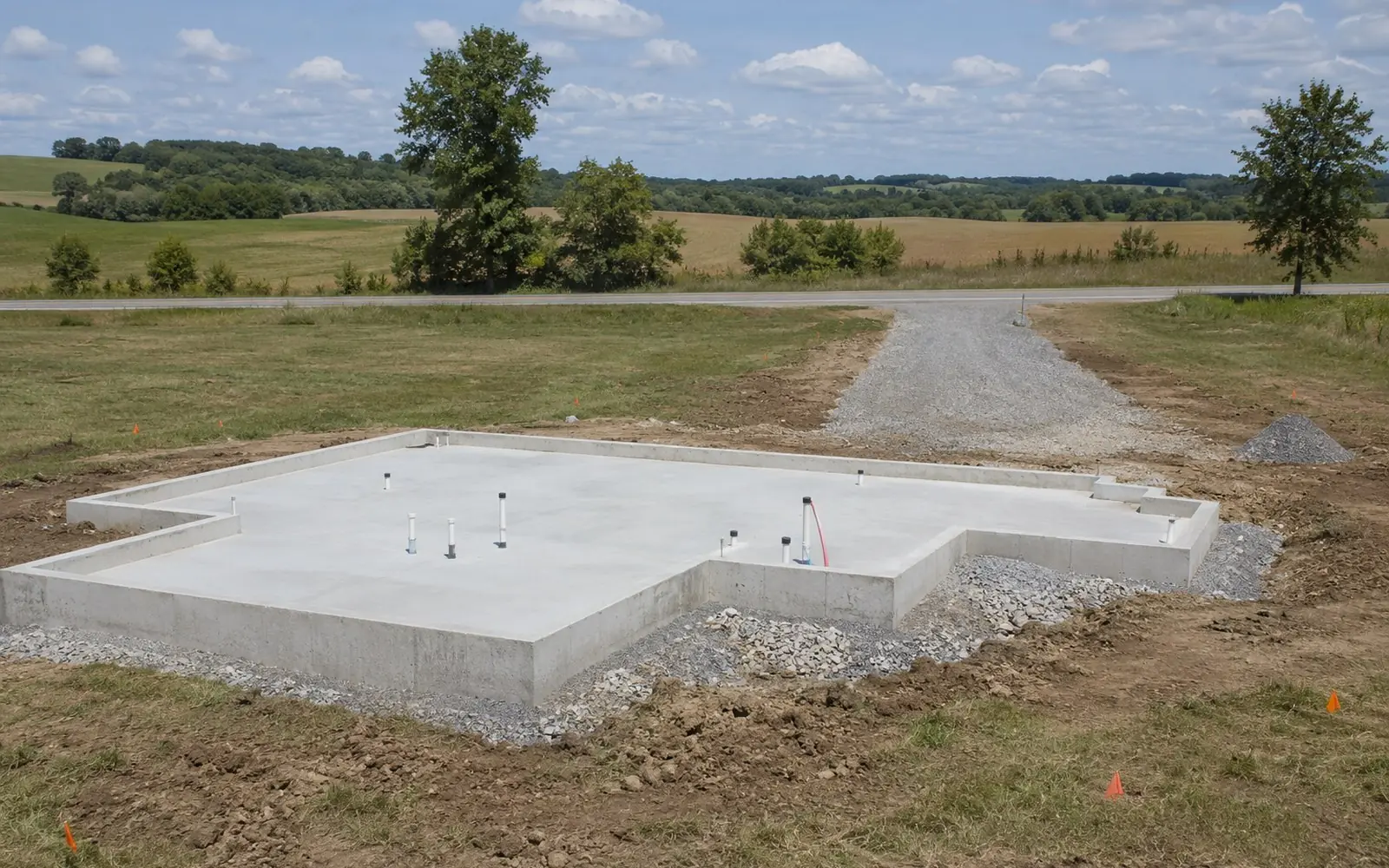
That exclusion is the whole point of this guide. The land is yours, so the builder's number stops at the house. Everything between the road and the foundation is a separate question: access, clearing, the drive, water, sewer or septic, power, permits and impact fees. Those items sit in the earliest and least visible stages of a job, and they are where owner builds go over budget.
Regionally, 2025 median contract prices ran $431,100 in the Northeast, $457,200 in the Midwest, $388,100 in the South and $377,200 in the West, with a relative standard error of 4 percent on the national total1. Per square foot the national median was $171.57, again with the lot excluded2. For scale, the median single-family house completed in 2025 finished at 2,142 square feet on a median lot of 8,855 square feet34.
Six lines that are yours because the land is yours
Every dollar figure below is a national average from NAHB's 2024 Construction Cost Survey, which rests on 41 usable responses from 4,000 builders emailed, publishes no geographic breakdown, and which NAHB says should not be compared across years5.
Site work is mostly paperwork
Site work averaged $32,719, and the largest pieces are not excavation. Building permit fees averaged $7,640, impact fees $6,367, water and sewer fees plus inspections $6,260, and architecture and engineering $6,4805. Those four add to $26,747 of the $32,719. On your own land, confirm in writing which of them the builder pays.
Foundations follow the site, not the plan
Foundations averaged $44,748, and $43,002 of that sits in a single line covering excavation, the foundation, concrete, retaining walls and backfill5. Rock, slope, fill, a high water table and poor bearing soil all land in that line. A soils report before you sign is the cheapest way to learn which of them you own.
Utilities are a site question
Water and sewer fees and inspections averaged $6,260 in the NAHB survey5. That figure covers fees. It does not cover the trench between your house and the main, and it does not cover a septic system or a well. No published source gives a national figure for either. Get a written scope for connections on your parcel.
Impact fees are set locally and published nowhere
NAHB reports a national average impact fee of $6,3675. No jurisdiction-level table was available for this guide, and impact fees are set locally, so the only reliable number is the one your county or city will quote you. Ask the permit office directly rather than relying on a builder's estimate.
Regulation is a quarter of the price
NAHB estimates that regulation adds $131,734 to a new single-family home, which it puts at 26.4 percent of an average sales price of $499,500 as of January 20266. Of that, $84,939 is imposed during construction and $46,795 shows up in the finished lot price. It has risen from $93,870 in 20216.
The work outside the walls
Items that finish the property rather than the house carry their own averages: driveway $9,635, landscaping $9,269, outdoor structures $4,722 and clean up $3,1835. That is $26,809 across four lines. On an owner build these are the easiest items to leave out of a contract and the hardest to live without once you move in.
What does it cost?
The house itself has a published anchor. Census reports a 2025 median contract price of $404,000 for contractor-built single-family houses and an average of $576,500, both excluding the improved lot, plus a median of $171.57 per square foot on the same basis12. Regional medians were $431,100 in the Northeast, $457,200 in the Midwest, $388,100 in the South and $377,200 in the West1. By financing method the medians were $399,100 conventional, $278,100 FHA insured, $501,600 VA guaranteed and $396,000 cash1.
The site costs exist only as national averages from one survey of 41 builders. Adding NAHB's three fee lines gives building permit fees of $7,640, plus impact fees of $6,367, plus water and sewer fees and inspections of $6,260, which totals $20,2675. Add architecture and engineering at $6,480 and those four come to $26,7475. Add the outside-the-walls lines, driveway $9,635, landscaping $9,269, outdoor structures $4,722 and clean up $3,183, and that is a further $26,8095. These are averages, not quotes, and no source publishes any of them for a specific state, county or parcel.
Contract prices come from the Census Bureau Survey of Construction for 2025 and exclude the value of the improved lot; every fee and site figure is a national average from NAHB's 2024 survey of 41 usable responses, carries no geographic breakdown, and is not a bid for your parcel.
How to hire a builder for land you already own
Who does the work
You are commissioning a house rather than buying one, so the relationship differs from a spec purchase. Census counted 97 percent of 2025 single-family completions as site-built and about 1 percent as modular, so a site-built general contractor is the ordinary case7. Excavation, septic or well work and utility trenching are often separate contracts with separate firms. Ask who holds each of them.
What pros will ask
Expect to be asked for a current survey, a soils or percolation test, proof of legal access, confirmation of utility availability at the property line, your zoning and setback limits, and any deed restrictions. Then drawings and a target finished area. For scale, the median 2025 completion was 2,142 square feet on a median lot of 8,855 square feet34.
What to check before signing
Confirm the contract price excludes the land, as the Census series does, then list every site item by name: clearing, excavation, fill, the drive, water, sewer or septic, power, permits, impact fees and final grading1. Assign each one to you or to the builder in writing. Ask what happens if the excavator hits rock, and who pays for it.
Related searches homeowners make
Pulled from the same demand data behind our Home Builders category.
Owner land questions, answered straight
Does the $404,000 median include my land?
No. The Census contract price table states that contract price excludes the value of the improved lot1. It measures what a builder agreed to charge an owner who already held the ground. If you compare it against a production builder's price on the builder's own lot, you are comparing two different things: the Census sales price series for finished new houses does include the improved lot, and its 2025 median was $417,4008.
What will site work actually cost on my parcel?
No source knows. NAHB's national averages are $32,719 for site work and $44,748 for foundations, with $43,002 of the foundation figure in a single line covering excavation, the foundation, concrete, retaining walls and backfill5. Those come from 41 usable responses, are national only, and carry no geographic breakdown. Your parcel decides the real number, which is why a soils report, a survey and a written scope for utilities are worth paying for before you agree a fixed price.
How big a lot do people actually build on?
The median lot for a single-family house completed in 2025 was 8,855 square feet, with an average of 41,4924. That gap is partly real and partly an artefact, because Census notes that lots over 25 acres were tabulated as 25 acres4. For houses built for sale by a builder, the median was 8,427 square feet and the average 14,625, with regional for-sale medians of 11,403 in the Northeast, 8,775 in the Midwest, 8,552 in the South and 5,996 in the West4.
How much do permits and impact fees add?
The only published figures are national averages from NAHB: building permit fees $7,640, impact fees $6,367, and water and sewer fees plus inspections $6,260, which is $20,267 across the three5. No jurisdiction-level table was available for this guide, and these fees are set locally, so the average gives you an order of magnitude and nothing about your county. Call the permit office and ask for the current fee schedule in writing.
Is building on my own land cheaper than buying a builder's house?
Not automatically. The 2025 median contract price was $404,000 without the lot, and the 2025 median sales price of a finished new house was $417,400 with the lot18. Per square foot the two series run the other way, $171.57 for contract builds against $154.79 for houses sold, both with land excluded29. Already owning the land is the single largest advantage you have. The site work, fees and connections that a production builder absorbs into a subdivision are now yours.
Where these facts came from
Every figure on this page was read out of the page linked below. We do not cite cost aggregators.
- Census Bureau, Survey of Construction, contract price of contractor-built houses
- Census Bureau, contract price per square foot, contractor-built houses
- Census Bureau, Characteristics of New Housing, 2025 highlights
- Census Bureau, lot size of new single-family houses
- NAHB, Cost of Constructing a Home, 2024
- NAHB, Government Regulation in the Price of a Home, June 2026
- Census Bureau, method of construction of new single-family houses
- Census Bureau, Survey of Construction, sales price of new single-family houses sold
- Census Bureau, sales price per square foot of new houses sold
Get quotes for your building on your own land project
Free for homeowners. No obligation. Up to four local pros compete.
Keep planning
More guides from the Home Builders hub.
New Construction Warranties
No national survey of builder warranty terms exists, so the document you are handed is the only authority. Here is how to read it.
Read the guideBuilder Contracts
Census measures the contract price without the lot and by finished area. Write your contract on the same definitions and most disputes disappear.
Read the guideCost to Build a House
Two federal price series answer two different questions, and mixing them is the fastest way to a wrong number.
Read the guide