
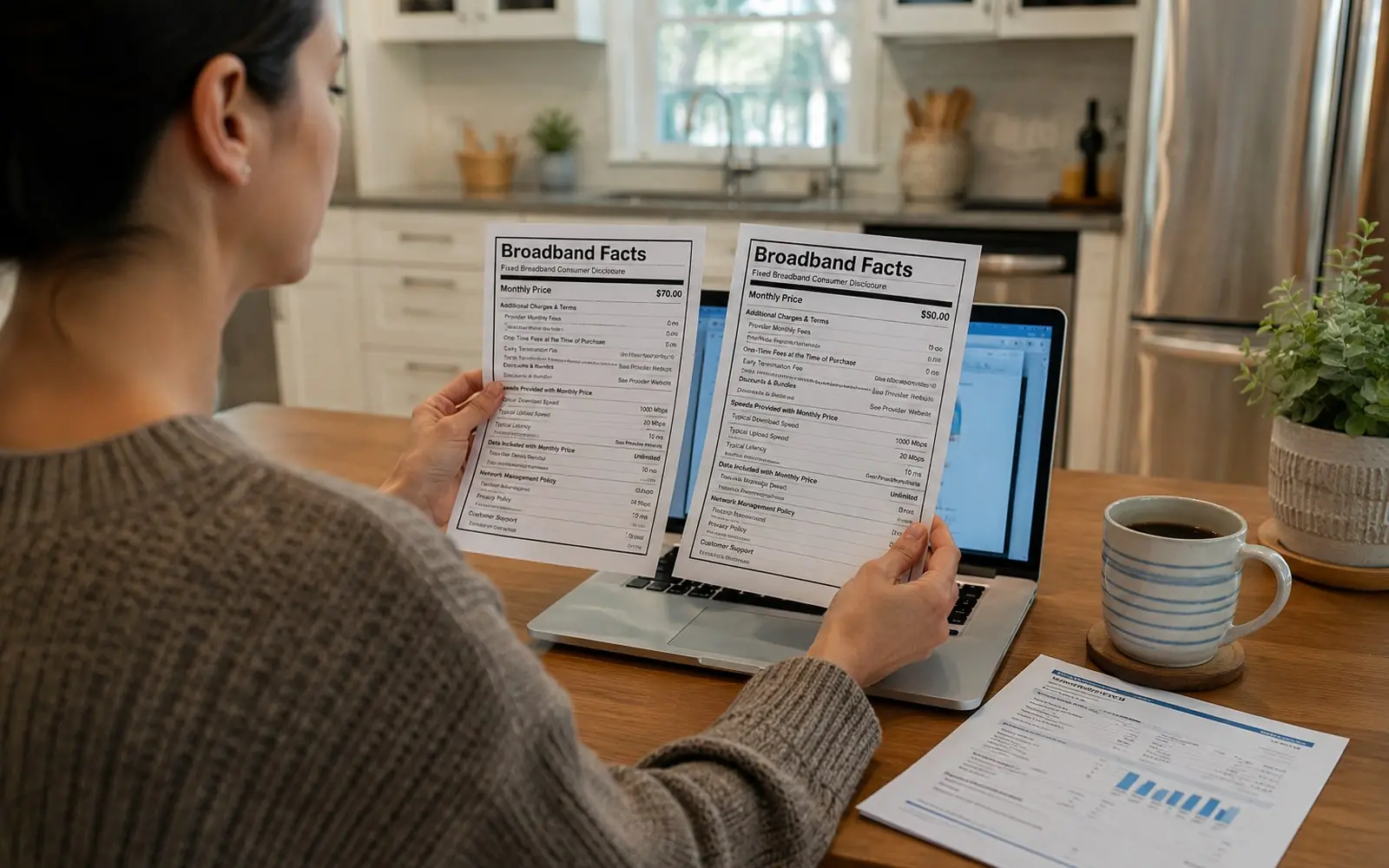
Broadband Consumer Labels
What federal rules force every internet provider to disclose before you sign, and how to make them hand it over.
The label is a legal right almost nobody asks for
Before you agree to an internet plan, the provider has to show you a label. Not a sales script, not a link buried in a footer. A fixed form in a layout the FCC prescribes. 47 CFR 8.1(a)(1) requires any person providing broadband internet access service to create and display an accurate broadband consumer label for each stand-alone plan it currently offers for purchase1.
Point of sale is defined broadly on purpose. The rule names the provider's website, a provider-owned retail location, a third-party retail location and the phone, and it goes further: point of sale also means the time you begin investigating and comparing broadband offerings available at your location1. A phone agent who skips the label is not saving you time.
The rule has teeth and a history. Compliance was required from 10 April 2024 for larger providers and 10 October 2024 for providers with 100,000 or fewer subscriber lines1. On 22 July 2026 the FCC adopted an order that removes several label requirements3. That order is not in effect yet, and this guide keeps the two apart.
Six things the label has to tell you
The FCC's 2022 order that created the label spells out each required field in words worth knowing.
The stand-alone monthly price
The price on the label is for broadband by itself. The FCC order says a provider must display the base monthly price for the stand-alone offering, meaning one that is not bundled with other services such as multichannel video or voice2. A bundle quote and a label price are different numbers.
The introductory rate and the price after it
If the provider shows an introductory rate, it must also show the rate that applies once the intro period ends, plus either the length of that period or the date it ends2. The Commission specifically rejected the idea that providers could merely link to introductory rates instead of printing them2.
Confirmation when a price is not promotional
The reverse case is covered too. If the listed monthly price is non-promotional, the provider must simply state that it is a non-introductory rate, and no further disclosures are required2. That single line is the difference between a price that holds and a price with a cliff in it.
Every recurring monthly fee, itemized
Providers must list all recurring monthly fees, meaning charges they impose at their own discretion rather than charges mandated by a government2. The order names examples: monthly charges tied to regulatory programs, fees for renting or leasing a modem and other network connection equipment, network access charges and USF charges2.
Every one-time fee, named and priced
The Additional Charges and Terms section must carry the name and cost of each one-time fee charged at sign-up2. The order lists the usual suspects: a charge for purchasing a modem, gateway or router, an activation fee, a deposit, an installation fee, or a late payment charge2.
Contract term, termination fee, speeds and data
The label must identify any fee for cancelling before a contract term ends, with a link explaining what triggers it, and the maximum if that fee is prorated2. It must also carry typical download speed, typical upload speed, typical latency, the data allowance and what overage costs2.
What does it cost?
The label is free, and asking for one costs nothing. What it costs you is the illusion that the advertised price is the bill. The FCC deliberately declined to require an all-in broadband price, disagreeing with commenters who wanted the monthly price aggregated with discretionary fees and government taxes2. Instead providers must state under Additional Charges and Terms that taxes will apply and may vary depending on location2. Read the label price as a rigorous floor with a tax warning attached.
Two published prices show why the introductory-rate field exists. Verizon's Fios page states that $99 setup and other terms may apply, exactly the kind of one-time fee the label has to name5. Viasat's own footnote reads that the Essentials plan starts at $39.99 a month with promotion and $69.99 thereafter6. That is a promotional number well under two thirds of the standing number, printed by the seller. No national average monthly internet bill is published by the FCC in any document available for this guide, so we do not print one.
Both figures are individual providers' own published prices, read from their own pages on the dates shown, and they exclude taxes, equipment charges and any address-specific fees.
How to use a label when you shop
Who does the work
The provider builds and posts the label. You have to ask, and you can ask anywhere they sell: the website, a company store, a third-party retail counter, or the phone1. If you are already a customer and the provider runs an online account portal, it must make your plan's label easily accessible inside it1.
What pros will ask
Expect a service address first, because availability and passthrough fees vary by location. Expect questions about whether you want broadband alone or bundled with television or phone, since the label price covers the stand-alone plan only2. Expect an autopay and paperless pitch. Ziply Fiber states plainly that its shown price includes a discount for being enrolled in paperless billing and autopay7.
What to check before signing
Line up labels from two or three providers and compare the same rows. Check whether the price is flagged introductory or non-introductory2. Check the recurring fee block for an equipment rental line2. Check the one-time fees and the maximum early termination fee2. Then remember taxes sit outside the label entirely and will land on the first bill2.
Related searches homeowners make
Pulled from the same demand data behind our Broadband & Connectivity category.
Label questions, answered straight
Where do I find the label for the plan I already have?
In your online account portal, if your provider offers one. The rule says providers that offer online account portals must also make each customer's label easily accessible in those portals1. If your plan is no longer sold, the current rule requires providers to archive labels for at least two years after a plan stops being available to new subscribers, and to give an existing customer their archived label on request within thirty days1. The July 2026 order removes that archiving requirement, and it is not in effect yet3.
Does the label price include taxes?
No. The FCC considered requiring an all-in broadband price and turned it down, disagreeing with commenters who wanted the monthly price aggregated with discretionary fees and government taxes2. What the rule requires instead is a statement under Additional Charges and Terms that taxes will apply and may vary depending on location2. This is the single most important thing to understand about the label. It is precise about everything the provider controls and silent on the dollar amount of everything it does not.
Can I get a label read to me over the phone?
Yes. The rule defines point of sale to include a provider's website and any alternate sales channels through which the service is sold, including a provider-owned retail location, a third-party retail location, and over the phone1. The July 2026 order would let providers describe label information in a natural, conversational style over the phone rather than reading the grid verbatim3. That change has not taken effect. Either way, the underlying obligation to disclose the same facts remains.
What exactly did the FCC change in July 2026?
The Commission adopted Report and Order FCC 26-48 on 22 July 20263. It eliminates the machine-readable spreadsheet requirement3, eliminates the two-year label archive3, lets providers show location-varying passthrough fees as a single up to total split into government-imposed and non-government categories3, and lets providers use a link or icon at the point of sale instead of the full label3. It keeps the account portal rule and the multilingual rule3.
Are the July 2026 changes in force now?
Not as of this writing. The order states that amendments to section 8.1(b) take effect 30 days after publication in the Federal Register, and that amendments to section 8.1(a) will not become effective until the Office of Management and Budget completes review of the information collection requirements, with the effective date announced by a later Public Notice3. A direct query of the Federal Register for FCC final rules published on or after 1 July 2026 returned no label order as of 6 August 20264.
Where these facts came from
Every figure on this page was read out of the page linked below. We do not cite cost aggregators.
- 47 CFR 8.1, broadband consumer label rule, current text
- FCC Report and Order establishing the label, 87 FR 76959, 16 December 2022
- FCC 26-48, Report and Order adopted 22 July 2026, label requirements trimmed
- Federal Register API, FCC final rules published on or after 1 July 2026
- Verizon Fios plan page, prices and setup fee read 7 August 2026
- Viasat internet plans page, promotional and standing rates read 6 August 2026
- Ziply Fiber internet page, autopay and paperless pricing note read 6 August 2026
Get quotes for your broadband consumer labels project
Free for homeowners. No obligation. Up to four local pros compete.
Keep planning
More guides from the Broadband & Connectivity hub.
Internet Speeds Explained
What 100/20 means, why the upload number matters, and how close providers came to their advertised speeds when the FCC measured.
Read the guideCable vs Fiber vs Satellite
What each technology actually publishes about price and speed, and why the television half of a bundle follows different rules.
Read the guideRouter Rental Fees
A federal statute bars your provider from charging rent on a router you own or on equipment you already returned. Here is the text.
Read the guide